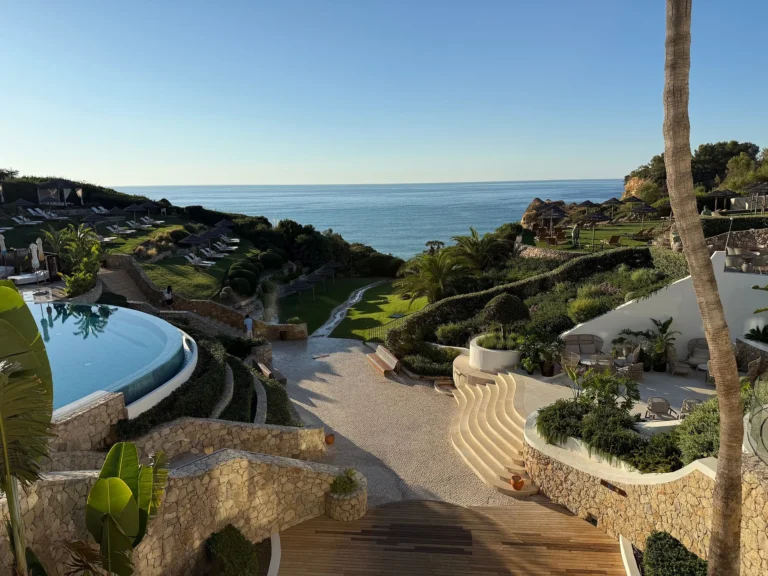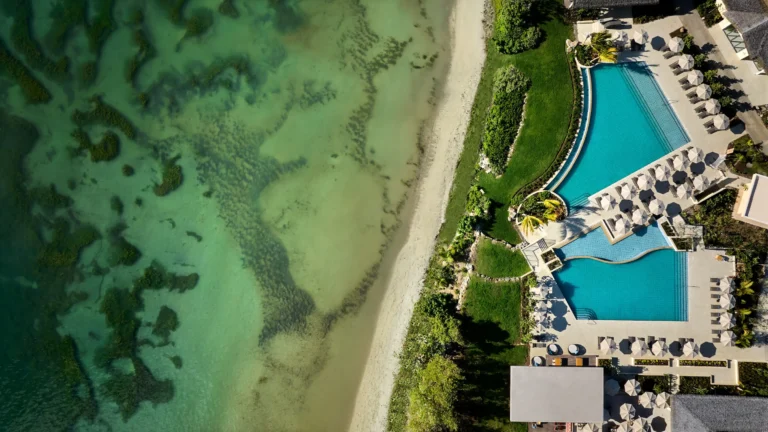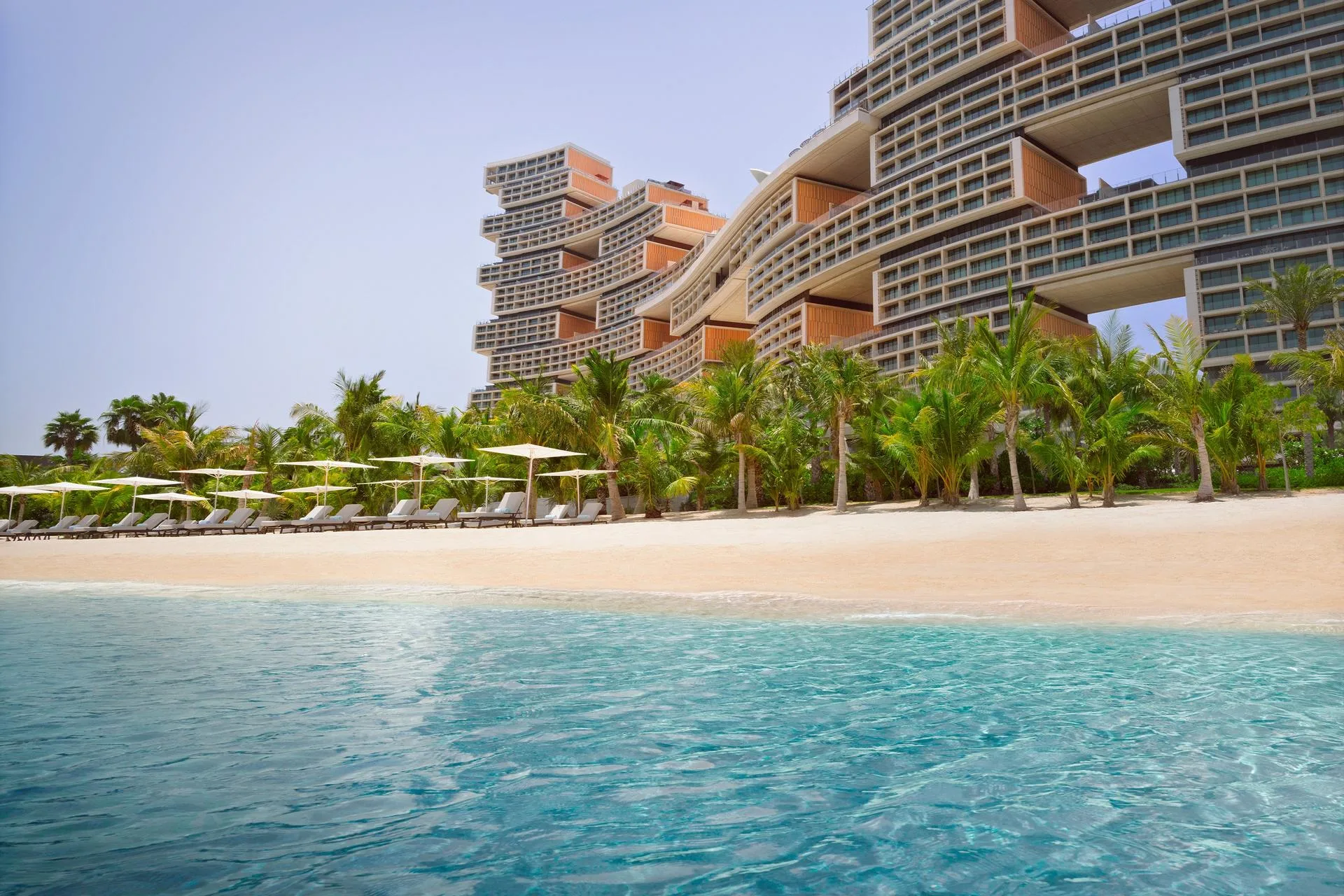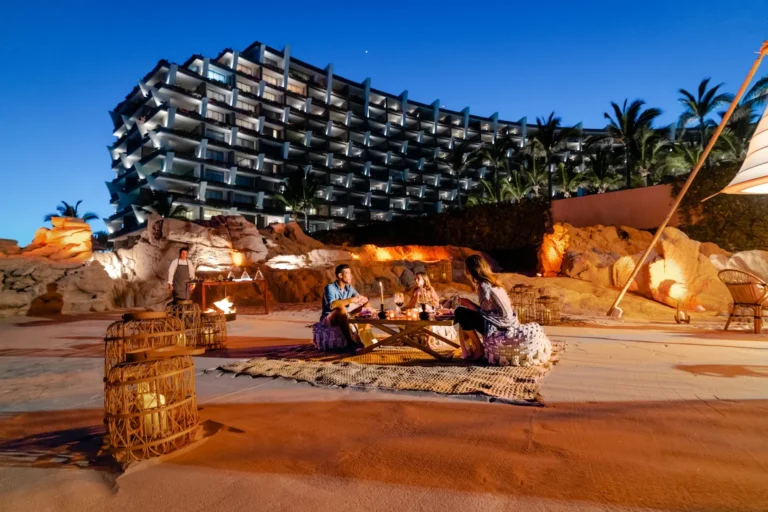


Our arrival at Fairmont Taghazout Bay happened in the late afternoon, when the Atlantic turns the colour of hammered copper and the argan trees along the coastal road cast long shadows across the tarmac. The taxi had barely stopped before our seven-year-old was out of the door, drawn toward what he could already see from the forecourt: a curved sweep of pool terrace dropping to a stretch of amber beach, with the Atlantic surf line beyond. We had about thirty seconds of composed adult arrival before the questions began. Can we swim? Is that the kids’ club? Is that our pool? It was, as it turned out, the right place to ask those questions.
Fairmont Taghazout Bay sits on the Souss-Massa coast of Morocco, roughly an hour’s drive south of Agadir, at a point where the country’s surf culture and its long tradition of Atlantic beach life converge in a five-star package. The resort opened as part of the broader Taghazout Bay tourism development project, a planned coastal strip that the Moroccan government has been developing for over a decade. What could have become a soulless enclave became, in this corner at least, a genuinely attractive beach resort. Credit the architecture, which draws on Moroccan craft traditions: geometric tile work, carved screens, arched doorways, without descending into pastiche. The bones are good.
For families, the pitch is layered. Entry rooms start at a published 50 m², which already sidesteps the usual resort trap of paying luxury prices for a room that runs out of floor space the moment you open two suitcases. A children’s club and a dedicated teen space handle the structured activity brief. Two pool areas, one for families and one adults-only, give each half of the party somewhere to properly exhale. And the beach is right there, wide and walkable, with the Atlantic rolling in at a consistent rhythm that makes it compelling for bodyboarders from the age of about eight and a serious proposition for anyone who wants to try surfing in conditions that are neither terrifying nor boring.
Location & Accessibility
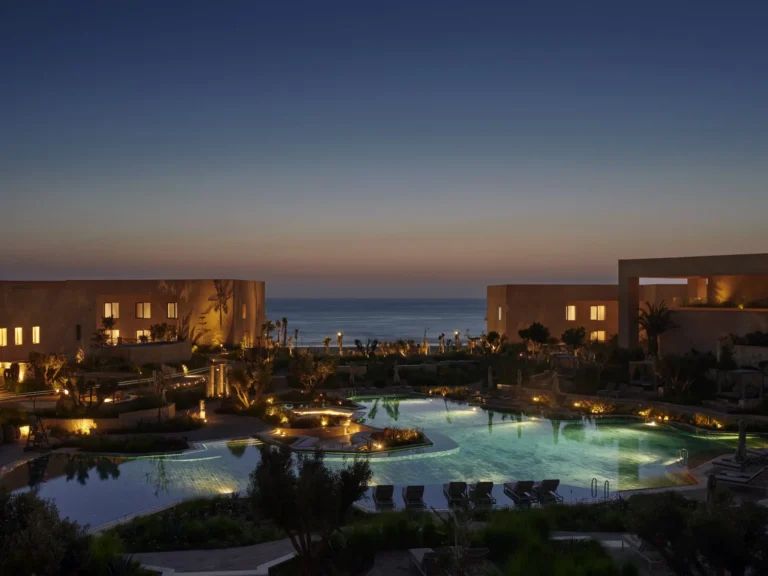
Taghazout Bay is not Agadir. That is worth stating plainly for anyone who imagines a walkable coastal town with local cafés and neighbourhood life. The resort occupies a self-contained development zone on the KM 17 mark of the Route d’Essaouira, and while the original surf village of Taghazout is accessible by car, this is first and foremost a resort destination rather than a base for urban exploration. Families who travel to Marrakech for the medina, the souks and the cultural immersion find a different proposition here: coast, ocean, garden, pool. If that is the brief, it lands.
Agadir–Al Massira Airport is approximately 45 minutes by road. The resort can arrange transfers on request, and the route is straightforward, a dual carriageway for most of the journey before the coastal descent toward the bay. Given the amount of luggage a family brings to a beach week, private transfers are the practical choice. Car-hire is a viable option if you want to drive to Taghazout village for lunch or explore the coastline south toward Agadir, though the resort itself rarely feels limiting for a week’s stay. The resort address is KM 17, Route d’Essaouira, Station Touristique, Taghazout Bay, 80750 Taghazout.
On-site navigation is easy. The grounds are compact enough to read on foot, wide enough to feel like a proper garden resort rather than a hotel complex. Buggy service is available for those who need it, and the path gradients are manageable for a stroller on most routes. The beach descent requires more care on the steeper sections, where a second adult is useful if you are pushing a pram and managing a second child at the same time. Once at the beach level, the flat sand extends wide enough that the whole family spreads out without feeling crowded even on busy days.
Accommodation (Rooms & Suites)
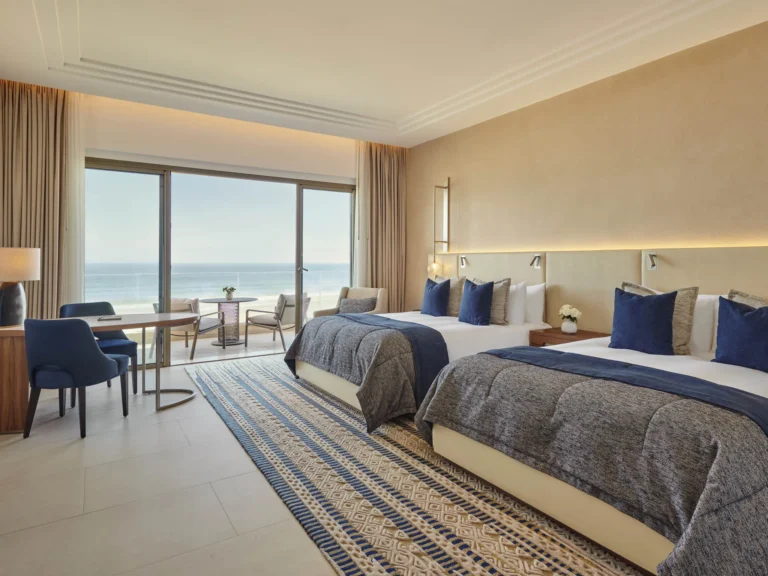
The room inventory at Fairmont Taghazout Bay is one of the strongest arguments for this address over comparable Atlantic-coast alternatives. The entry-level Superior rooms are published at 50 m², which gives two adults and one child a workable amount of space without requiring an upgrade to survive the week. Two-queen configurations exist specifically for families who want two proper beds rather than the rollaway compromise, and these are the rooms that work for two parents and two children without anyone needing to perform spatial gymnastics every morning. Private balconies or terraces come with the base category, and the Atlantic-view rooms face the ocean with the kind of sightline that turns a five-minute morning coffee into twenty.
The two-bedroom suite steps up to a published 200 m², with enough separation between sleeping spaces that different bedtime routines can coexist without negotiation. Moroccan families who travel with grandparents, or European families accustomed to the continental multi-generational holiday format, will find the suite provides the kind of space that makes everyone less irritable by day four. The property also operates five-bedroom villas, a rare category at a beach resort of this scale, and one that changes the per-person economics entirely for parties of eight or more. Connecting rooms are available on request for families who want the flexibility of separate space that can also open between units.
Rooms carry the Fairmont design language in a version adapted for the Moroccan coast: warm stone tones, geometric tile details, blackout curtains, and bathrooms that are sized for adults rather than apologetically fitted around the furniture. Mini-fridges are standard. The balconies face either the ocean or the resort gardens, and the garden-view rooms are the quieter choice in the early morning when the Atlantic side picks up a breeze. One variable worth knowing before booking: ocean sound at night ranges from restful to relentless depending on conditions and personal sensitivity. The Atlantic delivers it with consistency and some volume.
Family Amenities & Kids’ Activities
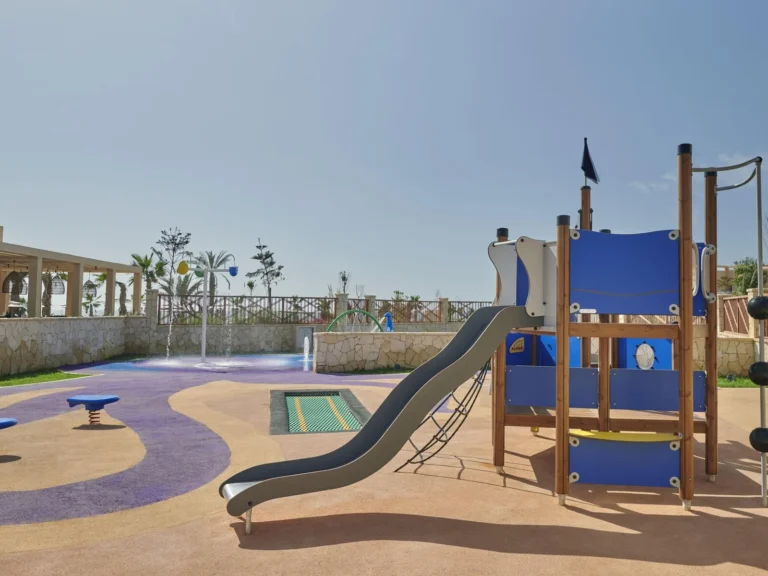
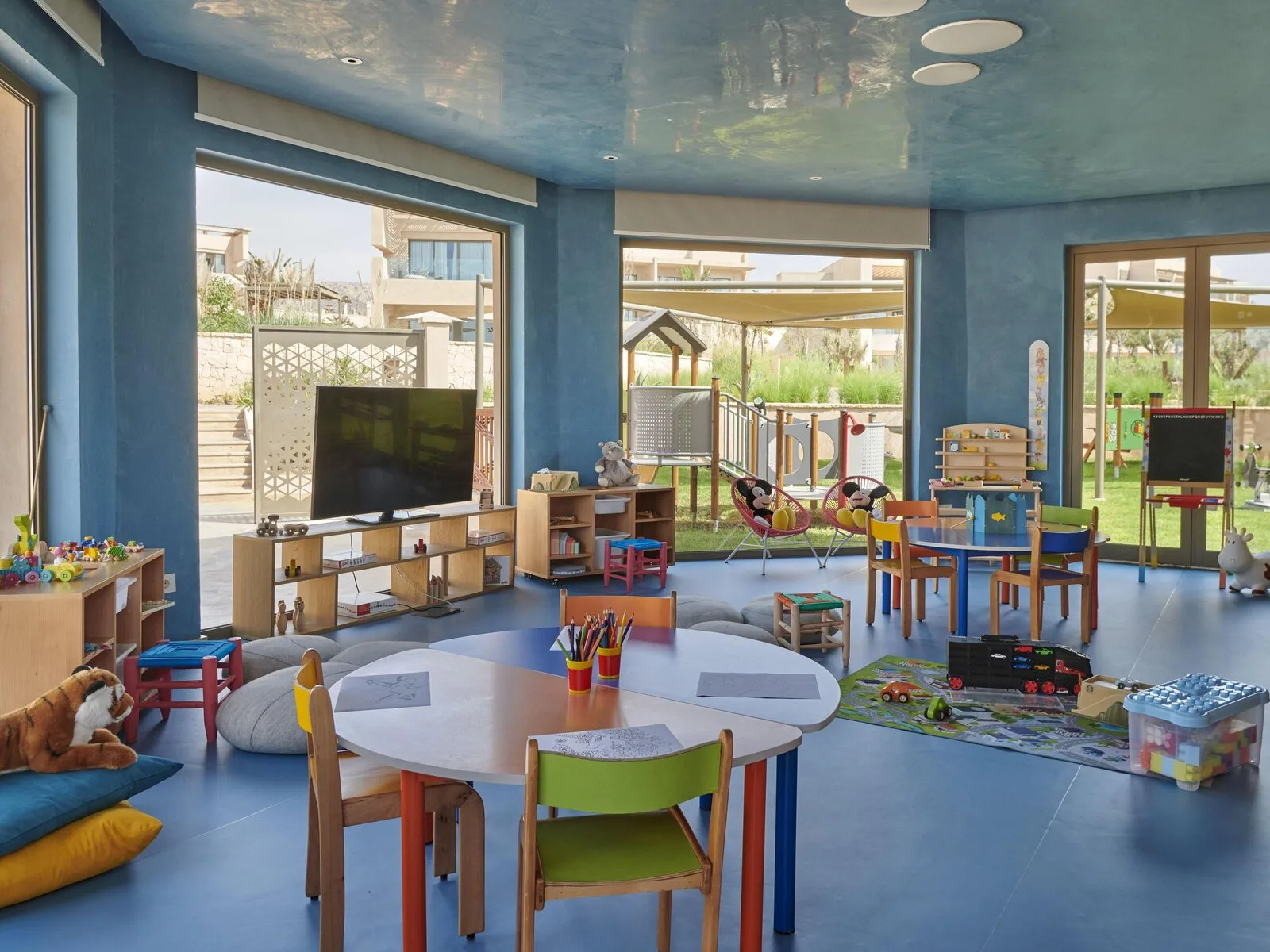
The children’s club handles the 4–12 age band, with activities that cycle across the week: arts and crafts, treasure hunts, organised beach games, pool sessions, and Moroccan cultural elements that give the programme some local texture rather than a generic resort feel. The space has both indoor and outdoor components, which matters in Morocco where the shoulder-season sun is strong enough by eleven o’clock to make outdoor-only programming uncomfortable for the youngest guests. Club sessions run in morning and afternoon blocks rather than continuous all-day cover, so the schedule requires a degree of logistics if parents want to use both halves of the day.
The teen zone gives 13-to-17-year-olds their own corner with gaming and hangout space, properly separated from the younger club. A family who visited in April 2026 noted that their teenage son singled out the teen zone and the activities there as a particular highlight, which is exactly the kind of response that is hard to manufacture. Parents of tweens who have outgrown structured children’s-club activities but are not yet old enough for full independence will find the teen space a useful intermediate option. For the same age group, surfing lessons through the resort give a structured activity that sits at an entirely different point on the stimulation spectrum from a games console.
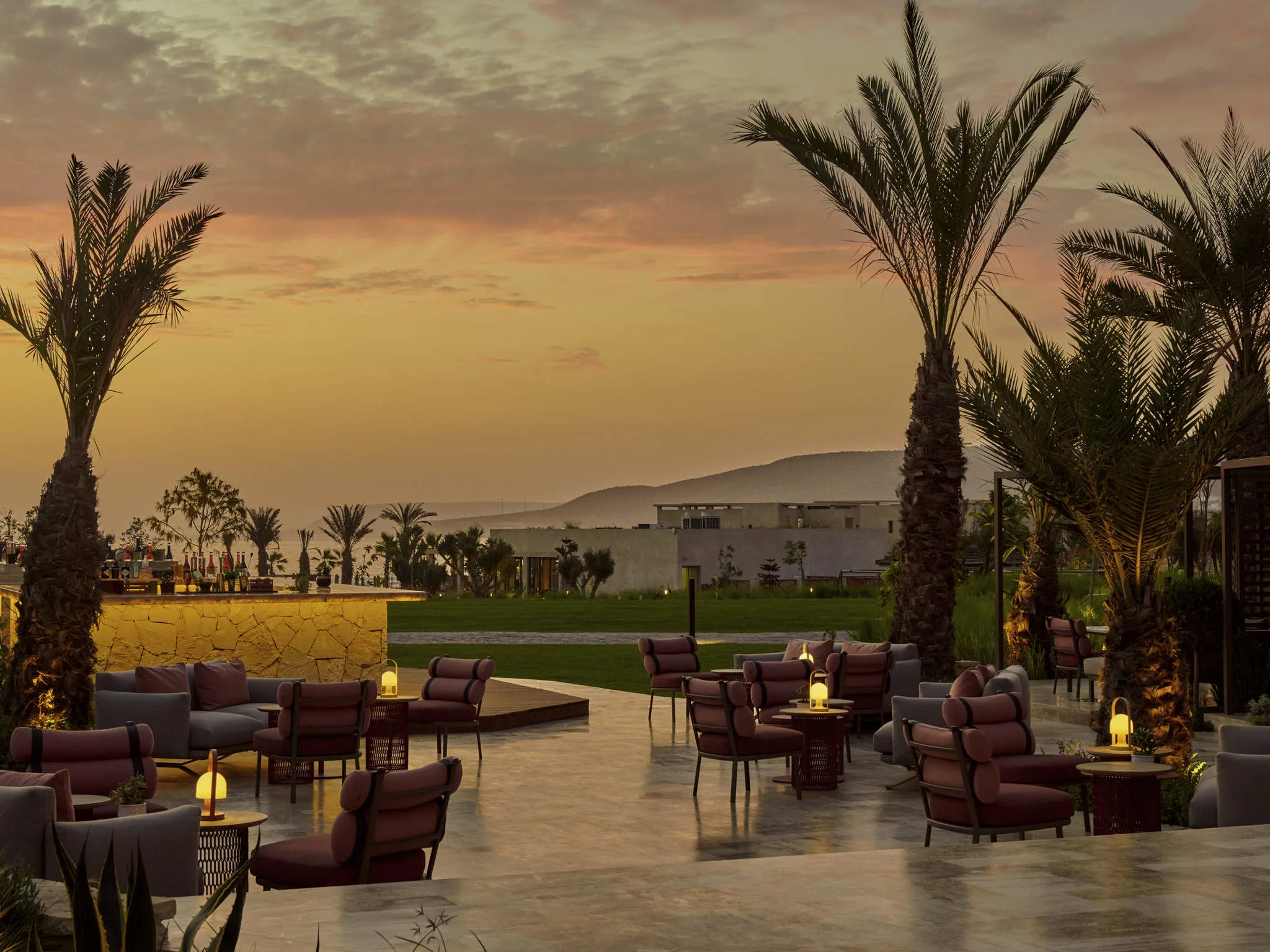
Two pool areas divide the water experience cleanly. The family pool is the social centre of the resort during the day: a good depth range for confident swimmers, with shallower edges for younger children, pool towel service, and the poolside bar accessible from the deck. The adults-only pool runs at a different pace entirely, and the parents who appreciate that distinction know exactly who they are. Between the two, a family can segment the day so that different needs are met in parallel rather than sequentially.
The beach sits at the base of the resort, directly accessible. This is the Atlantic rather than the Mediterranean, and the distinction is material for families: the surf is real, consistent, and powerful enough that younger children require close adult supervision in the water at all times. Bodyboarding is viable from around eight or nine years old with appropriate conditions and supervision. The beach setup includes lounger and towel service, and the beach bar provides the late-afternoon option when nobody wants to change back into clothes but everyone is ready to eat something.
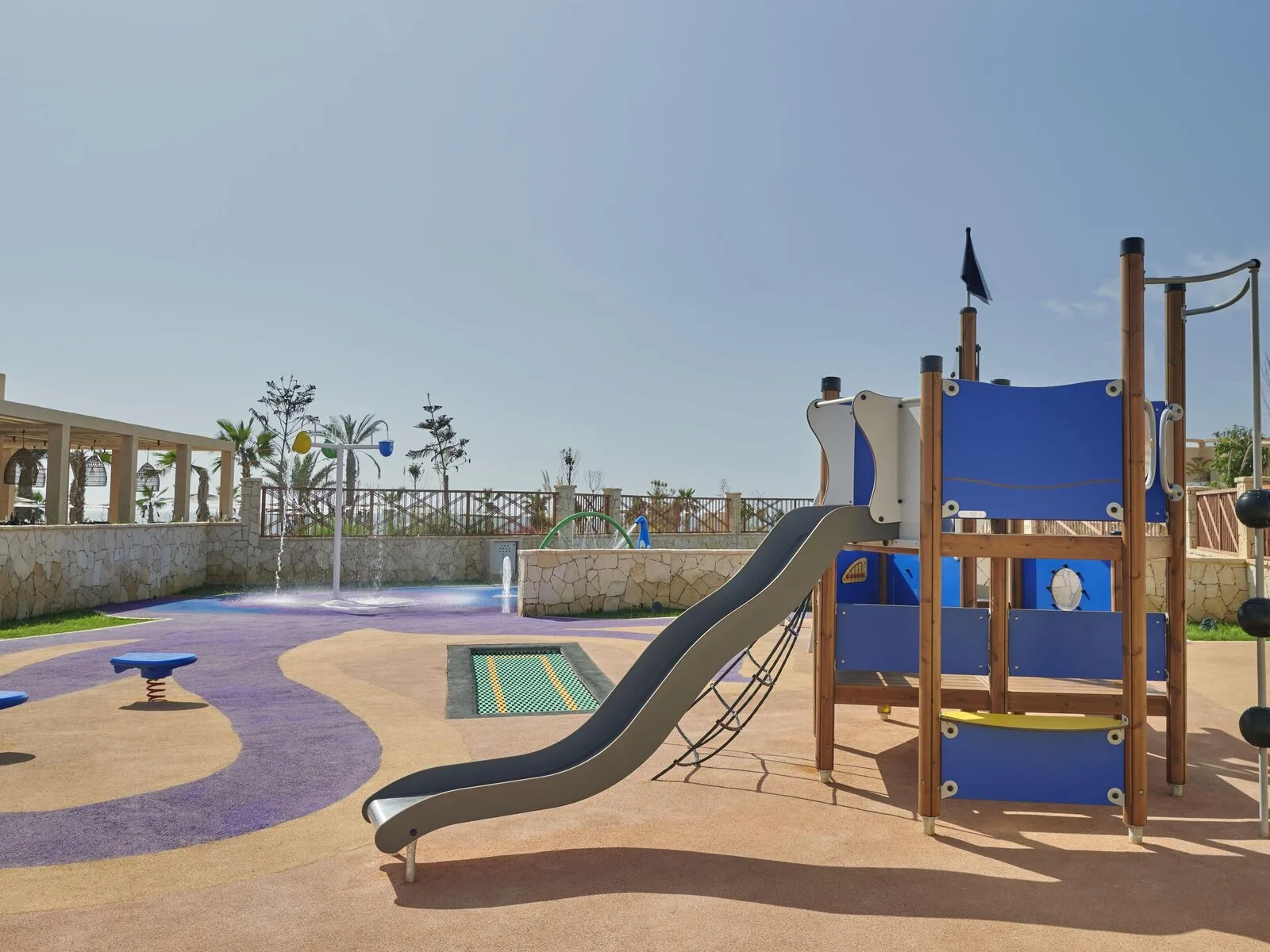
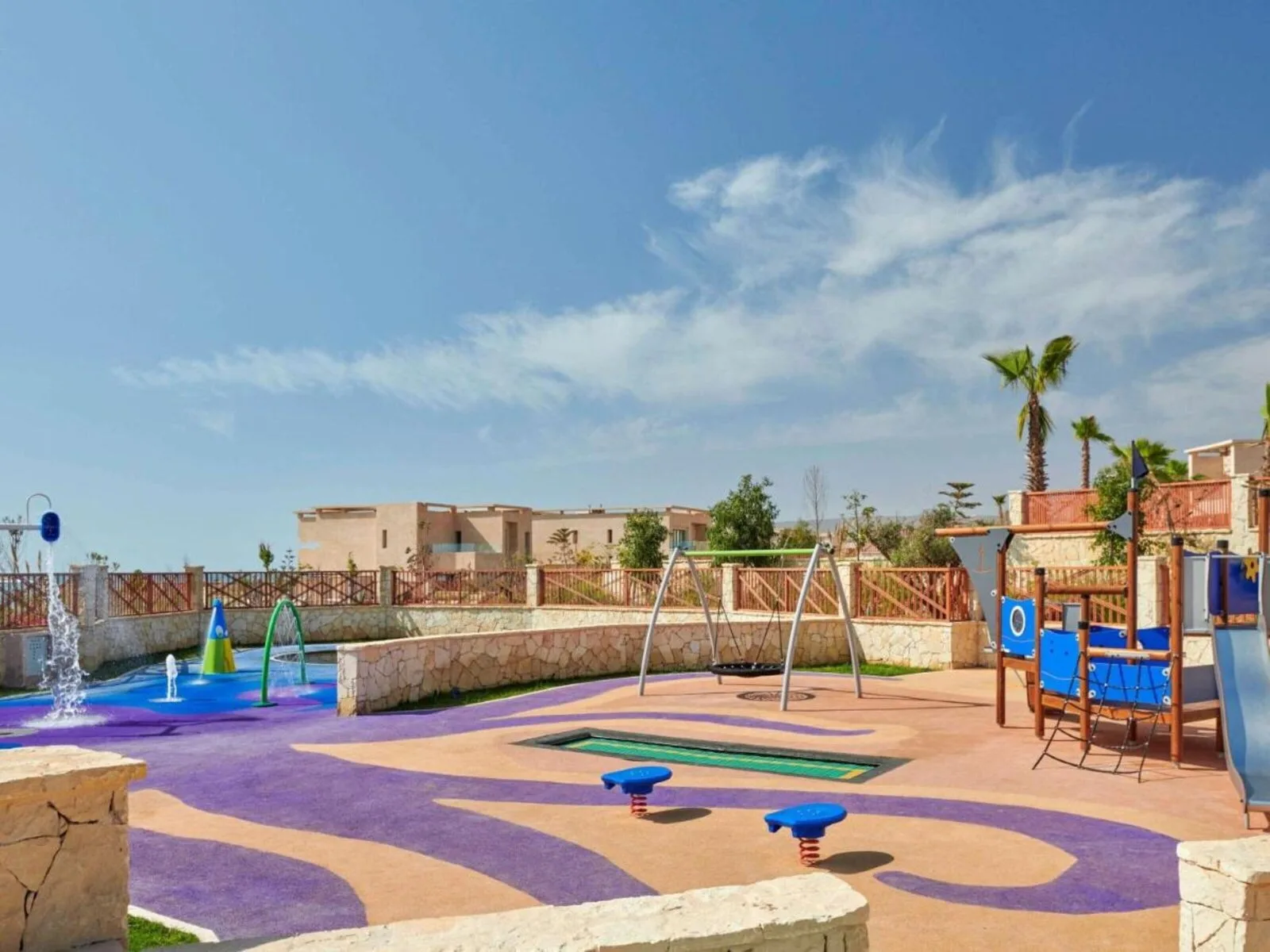
Baby equipment including cots is available on request. Babysitting can be arranged through the hotel for children outside the club age range, with pricing and availability to be confirmed in advance. Strollers manage the main resort paths without difficulty. The outdoor playground supplements the club space for the youngest guests. Yoga and pilates sessions are available on the grounds, the fitness centre operates throughout the day for adult guests, and the full-service spa runs as an adults-only facility. For parents who want a structured morning session while the children are in the club, the timing aligns well.
Dining
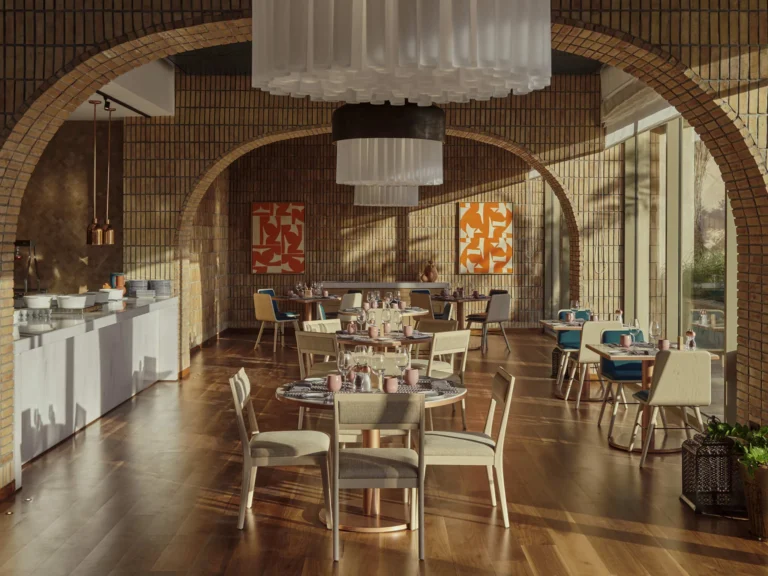
Breakfast at Fairmont Taghazout Bay earns its place as the meal families plan around. A gluten-free station with dedicated bread and crêpes was something that at least one family found had been set up without them having to request it repeatedly, which is the difference between dietary accommodation as a policy and as a practice. The spread runs live stations, local produce, Moroccan pastry and tea service alongside the continental range, and the setting on the terrace makes it a meal rather than a fuelling stop. Children who arrive at the restaurant in the state that children arrive at breakfast on the third day of a holiday, disorganised and loud, are absorbed without drama.
Beef & Reef is the main family-accessible restaurant for lunch and dinner, with a menu that covers enough ground to manage the internal negotiations that most family tables require. The outdoor terrace faces the gardens and is the better choice in the evenings when the temperature drops and the light changes. Dietary requests are handled with reasonable consistency across the kitchen. The lunch offering is narrower than the dinner spread, which can feel limiting midweek when the resort is full and the poolside bar queue is long. The beach bar fills the gap between afternoon swim and formal dinner for families who need something before 7 o’clock without committing to a table.
Board basis is bed and breakfast, which means that lunch and dinner costs accumulate over a week at resort pricing. A family of four eating every meal on property will spend considerably more than the room rate suggests. That financial reality is worth building into the trip budget beforehand rather than encountered at checkout. The breakfast inclusion takes one daily cost decision off the table, which has its own value when the logistics of managing children at a beach resort occupy most of the mental bandwidth by the second afternoon.
Moroccan food appears in the restaurant mix but does not dominate it, which is a fair observation for any guest who arrives in Morocco expecting tagine at every meal. The programme is more internationally inflected than locally rooted. Taghazout village is driveable for guests who want to supplement resort dining with something more locally specific at lunch, and the broader Taghazout Bay development zone has other options emerging. For families who eat what is in front of them and appreciate consistency over culinary adventure, the resort kitchen is a reliable base.
Staff & Service Quality
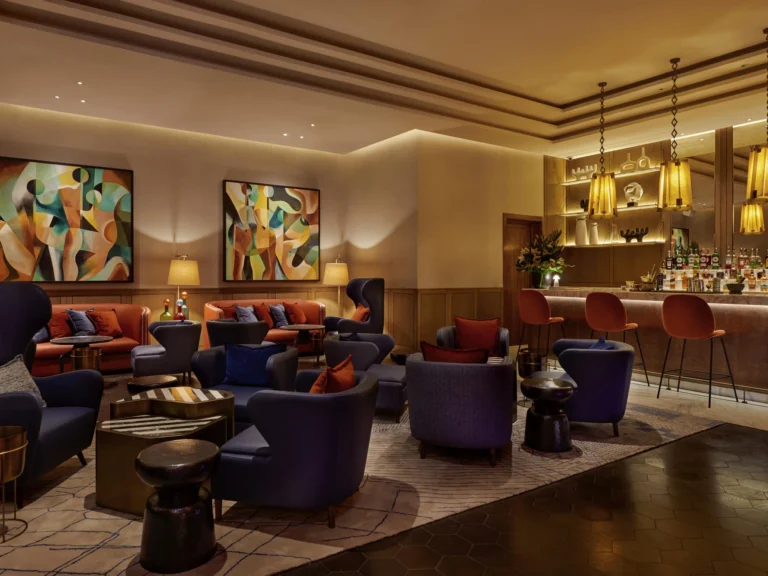
The front-desk team handles arrival with the kind of ease that comes from a well-run Fairmont property: multilingual, responsive, and alert to the fact that families arrive with more requirements than a couple checking in for a weekend. Children are acknowledged as guests with their own needs rather than as extras attached to the adult reservation. That procedural warmth was consistent across the accounts we gathered and across different seasons, which matters more than a single exceptional interaction.
Pool and beach service ran well during standard-occupancy periods. The beach bar team drew repeated praise from multiple family groups, including one guest who had returned four times and specifically noted the same team as the reason for coming back. Housekeeping was praised across the majority of accounts, with one exception noted in a 2025 review involving a missed room clean that reception corrected the same day. Service pace at peak capacity, specifically summer school holidays and long weekends, was flagged in several reviews as slower than the price point justifies. This is consistent with the pattern at any resort running near maximum occupancy, but it is a real variable rather than an exception.
The children’s club management showed variation across the review record, with certain visits producing strong engagement and at least one earlier account noting weaker supervision during a busy session. The most recent family evidence from 2026 is positive, and the allergy attentiveness noted across multiple accounts suggests that the team runs active systems for dietary management rather than relying on case-by-case improvisation.
Concierge services cover transfers, excursions, surfing instruction bookings, and spa reservations. The language range at the front desk extends to English, French, and Arabic at minimum, with coverage across the floor staff in the same languages. The service register is formal without being stiff, which is the Fairmont standard and lands well in the context of a beach resort where guests arrive in swimwear by day two.
Safety & Cleanliness
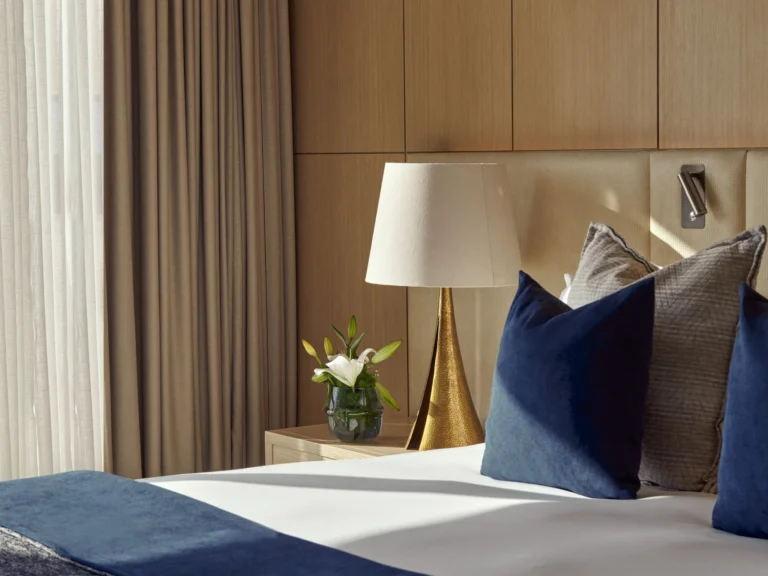
Cleanliness across the resort was praised consistently across family reviews spanning multiple years. Room standards held through different seasons and occupancy levels. Gardens and public areas maintain the appearance appropriate to a five-star property, and the pool decks are managed with enough regularity that the mid-afternoon peak does not produce the accumulated towel-and-litter situation that lower-grade beach resorts allow to develop.
The Atlantic beach requires active adult supervision for all children at all times. The surf line is not a paddling pool, and it should not be treated as one even for children who are confident swimmers in other contexts. Lifeguard presence at the beach has been referenced in the review record, but the exact staffing hours and coverage arrangement should be confirmed directly with the hotel rather than assumed from third-party accounts. The family pool is the correct environment for younger and less experienced swimmers.
Sun exposure on this section of the Souss-Massa coast runs significant from April through September. The midday hours on an Atlantic beach facing west carry real UV intensity that catches unprepared families by the second afternoon. Shade provision on the beach deck is adequate but finite. Families with young children need sun strategy and hydration planning as operational requirements. The garden paths and main public areas operate as smoke-free zones in practice.
Value & Pricing
Entry rooms guide at approximately €350–€450 per night in lower-demand periods, and €700–€900 or above in summer and school holidays. These figures require verification against current rates, which move with season, exchange rate, and advance-booking window. At those price points, Fairmont Taghazout Bay sits at the top of the Moroccan coastal market and at the competitive midpoint of comparable Atlantic-coast resort alternatives in Europe. The case for the pricing rests on room size, the directness of the beach access, the family infrastructure, and the quality of the resort fabric. Breakfast included narrows the per-day cost gap relative to properties that charge separately.
Against Europe’s Atlantic coast, a family of four at a comparable standard in Portugal or southwest France will find Morocco’s overall travel costs lower. Against Morocco’s own luxury inland market in Marrakech, Taghazout Bay carries a coastal premium that is straightforwardly explained by what the coast provides. The five-bedroom villas shift the per-person economics for large multi-generational groups: the headline room rate divided by the actual headcount produces a number that looks very different from the rack rate figure.
Families who book on bed-and-breakfast terms and then eat every meal on property, add surf lessons, use the spa, take excursions, and pick up gift-shop items will spend considerably more than the room rate implies. That compound spend is a feature of any beach resort at this tier, and it is better encountered in the planning spreadsheet than at checkout. Children’s charges for breakfast and extra beds should be confirmed at booking, as these vary by rate and are not consistently published on third-party platforms.
Why We Picked It
The room sizes settled the question. At 50 m² for the entry room and 200 m² for the two-bedroom suite, Fairmont Taghazout Bay removes the spatial constraint that makes an otherwise strong beach resort feel like a compromise for a family of four managing the accumulated physical presence of two children and their equipment. You arrive, you unpack, and the room is still a room rather than an obstacle course.
The Atlantic setting brings something that a calm-sea resort cannot replicate. The surf is audible from the terrace. The horizon is broad. Children who are old enough to go into the water approach it with the particular focus that real ocean inspires; younger ones who watch from the pool deck get the visual without the current. The two coexist without one undermining the other, which is harder to achieve than it sounds at resort scale.
Morocco in winter is one of the better-kept family travel propositions on this side of the Atlantic. The Souss-Massa coast runs mild from October through April, the resort operates at lower occupancy, prices drop meaningfully, and the beach is still usable in conditions that most comparable Atlantic destinations in Europe cannot offer in January. For families who want to leave Europe in mid-winter without flying ten hours, the case for this address is more coherent than many alternatives at the same price tier.
The families who fit this property are those who want direct beach access as the centrepiece of the week, children in the 4–12 range who will use the club programme, and parents who have decided that room space and the adults-only pool option are worth absorbing in the pricing. Teenagers with a surfing interest, or parents who want to surf while the children are in the club, will find the setup unusually coherent on that specific dimension. The resort is not the right choice for families who need all-inclusive convenience or urban cultural immersion from the same base. For families who have decided they want the Atlantic, a Fairmont-standard product, and a Morocco that moves at a different pace from Marrakech, this is a strong and specific answer to that brief.
Family Travel FAQs
What ages does the children's club cover at Fairmont Taghazout Bay?
The children's club is designed for ages 4 to 12. Activities include arts and crafts, beach games, pool sessions and Moroccan cultural elements. Club hours should be confirmed at booking, as sessions run in morning and afternoon blocks rather than continuous all-day cover. Children must be potty-trained for drop-off participation.
Is babysitting available for babies and toddlers under 4?
Babysitting can be arranged on request for children outside or below the club age range, including infants. Pricing and availability should be confirmed directly with the hotel in advance, particularly during school-holiday periods when demand is higher. Baby cots are available on request.
What is there to do for teenagers at Fairmont Taghazout Bay?
Teenagers (13–17) have a dedicated teen zone with gaming and hangout space separate from the younger children's club. Surfing lessons are available through the resort for older children and teens who want structured instruction. The beach and bodyboarding are also accessible independently for older guests with appropriate supervision.
What room configurations work best for a family of four?
The Superior Two-Queen room is the baseline configuration for two adults and two children in one room. Connecting rooms are available on request for families who want separate sleeping spaces. The two-bedroom suite at a published 200 m² provides the best separation for families who want adult and child bedrooms independently. Confirm specific availability at booking.
Can you guarantee connecting rooms at Fairmont Taghazout Bay?
Connecting rooms are available on request at Fairmont Taghazout Bay, but as at most hotels, a specific connecting configuration cannot be formally guaranteed at booking. Contact the hotel directly before arrival to request this arrangement, preferably at the time of reservation to improve the likelihood of it being available.
What baby and toddler equipment does the hotel provide?
Baby cots are available on request. Strollers can be used throughout the main resort paths. High chairs are available in the restaurants. Confirm the full inventory of baby equipment (changing facilities, food warmers, bottle sterilisers) directly with the hotel, as the published guest-services list does not detail every item available.
Is kids' dining included and how does the breakfast work?
Breakfast is included in the standard room rate on a bed-and-breakfast basis. Children's breakfast pricing and at what age children eat free should be confirmed at booking, as this varies by rate and room category. Lunch and dinner are charged additionally. The main restaurant offers a children's menu and the kitchen handles common dietary requirements including gluten-free options.
How do you get from Agadir airport to Fairmont Taghazout Bay?
Agadir–Al Massira Airport is approximately 45 minutes by road. The hotel can arrange private transfers on request. For families, a private vehicle with child seats is the most practical option; confirm child-seat availability when booking the transfer. Taxi hire is available from the airport if a hotel transfer has not been pre-arranged.
What does a week at Fairmont Taghazout Bay actually cost for a family?
A Superior Two-Queen room on a bed-and-breakfast basis runs approximately €350–450 per night in off-peak periods and €700–900 or more in summer and school holidays. A seven-night stay at those rates is €2,450–€6,300 before adding lunch, dinner, spa, surf lessons, transfers and excursions. Families who budget for full resort dining should add additional daily spend per person for lunch and dinner. These figures require verification against current rates.
Is Fairmont Taghazout Bay worth the money for families?
For families who want Atlantic beach access, generous rooms and a credible children's programme in one package, the pricing makes sense against comparable European Atlantic destinations. The room sizes justify the rate tier better than most comparably priced beach resorts. Morocco's shoulder season (October–April) offers meaningful discounts and milder, quieter conditions that strengthen the value case further.
What are the main drawbacks of Fairmont Taghazout Bay for families?
Pool heating is inconsistently reported in winter months, with some guests finding the water cold outside summer season. Service pace can slow during peak occupancy periods. The dining mix is more international than locally Moroccan, which matters for families who want to eat Moroccan food at every meal. The Atlantic surf requires close adult supervision for all children. Lunch choice can feel limited midweek.
Which families would be better served by a different resort?
Families who need all-inclusive pricing, urban cultural access from the same base, or a calm enclosed sea for young non-swimmers would be better matched elsewhere. The resort suits older children more naturally than infants; families with babies under 18 months may find the Atlantic setting and the limited structured baby provision less supportive than a more contained resort environment.
How does Fairmont Taghazout Bay compare to other FFH-reviewed beach resorts?
Against Sani Beach Club in Greece, Taghazout Bay offers a more intimate scale and a wilder Atlantic setting versus Sani's broader resort complex and calmer Aegean water. Against Vila Vita Parc in Portugal, Taghazout Bay sits at a lower price point and leans into surf culture where Vila Vita leans into wine and Algarve luxury. Both are strong five-star family beach resorts; Morocco adds a climatic and cultural dimension that the Algarve cannot provide in winter.