Stokke JetKids BedBox
Stokke JetKids BedBox – Stokke
For families with children aged 2 to 7 who take more than two long-haul flights a year and want to arrive without having carried anyone.
Overview
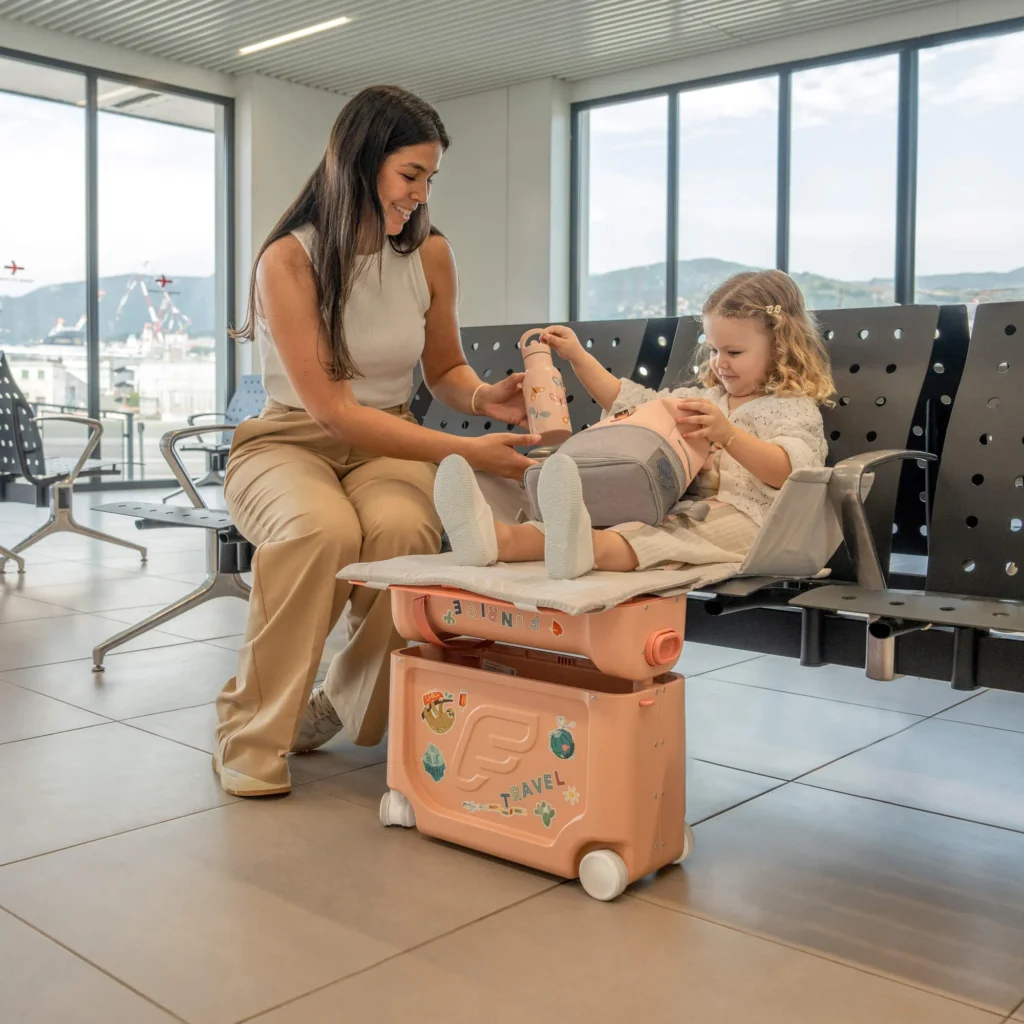
At 3.3 kg and 46 × 20 × 36 cm, the JetKids BedBox sits comfortably in the cabin-bag category. What lifts it out of that category is what it does at either end of the journey: a child aged 3 to 7 sits on top and rides it through the terminal, then, once the seatbelt sign is off, the lid hinges open and the case becomes a padded extension of the aircraft seat. For the right age on the right airline, a toddler who would otherwise be wedged upright between your arm and the armrest can instead lie down and actually sleep. Seven hours of economy class, and the child arrives rested.
We have used it across several long-haul trips now, beginning when our youngest was just past three. The terminal function delivered immediately: she climbed on at check-in and did not ask to be carried once. The in-flight function required more from us, specifically a window seat, an approved carrier, and enough optimism to open the lid at 35,000 feet. When it worked, it worked well. There are meaningful conditions to that “when”, and we will be clear about them.
Why It’s Great for Family Travel
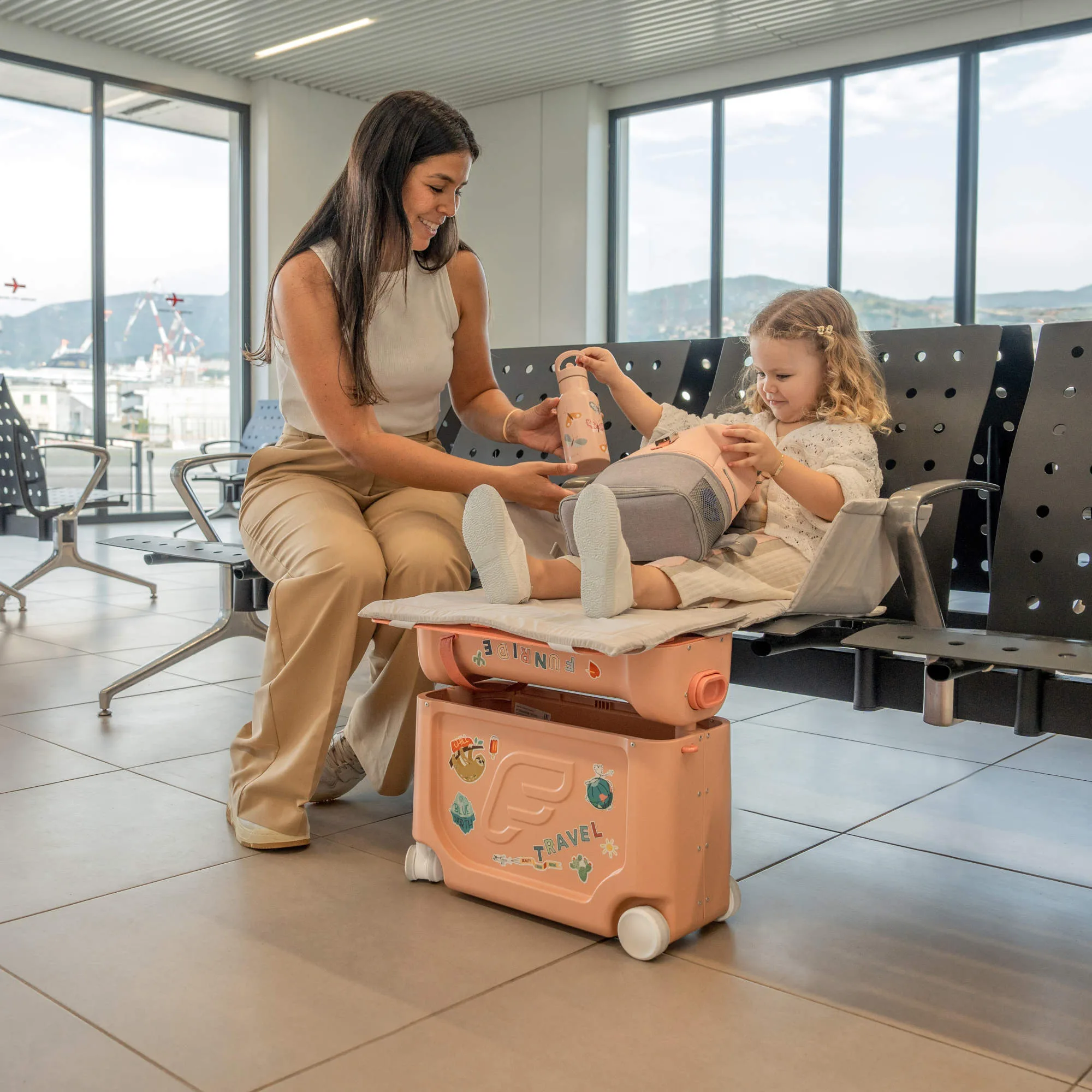
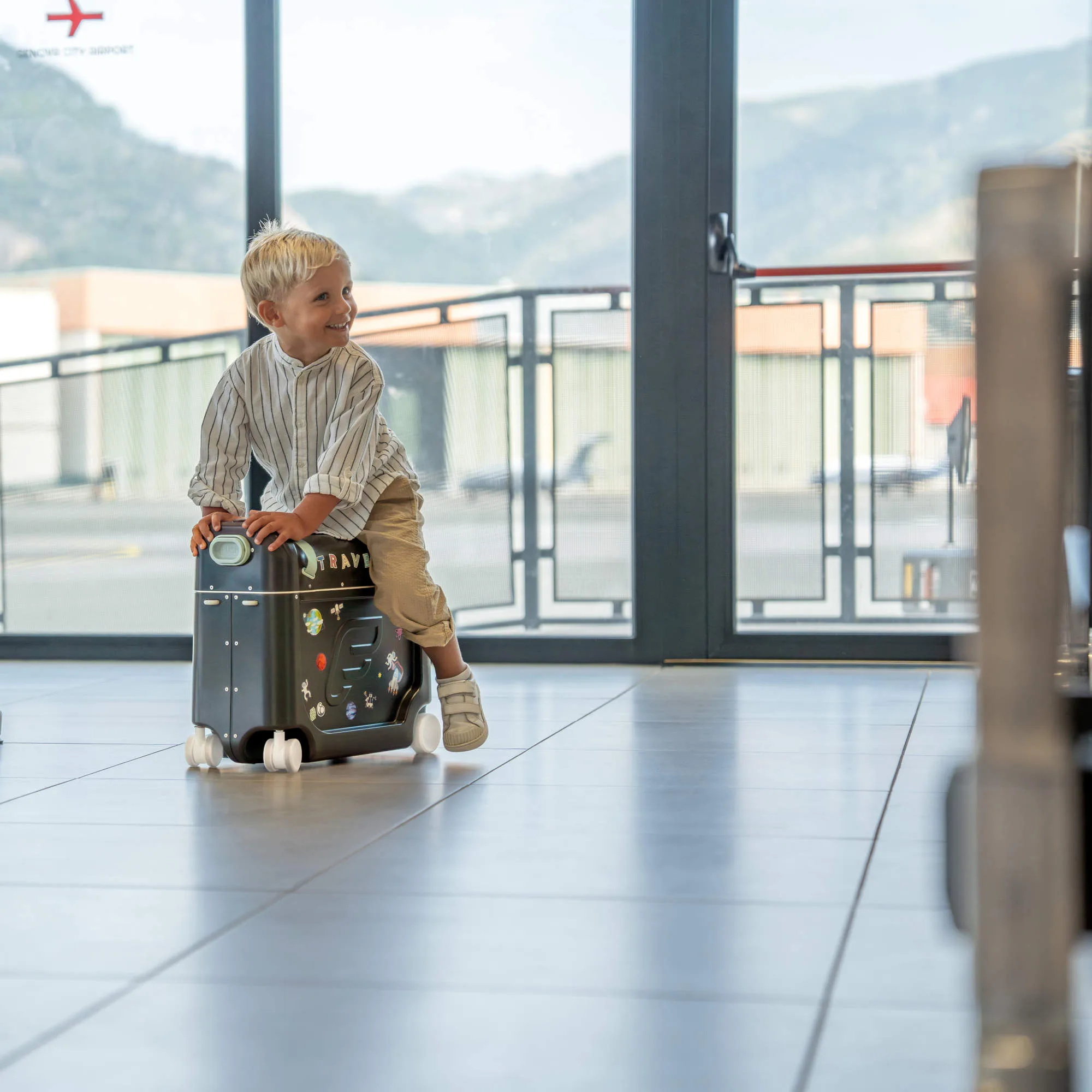
The ride-on function is the purchase decision for most families, and it is exactly as useful as it sounds. Children between roughly 3 and 6 (the official ceiling is age 7, up to 35 kg) sit on the case and are either towed by the telescoping handle or push themselves along with their feet. Through check-in, security, the long corridor to the gate, and any connecting walk between terminals, this is a child who is not asking to be carried. On a two-connection itinerary to Southeast Asia, that is the difference between arriving at the gate composed and arriving spent.
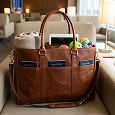
The 19-litre interior is more useful than that number suggests. A packed day’s worth of toddler essentials (spare clothes, snacks, a soft toy, tablet, small shoes) fits without drama. There is a catch: the foam mattress pad, when stored inside the case, consumes roughly a third of that space. Most experienced BedBox families stop packing it in the case and slide it flat into the main luggage instead. This is worth knowing before the first trip rather than discovering at the airport with no room for the extra layer.
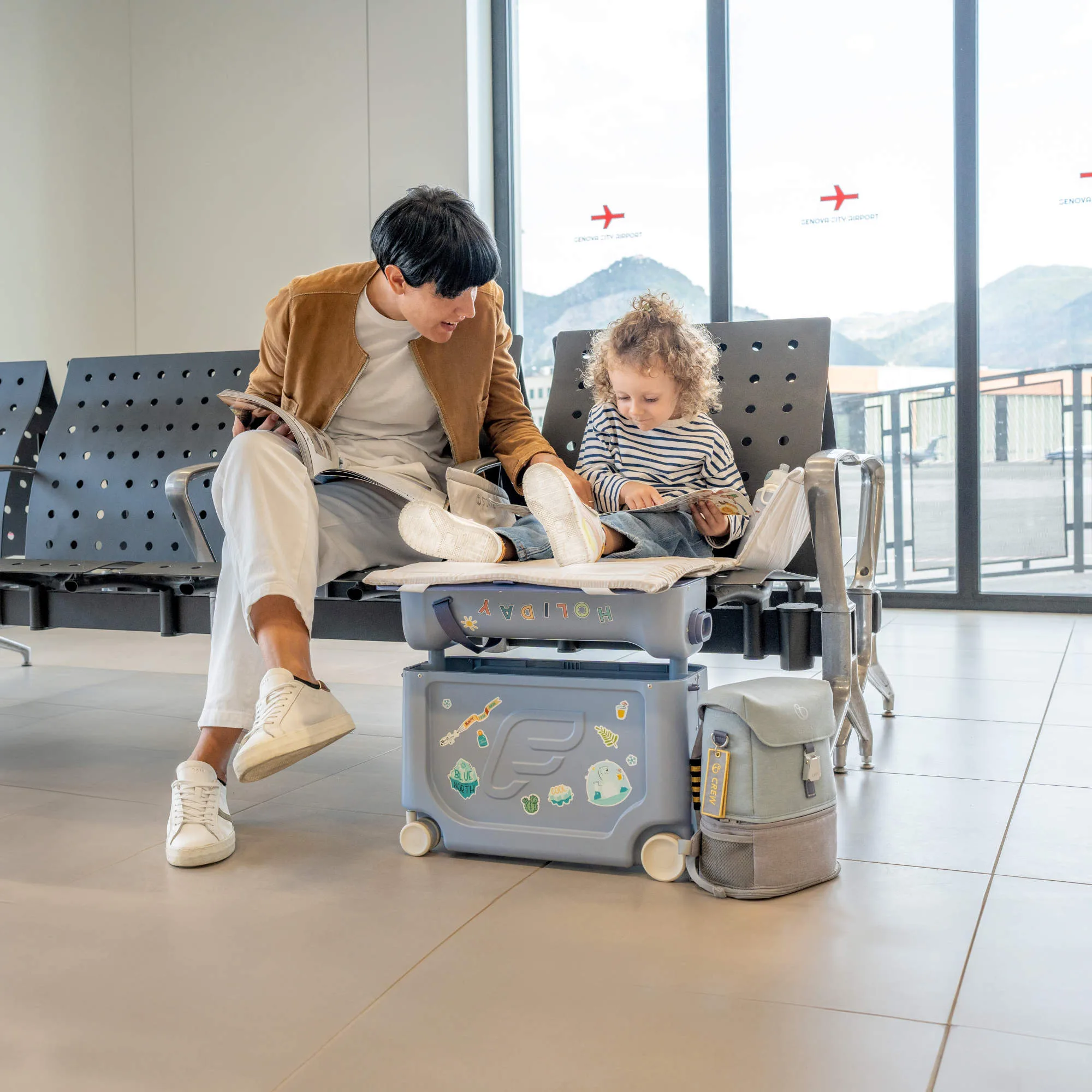
When conditions align for the bed function, the results are striking. The lid opens on a hinge, the mattress pad clips into the underside, and the extended surface bridges the child’s seat and the seatback in front. For a child under about 100 cm, this creates a surface long enough to stretch out on. The foam is thin (call it a firm daybed, not a proper mattress), but children who can sleep anywhere need only a horizontal surface to do so. One colleague described watching her daughter fall asleep 30 minutes into the setup while the surrounding passengers craned to see what was happening in row 42E. The bed draws attention, and the parents of sleeping children tend not to mind.
The case is approved by more than 50 airlines, which sounds like a lot until you look at which major carriers are missing. Emirates, British Airways, Air France, Qatar Airways, Air Canada, and Qantas all restrict or ban the bed function in-flight. Some Lufthansa routes enforce the same restriction; whether a crew enforces it depends on the flight and the individual. For families in Germany, Austria, and Switzerland whose preferred long-haul carrier is Emirates or Qatar, this is a significant gap. The ride-on function still works on any flight. The bed does not, on those carriers, and no amount of polite conversation at the gate will change it.
Real-World Use (Airport / Car / Hotel)
At the airport, the BedBox is at home. The two front wheels have a 360-degree swivel, which makes threading the security queue one-handed, then turning sharply to catch the tray on the belt, something a parent can manage without stopping. Rolling on smooth terminal floors is genuinely smooth: multiple long-term users describe the wheels as noticeably better than comparably priced children’s luggage. On rougher surfaces (outdoor paving, older terminal tiles, sloped walkways) the small wheels show their limits. This is not a case to drag across cobblestones; the airport is its territory.
A word about fall risk for very young riders. Children under two-and-a-half, those still finding their balance, brace themselves against the telescoping handle post. There is no saddle grip, no side rail. Falls happen with the youngest riders, and on smooth airport tile that means landing on concrete. The ride-on function is most reliable from age 3, and fully confident at 4 and 5.
In the car, the 46 × 20 × 36 cm profile is slim enough to slide into a boot corner without rearranging the rest of the load, even on a modest hire car. The case does not fold further or compress to a smaller form, which means the full footprint is always what you plan around.
At the hotel, the BedBox is simply a suitcase. Children tend to want it unpacked and ridden around the corridor on arrival, which is either endearing or an issue for the neighbours, depending on the landing hour. The hard ABS shell handles the room-to-room journey well. The warranty covers cabin use but explicitly not checked-baggage handling: Stokke designed this case for the cabin, and putting it in the hold voids the warranty.

One version note matters for buyers. The BedBox went through four wheel design iterations. Pre-V4 units showed a documented failure mode: the plastic housing at the front wheel mount cracked under pressure, typically with children at the heavier end of the age range (5 to 6-year-olds near 25 to 30 kg). Multiple reviewers on Trustpilot, Amazon, and German family blogs described the same failure point, and Stokke acknowledged the pattern through successive redesigns, with V4 specifically marketed as having enhanced front wheels that will not be easy to break. The current product sold in Europe is V4; anyone buying second-hand should confirm the version number before committing, as pre-V4 units remain in circulation and the long-term V4 durability record is still accumulating.
Specs That Actually Matter
- Weight (empty): 3.3 kg.
- Dimensions (closed): 46 × 20 × 36 cm (L × W × H).
- Interior volume: 19 L official (effective packing space with mattress pad stored in main luggage); approximately 23 L total interior cavity.
- Age and weight: ride-on from age 3 to 7, maximum 35 kg; bed and leg-rest function from age 2.
- Shell: hard ABS plastic; 4 wheels (2 front 360° swivel, 2 rear fixed).
- Mattress pad: thin foam with cotton-covered fabric; clips into the underside of the open lid.
- Airline approval: 50+ airlines per Stokke, including American Airlines, Delta, Singapore Airlines, Cathay Pacific. Emirates, British Airways, Air France, Qatar Airways, Air Canada, Qantas restrict or ban the bed function. Crew discretion varies even on approved carriers. Verify with your specific airline before each trip.
- Safety: EU 2001/95/EC; EN 71-3:2019+A1:2021; REACH. No recall in EU/EEA/UK/USCA as of November 2024 per Stokke Compliance Declaration.
- Warranty: 2 years; explicitly excludes checked-baggage use.
- Price: €199 RRP; typically €149–€169 via major retailers.
Pros & Cons
Pros
- Eliminates the airport carry-me problem for children aged 3 to 6.
- When the bed function works, it genuinely enables long-haul toddler sleep in economy class.
- 360-degree swivel wheels roll smoothly through busy terminals.
- 19 L interior holds a full day’s child essentials once the mattress pad is packed separately.
- Hard ABS shell body has proven durable over years and multiple flights; V4 wheel redesign addresses the documented failure point.
- Strong second-hand resale value; Stokke brand retains demand on the pre-owned market.
Cons
- Bed function banned or restricted on Emirates, British Airways, Air France, Qatar Airways, Air Canada, Qantas, and some Lufthansa routes.
- Mattress pad consumes roughly a third of interior space when packed inside the case.
- Mattress adhesion during turbulence is imperfect; the pad can shift or slide on overnight flights.
- Narrow effective age window: ride-on best from age 3 to 6; bed function most meaningful from age 2 to 5.
- Pre-V4 units had documented front wheel failures; long-term V4 durability data is still limited.
- €199 RRP is a considered commitment for a product whose headline feature depends on carrier approval on the day.
FFH Gear Score
The BedBox is a thoughtful piece of design that delivers its core promises in the right conditions. Our four equal-weight criteria:
- Functionality: 8.3 / 10.
- Build Quality & Durability: 7.2 / 10.
- Ease of Use: 8.1 / 10.
- Family Practicality: 8.4 / 10.
- Pricing: $$$ of $$$$$.
- FFH Gear Score: 8.0 / 10.
Build quality sits below the other three because the wheel issue on earlier versions was genuine and recurrent, and the V4 redesign has not yet accumulated the volume of long-term reviews that would fully vindicate it. Pricing tier 3 reflects a product that is clearly premium for children’s carry-on luggage but not extravagant for a family that boards a long-haul flight three or four times a year.
Final Verdict
Buy the JetKids BedBox if you fly long-haul at least twice a year with a child between 2 and 6, and your main carriers are not on the ban list. At those conditions, the airport ride-on function alone is worth the price of entry: it replaces a pushchair through the terminal and removes the carry-me negotiation from every transit corridor. The bed function, when it lands on an approved carrier with a window seat, can turn a nine-hour economy leg into something you will describe to other parents for years. A preschooler sleeping seven hours while the adults watch a film is a specific, memorable kind of travel relief.
For families whose primary long-haul carrier is Emirates, Qatar, British Airways, or Qantas: buy it for the terminal function and accept that the bed feature will not repay the extra cost on those routes. That is an honest assessment for a significant share of European families, particularly those routing through Dubai or Doha.
Pack the mattress pad in your main hold luggage, not inside the case. Book a window seat. Check your carrier’s current policy before each flight. The BedBox rewards preparation, and it rewards families who travel often. For the FFH family for whom the airport is simply where the holiday starts, this is one of the better pieces of kit we have packed.
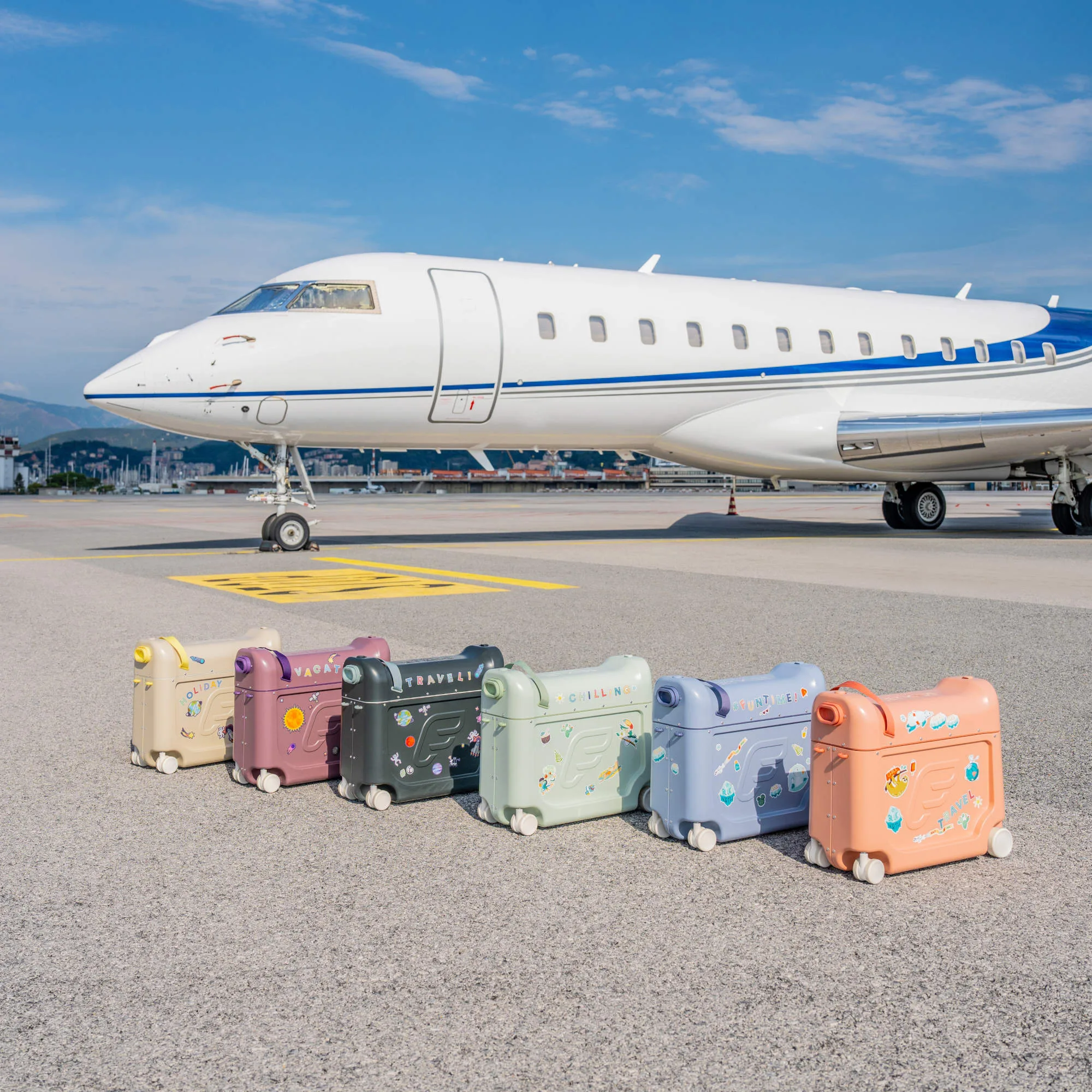
Gallery
Stokke JetKids BedBox: Questions and Answers
Who is the Stokke JetKids BedBox best suited for?
The BedBox delivers most for families with children aged 3 to 6 who take long-haul flights at least twice a year and primarily fly carriers that permit the in-flight bed function. At the airport, any child in that age range benefits from the ride-on function regardless of carrier. The bed function requires an approved airline, a window seat, and a child under roughly 100 cm. Families flying Emirates, British Airways, Qatar Airways, Air France, Air Canada or Qantas will get the terminal ride-on and the storage, but not the in-flight bed.
What are the age and weight limits for the JetKids BedBox?
The ride-on function is rated for children aged 3 to 7, up to a maximum of 35 kg. The bed and leg-rest function is suitable from age 2. In practice, the bed function is most effective for children under roughly 100 cm in height, as taller children will not lie fully flat across the extension. Most children exceed 35 kg well before age 8, so the ride-on window closes naturally around age 6 to 7 for most families.
How heavy is the BedBox and will it fit as carry-on?
The BedBox weighs 3.3 kg empty and measures 46 × 20 × 36 cm when closed. It is confirmed carry-on compliant ('Als Handgepäck zulässig' per otto.de). The official interior volume is 19 litres effective (with the mattress pad stored inside); the total interior cavity is approximately 23 litres. Most users pack the mattress pad separately in the main family luggage to regain the full interior for children's essentials.
Which airlines allow the JetKids BedBox bed function in-flight?
Stokke claims approval from more than 50 airlines, including American Airlines, Delta, Southwest, Singapore Airlines and Cathay Pacific. Airlines that restrict or ban the bed function include Emirates, British Airways, Air France, Qatar Airways, Air Canada, Qantas, and Lufthansa on some routes (individual crew discretion applies even on approved carriers). Policies change, and Stokke recommends contacting your airline before each flight. The ride-on function at the airport is unaffected by in-flight policy and works regardless of carrier.
How long does it take to set up the in-flight bed?
Most reviewers report setup in four to five minutes. The lid hinges open, the foam mattress pad clips into the underside of the lid, and the extended surface rests against the seatback in front. A window seat is strongly recommended; the setup is difficult or impossible in a middle or aisle position. First attempts take longer. Budget a practice run at home before the actual flight so that setting up at 35,000 feet is not the first attempt.
Is the JetKids BedBox durable enough for frequent travel?
The hard ABS shell body has proven durable across long-term tests, including one review covering five-plus years of use and another citing 60-plus flights with no damage to the main case. The documented weak point is the front wheel housing: pre-V4 units showed a consistent failure where the plastic casing cracked under heavier children (typically 25 to 30 kg). Stokke addressed this in each successive version; V4 carries enhanced front wheels. Long-term V4 data is still limited. Buying second-hand means confirming the version before committing.
Do I still need a travel stroller if I have the JetKids BedBox?
For children between 3 and 6 who can ride the BedBox through the terminal, many families skip the stroller on short and medium-haul trips entirely. The BedBox handles airport transit and adds in-cabin storage; a pushchair adds nothing if the child rides the case instead. For children under 3 or those too heavy for the ride-on, the BedBox is a carry-on, not a stroller replacement. If you need a cabin-compliant pushchair at the destination, the Stokke YOYO3 folds to overhead-bin dimensions and is usable to 22 kg. Many FFH families with children in the 2-to-4 range travel with both: the BedBox for the airport ride-on and in-flight sleep, a compact folding stroller for the destination city.
How much can you actually pack in the BedBox?
The official interior volume is 19 litres with the mattress pad stored inside the case. Pack the pad in the main family luggage and the effective packing space expands to approximately 23 litres. That fits one full change of clothes, a small soft toy, a tablet in its case, a snack pouch and a pair of shoes. The BedBox is a children's carry-on, not a replacement for a full family suitcase. Multiple long-term users describe the storage as underrated once they stop trying to fit the mattress inside it.
What safety certifications does the JetKids BedBox carry, and has it been recalled?
The BedBox carries EU 2001/95/EC (European Product Safety Directive), EN 71-3:2019+A1:2021 (Migration of Certain Elements), and REACH Annex XVII compliance. Stokke's November 2024 Compliance Declaration states the product is not subject to any recall in the EU, EEA, UK or USCA and has no known flaws or defects from a product safety or compliance perspective. Recent USCPSC recall notices for Stokke products (Tripp Trapp chair and YOYO stroller brake) relate to different products, not the BedBox.