




Overview
On our second morning the tide had gone out far enough that the lagoon in front of our villa turned into a shallow, sun-warmed wading pool the colour of a swimming-pool advertisement, and our youngest simply walked into it up to her knees and stood there, transfixed, while a small reef shark the length of a baguette flicked past her ankles and away. Nobody screamed. A barefoot Maldivian man in linen (our butler, or as Soneva insists on calling them, our Barefoot Guardian) happened to be wheeling past on a bicycle with a tray of iced hibiscus tea and simply said, over his shoulder, that the little ones are more curious than we are, and pedalled on. That, in a single unhurried sentence, is Soneva Fushi: a place where the wildest thing in the water is treated as ordinary, where shoes are collected at the seaplane dock and posted back to you on departure, and where the entire operation is built on the radical premise that a family holiday should slow your pulse rather than raise it. We came expecting a very expensive beach. We left having recalibrated what a family resort could be.
Soneva Fushi occupies the whole of Kunfunadhoo Island in Baa Atoll, a dense, deliberately overgrown jungle-island in a UNESCO Biosphere Reserve, and it has been doing so since 1995. In Maldives terms, that makes it the venerable grandparent of the barefoot-chic genre it more or less invented. The ethos, printed on the little wooden signs and lived out in a thousand small ways, is “no news, no shoes.” What that means in practice for a family is a car-free island you cross by bicycle, roughly seventy villas hidden so thoroughly in the foliage that you rarely see your neighbours, a children’s club the size of several tennis courts, and a level of personal service that our children started to take, alarmingly, as their due. It is genuinely one of the best hotels in the world for families (we would put it near the very top) and it is also, we should say plainly and early, one of the most expensive and most logistically demanding. Both things are true at once, and a clear-eyed read of this place lives in the tension between them.
This is our full, first-hand account of a stay here with children across the age range, from the toddler in the lagoon to a teenager we watched learn to free-dive. We have tried to be the friend who has actually been, not the brochure: to tell you where the magic is unarguable and where the money starts to sting.
Location & Accessibility
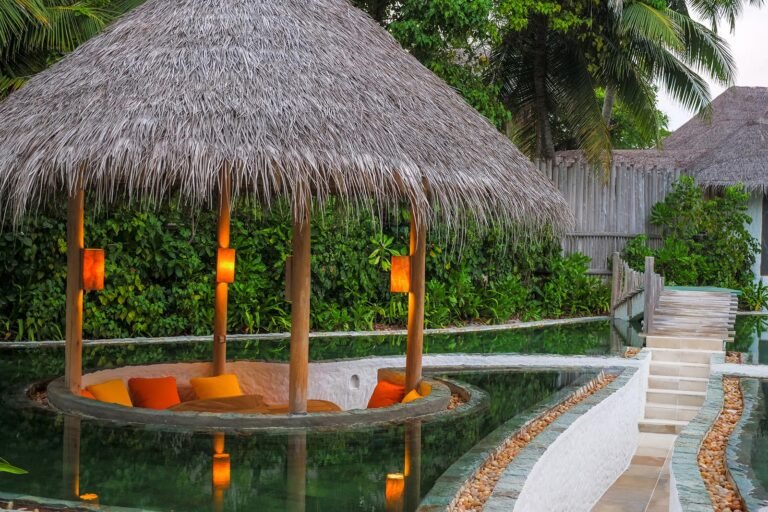
Getting to Soneva Fushi is the single biggest thing to understand before you fall in love with the photographs, because the journey is both part of the romance and, with small children, a genuine test of nerve. The island sits in Baa Atoll, roughly a hundred kilometres north-west of Malé, and there is no bridge, no causeway, no road. You arrive by air over water.
For most of the year that means a seaplane. Soneva runs its own small fleet of Twin Otters (grey and purple, fitted with eight roomy seats where a standard seaplane crams in fifteen) and the flight from Velana International Airport takes around thirty minutes, skimming low over that impossible palette of turquoise and deep blue with the atolls scattered below like spilled jewellery. It is, we will not pretend otherwise, one of the great arrivals in travel. It is also hot, loud, and, if you are holding a baby on your lap in a cabin that has been baking on the tarmac, a real physical trial. We travelled with a friend’s ten-month-old on one leg and there is no sugar-coating it: seaplanes are cramped, noisy and warm, there are no infant seatbelts of the kind you get on a jet, and a tired toddler at the end of a long-haul flight will not thank you for the extra transfer. Pack water, ear defenders and low expectations, and it passes; the relief when the dock appears in the heat-haze and the engine finally cuts is all the more welcome for it.
The seaplane also flies in daylight only. If your international flight lands in the late afternoon or at night (which many long-hauls from Europe do), you take the alternative instead: a short domestic hop to Dharavandhoo airport followed by a speedboat of ten to fifteen minutes to the island. Frankly, with young children, we came to prefer this routing; it is cooler, the boat is fun, and it removes the daylight deadline that can otherwise pin you to an overnight in Malé. One caution, drawn from a transfer delay we heard described first-hand at the jetty: seaplane and speedboat services in this region are occasionally operated by third parties and, in poor conditions, can be delayed, diverted or aborted. Build slack into your schedule, do not book the tightest possible connection home, and confirm your transfer details and timings with the resort well ahead, certainly more than seventy-two hours out.
Once you are on Kunfunadhoo, though, the difficulty evaporates and the genius reveals itself. The island is car-free. Every villa comes with bicycles (adult bikes, children’s bikes, bikes with baby seats) and the whole family simply cycles the sandy jungle paths between the beach, the restaurants and The Den. Our children learned the island’s geography faster than we did and were soon pedalling off ahead down tunnels of green, past the resident population of tame rabbits that hop across the paths at dusk. There is a buggy service if you would rather be driven, and the flat, soft-sand tracks are forgiving for wobbly new cyclists. For a family, this car-free freedom (kids roaming under their own steam in a completely enclosed, traffic-free, safe environment) is one of the resort’s quietly great gifts. It is worth knowing that the island is emphatically not suited to guests with limited mobility: the terrain is sand, the distances are real, and a wheelchair would struggle.
One note on the setting worth adding. From the sunset side of the island you can see, across the water, the inhabited local island of Eydhafushi, complete with the odd transmitter mast and the low hum of a working Maldivian town. It is a minor thing and, to our eyes, a rather nice reminder that real life carries on beyond the resort bubble, but if your fantasy is an entirely empty horizon in every direction, ask for a villa on the ocean-facing side when you book.
Accommodation (Rooms & Suites)

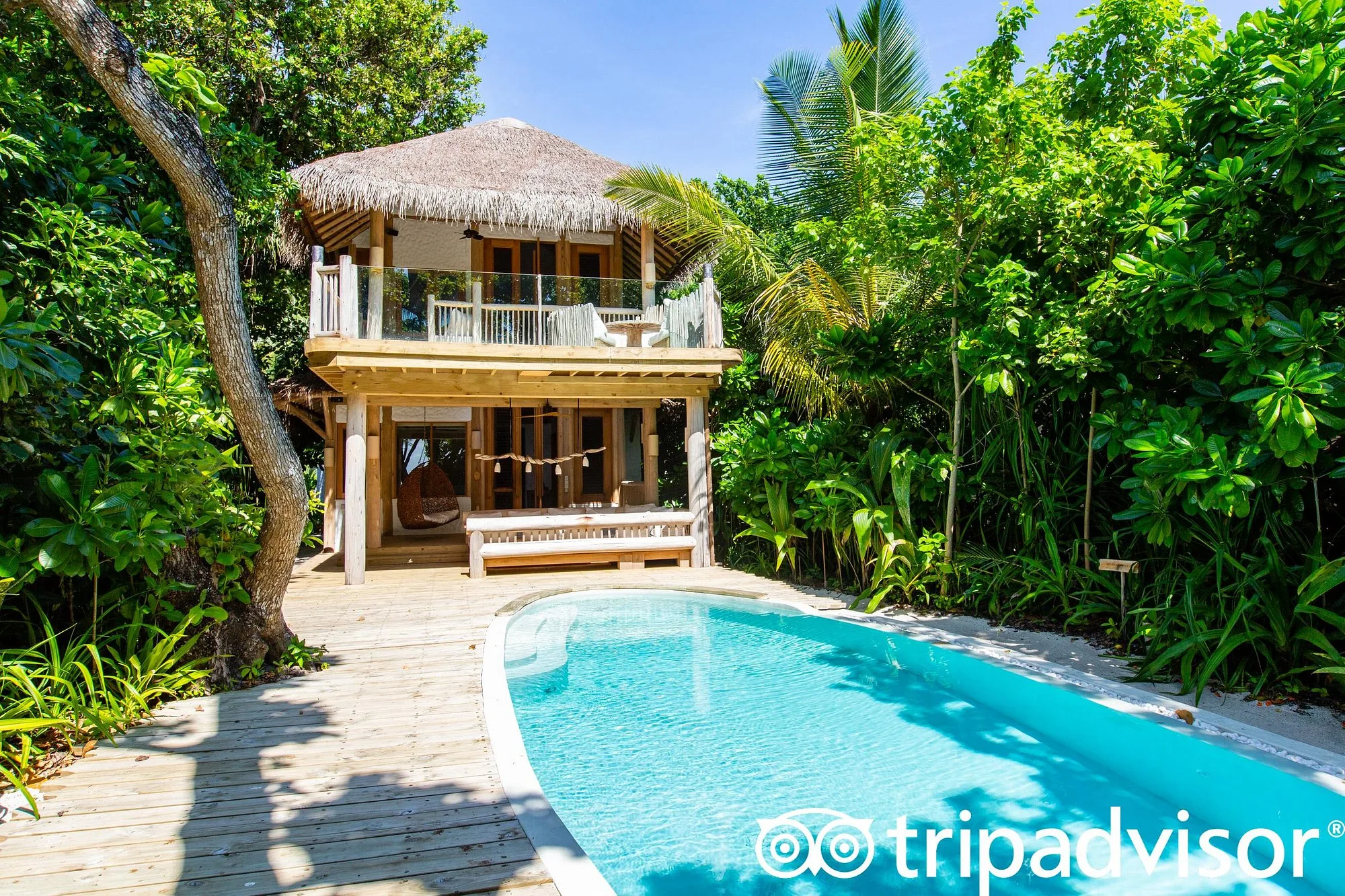
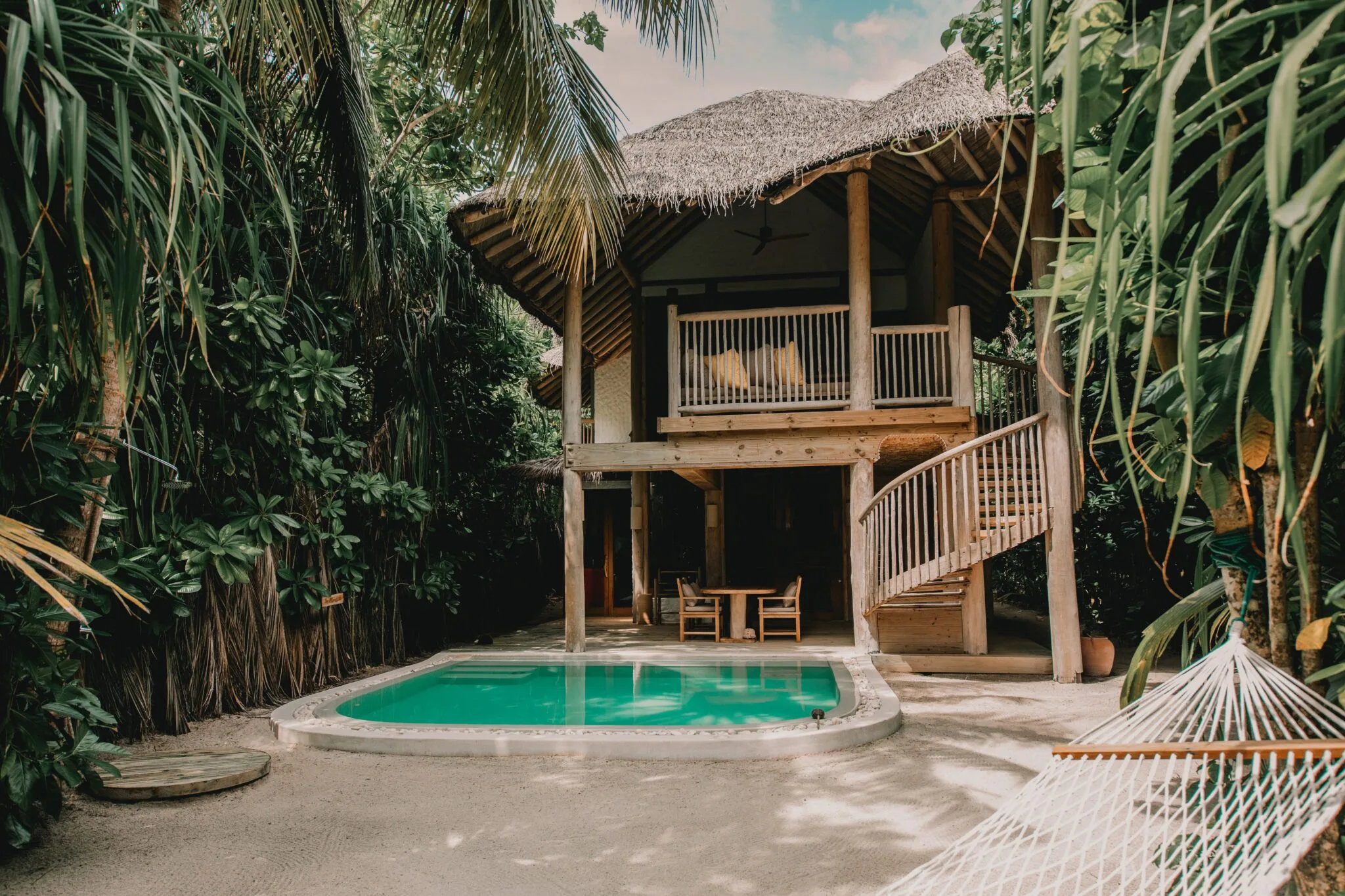
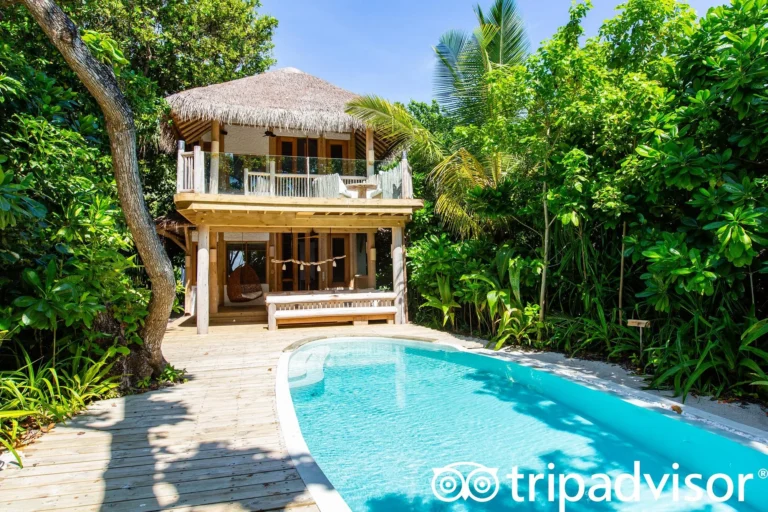
The villas at Soneva Fushi are, first and foremost, big: almost comically so if your last beach holiday was a standard hotel room. The entry-level Crusoe Villa with Pool runs to around 145 square metres of indoor-outdoor living, and that is the smallest thing on the island. From there the ladder climbs through one- and two-bedroom villa suites and Crusoe suites of 270 to 550 square metres, up to multi-bedroom beach residences and, at the summit, the overwater Water Retreats and vast private reserves that sleep entire extended families. Every single villa has its own private pool. There is no communal resort pool at all: a deliberate choice that suits families beautifully, because your children can swim, unobserved and un-jostled, in your own garden, at any hour, in swimwear or nothing at all.
What defines these villas is space and a particular kind of raw, jungly, barefoot indulgence. Ours had polished concrete and reclaimed timber, an open-air garden bathroom where we showered under the sky, a daybed the size of a small boat, and glass doors that folded away entirely so that the line between “inside” and “the beach” simply dissolved. The children adored it. Sand comes in; geckos come in; the odd hermit crab makes an appearance. This is the point, not a flaw, and if the idea of an insect in a bedroom appals you, this may not be your island.
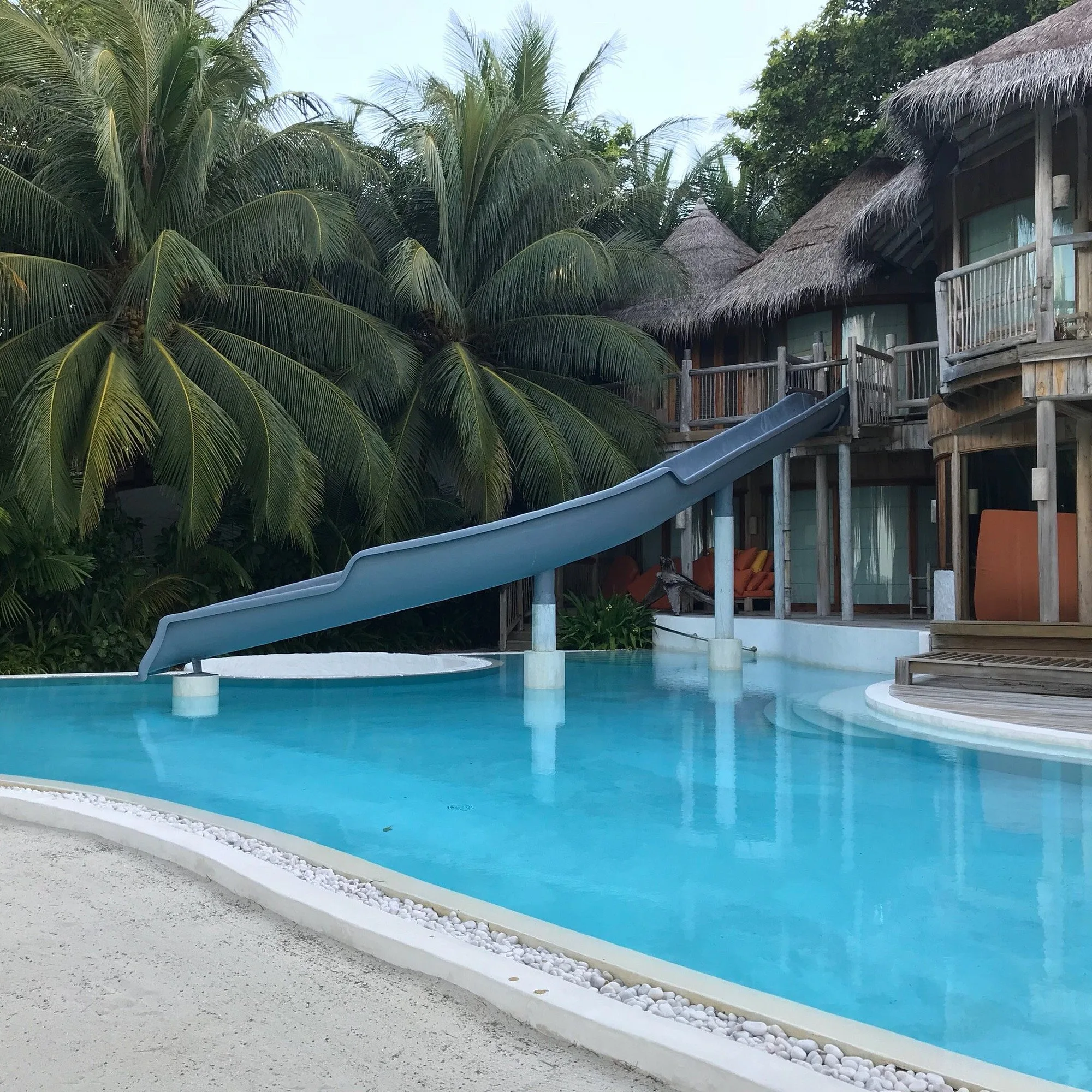
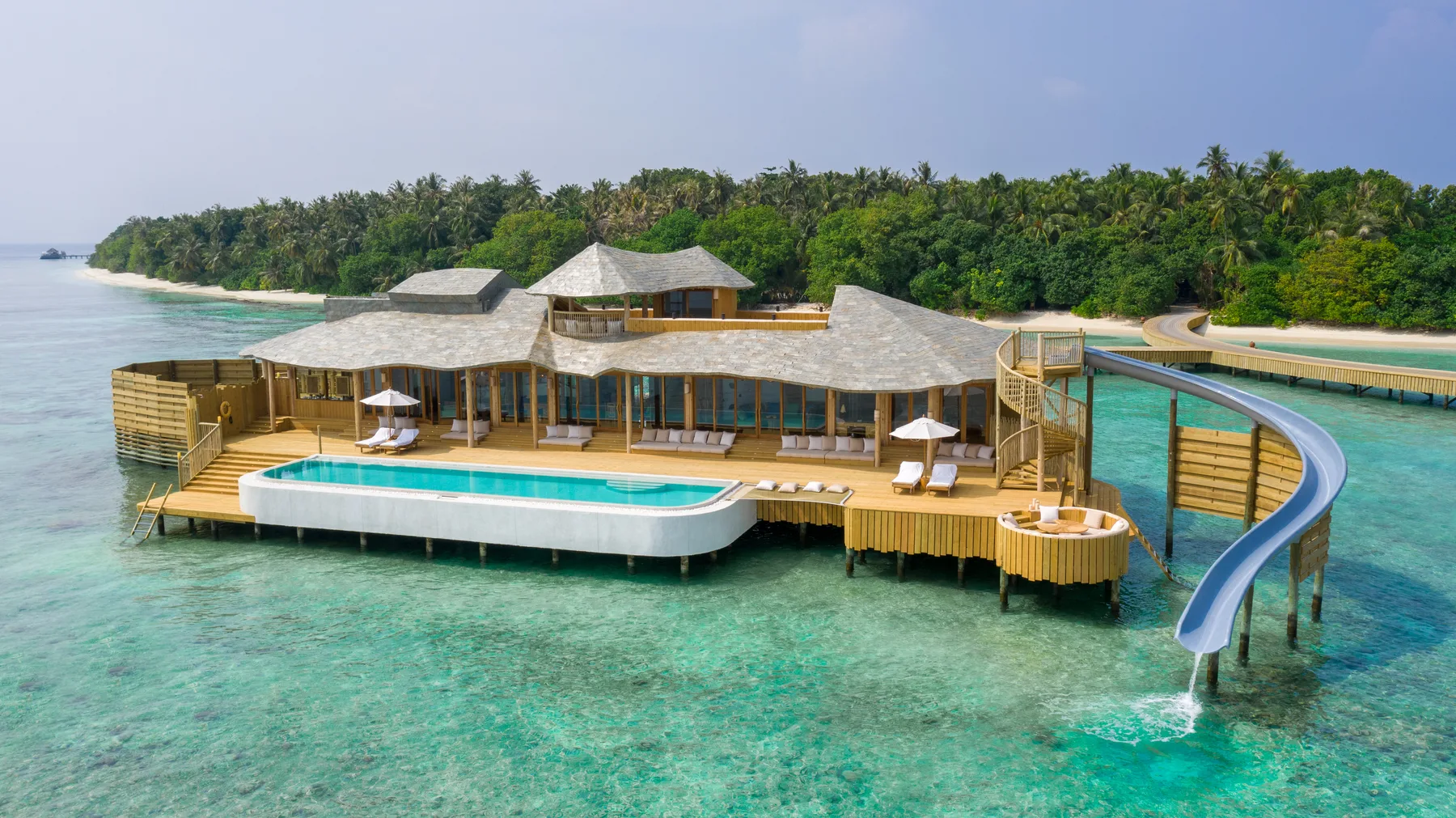
For families, the layouts are the real draw. The Family Villa Suite gives you a master bedroom plus a dedicated children’s room, all wrapped around a private pool, and the two-bedroom Crusoe and residence categories scale that up handsomely: some sleeping ten, twelve, even fourteen across a compound of connected pavilions with their own kitchen and fitness room. We travelled alongside a multi-generational group who took a large reserve and effectively colonised a slice of jungle for the week; the grandparents had their own wing, the cousins had theirs, and everyone converged on the shared pool for meals. For big family trips, this is close to unbeatable. The newest and most photographed accommodation, the overwater Water Retreats that opened in 2020, are extraordinary: among the largest overwater villas anywhere, with a retractable roof over the master bed for sleeping under the stars, glass floor panels, catamaran nets slung over the water and a curved nineteen-metre slide that fires you straight off the deck into the lagoon. Our older child would have happily lived on that slide, and spent the final morning making a reasoned case for this arrangement that we lacked the energy to properly rebut.
Now the honesty this section demands. Soneva Fushi is nearly three decades old, and although it is constantly renovating, not every villa has been brought up to the standard of the newest ones. Some of the older Crusoe categories feel, to a discerning eye and a high price point, a touch rustic and dated: storage is limited in the smaller villas, the deliberate jungle density means several villas have surprisingly little sea view despite being metres from the beach, and the “barefoot” aesthetic can occasionally read as simply worn rather than charmingly weathered. This is the single reason our accommodation score is our lowest of the five, at 8.4: the space and the setting are magnificent, but the consistency of the hard product across so many villa vintages is not flawless, and at these prices we hold it to a high bar. If a pristine, contemporary finish matters to you, book a Water Retreat or one of the recently refurbished categories, and ask directly about the villa’s age and its outlook before you commit.
Family Amenities & Kids’ Activities
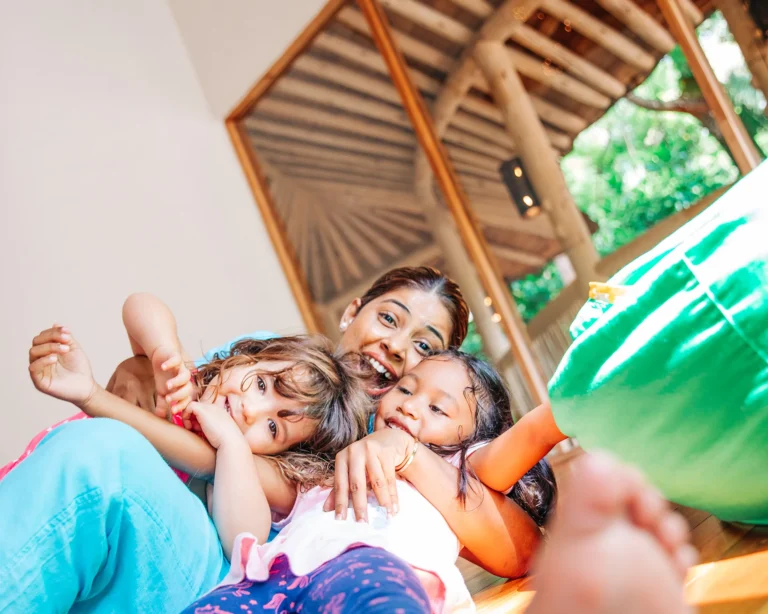
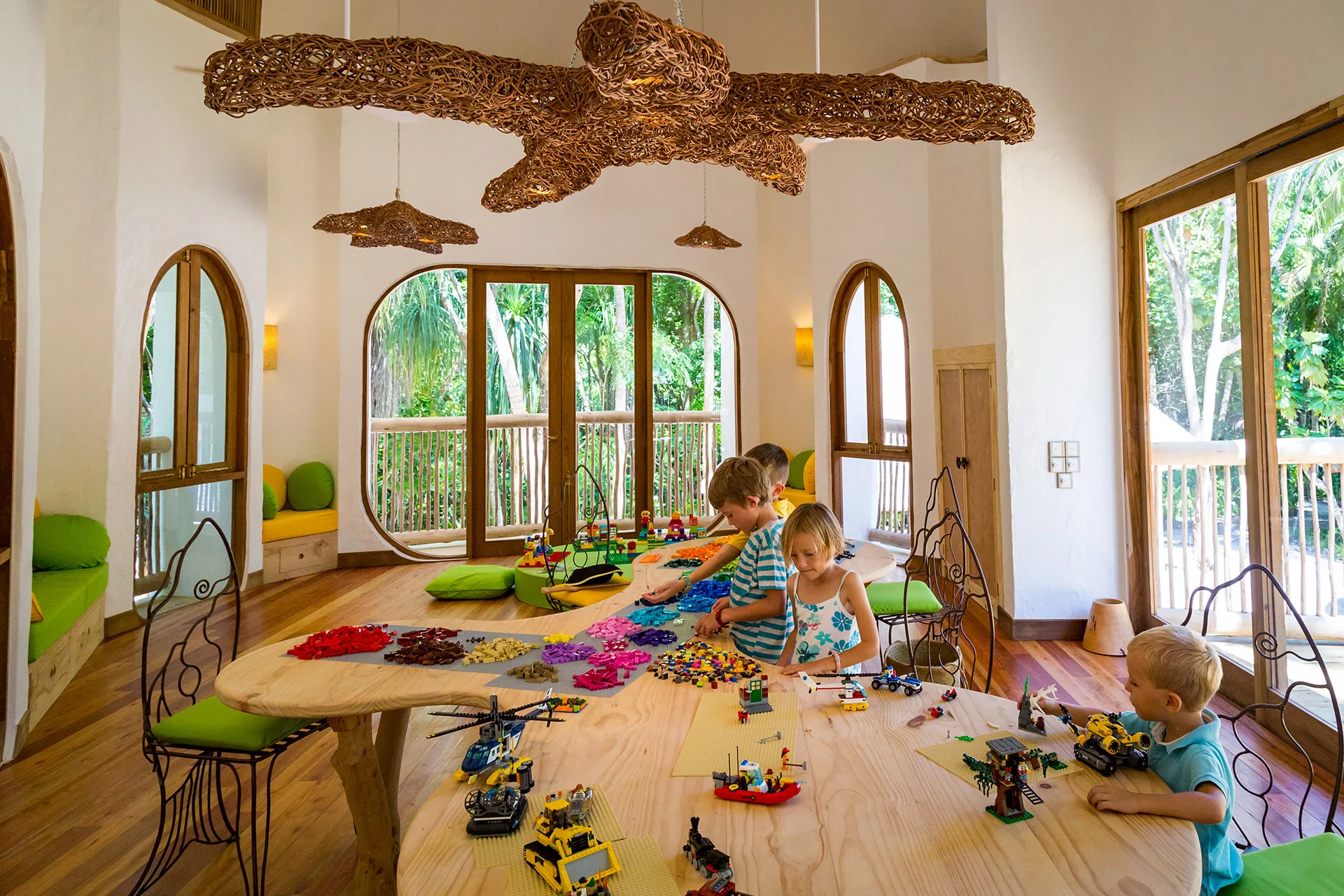
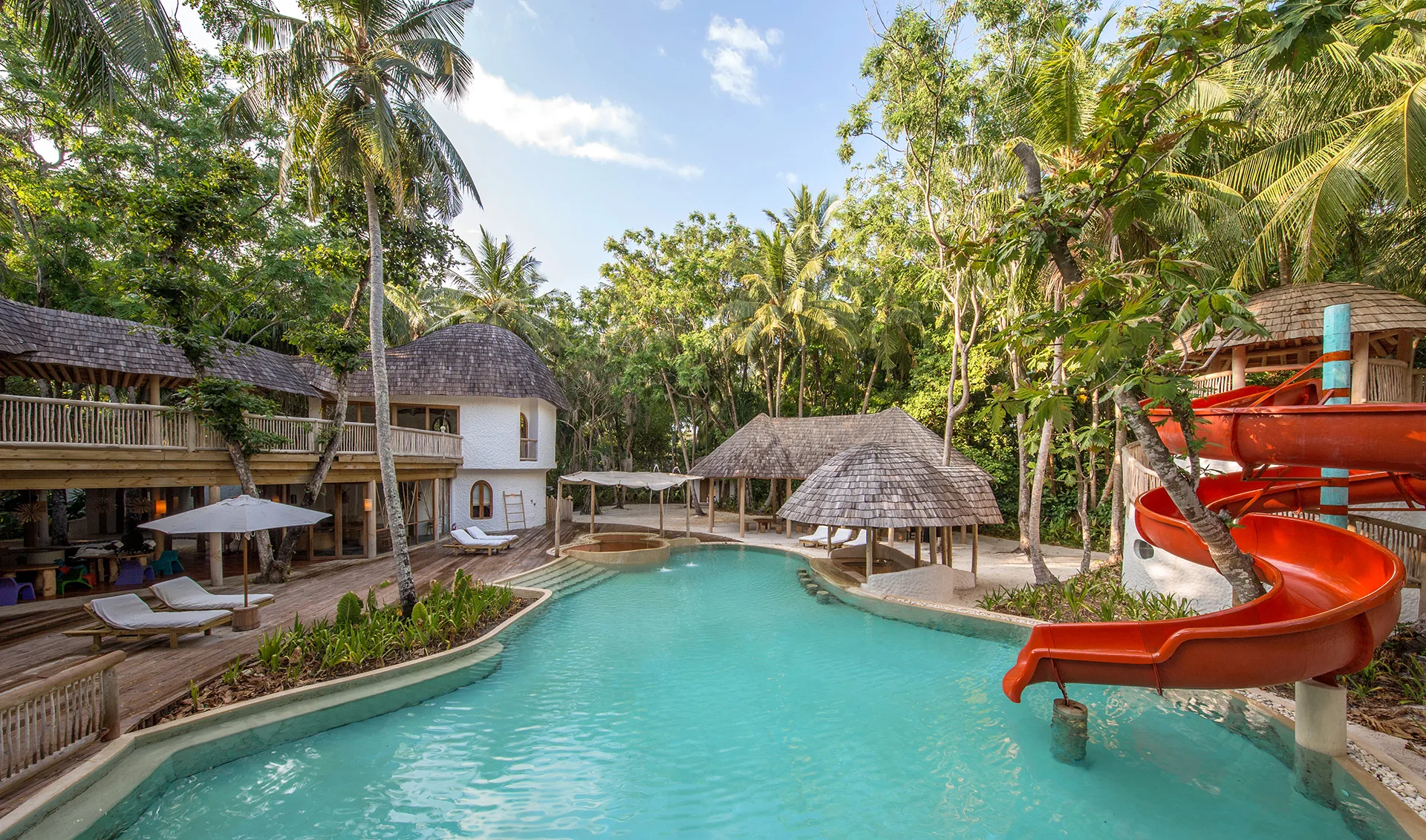
If there is one thing that makes Soneva Fushi a serious contender for the best family hotel in the world, it is The Den, and having now watched our children disappear into it every single morning, we understand the reputation completely. The Den is a children’s club on a scale we have not seen anywhere else: acres of it, spread across an area the size of several tennis courts, and built with the imagination of people who clearly remember being children themselves. There is a pirate ship rising out of a saltwater pool. There is a separate, Nemo-shaped wading pool for toddlers. There is a spiral water slide, a LEGO and Duplo room, a music studio with a drum kit and DJ decks, a dressing-up corner, a library of reading nooks, a private cinema, trampolines, a zip-line, secret tunnels and bridges, an art and cooking studio, and a mocktail bar where the currency is entirely imaginary. Our kids’ verdict, delivered with total seriousness, was that it was “better than home.”
Crucially, it is complimentary. Everything at The Den (the space, the toys, the supervised activities, the daily programme) is included in your rate, which given what everything else here costs feels almost subversive. The supervised programme runs from mid-morning to around five in the afternoon for children roughly four to twelve, with evening activities layered on according to the daily schedule. The daily schedule is properly good and not remotely a babysitting parking lot: marine-biology sessions with the resident marine biologist, snorkelling trips, treasure hunts, cooking classes, arts and crafts, and astronomy evenings. We should be precise about the youngest, though, because it caught us out: children under four are welcome in The Den only with a parent or guardian alongside: they are not independently supervised. The drop-and-vanish freedom that the headline hours imply really begins at four. Below that age, the facilities are wonderful but you are on duty, or you are paying for a babysitter.
On babysitting: it is available on request with a day’s notice, at a per-hour rate, and our experience of the sitters (warm, attentive, unfailingly patient with a fractious toddler at bedtime) was excellent. The Barefoot Guardian who looks after your villa also functions, in effect, as a family concierge who will conjure whatever a child needs.
Beyond The Den, the island itself is one enormous activity. The complimentary non-motorised water sports (snorkelling gear, kayaks, paddleboards, windsurfers) are there for the taking, and the house reef, reached from four different entry points, is superb: we saw turtles most days and reef sharks daily, all a few fin-kicks from the sand. This is a superb place for a child to snorkel for the first time in calm, shallow, warm water with a marine biologist pointing things out. The paid experiences pile on from there: diving through the resident PADI centre, SEABOB underwater scooters, eFoils, sunset dolphin cruises, and the great seasonal set-piece: Hanifaru Bay. Roughly twenty minutes by speedboat, this UNESCO-protected channel hosts what is billed as the world’s largest gathering of manta rays, plus whale sharks, in the plankton-rich months of roughly June to November. Snorkelling among dozens of mantas, each the width of a small car, is the kind of thing a child does not forget; ours talked about it for months. It is strictly snorkel-only, ranger-supervised and time-limited, which is exactly as it should be.
Then there are the touches that make this island feel invented by a slightly eccentric genius. The So Celestial observatory, with a serious telescope and a resident astronomer, does stargazing evenings that mesmerised our tween. The So Glasscycle studio (the first glass-blowing studio in the Maldives, melting down the island’s waste glass) runs demonstrations and workshops. Cinema Paradiso screens films after dark on a beachside outdoor screen, complete with unlimited popcorn and ice cream, and it is family-friendly rather than adults-only; a starlit outdoor screening of an animated film, blanket, ice cream, sand between the toes, is a near-perfect family evening. And for the older set there is the Soneva Academy, a real sustainability and marine-conservation programme for children and teens from around twelve, plus the full menu of diving, surfing and free-diving for teenagers with a sense of adventure.
The real gap for a certain kind of family is the teenage years. The Den is superb up to about twelve, and after that the structured offering thins to activities rather than a dedicated teen space or programme. A water-obsessed fifteen-year-old will be in heaven: there is diving, free-diving, surfing, eFoiling and the Academy to fill their days. A less active or more socially inclined teenager, who wants other teens and a hangout of their own, may find the island quiet by the third day. Plan accordingly, and lean into the water sports if you are bringing teens.
Dining

Dining is where Soneva Fushi tips from “excellent resort” into “slightly unhinged culinary theme park,” and we mean that as high praise. There are something like fourteen dining concepts scattered across the island, and a family could eat somewhere different at every meal for a week and still not exhaust them. The soul of the place is Mihiree Mithaa, the main beachside all-day restaurant, whose breakfast buffet is, without exaggeration, the most extravagant we have ever encountered: a room of cured meats and cheeses, a tandoor, wood-fired ovens, tropical fruit we could not name, and a made-to-order station that will build a child whatever they can dream up. Breakfast alone was reason enough to get the kids out of bed before seven, and they kept this arrangement with a cheerfulness that did not extend to every other area of the morning.
From there the concepts get wonderfully strange. Out of the Blue is an overwater kitchen doing Japanese, Thai, Vietnamese and Indonesian across several counters. So Hands On is a six-seat omakase sushi counter. Fresh in the Garden sits on a raised platform above the organic vegetable gardens, reached by a rope bridge, and does dinner as the sun drops. Flying Sauces (and we promise we are not inventing this) is a fine-dining experience you reach via a two-hundred-metre zip-line through the jungle canopy, food arriving along the wire. Shades of Green is a dedicated plant-based restaurant in the gardens. There is a beach shack for tapas, a tasting-menu room with a retractable star-view roof, and sandbank dinners set up on a private spit of sand at low tide.
And then, the detail that every family fixates on and rightly so: the free rooms. So Cool is an ice-cream and sorbet parlour with more than sixty rotating flavours, open all day, unlimited, included. So Guilty is a chocolate room (an entire room of chocolate) likewise complimentary and unlimited. So Delicate does the same for cheese and charcuterie. Our children conducted extensive, repeated, deeply serious research into the ice-cream flavours and we let them, because when else in life do you get an unlimited gelato room. For a family, this all-day free ice cream and chocolate is not a gimmick; it is a genuine daily joy and one of the things the kids missed most on the flight home.
On the practicalities: the default rate is room-only, and you will want to think hard about the meal plan. The Soneva Unlimited all-inclusive package exists and is comprehensive, but it is expensive; without it, à la carte dining across these venues adds up with startling speed. Children under twelve generally stay and dine at no extra charge under the resort’s family offers (a meaningful saving), though the exact terms depend on the villa category and the offer of the moment, and children from around thirteen are typically priced as adults. There is a proper children’s menu, high chairs, and in-villa dining around the clock; a quiet room-service supper on your own deck while the toddler sleeps is one of the underrated pleasures here. Two caveats worth flagging: at peak times, service at the main restaurant could slow noticeably (a simple coffee-and-eggs order occasionally took longer than it should), and the à la carte prices, once you step outside the included venues, are frankly eye-watering. A single specialist beach dinner can run to several hundred dollars a head before drinks, and drinks themselves are steep. We say more about that below, because it is the crux of the value question.
Staff & Service Quality

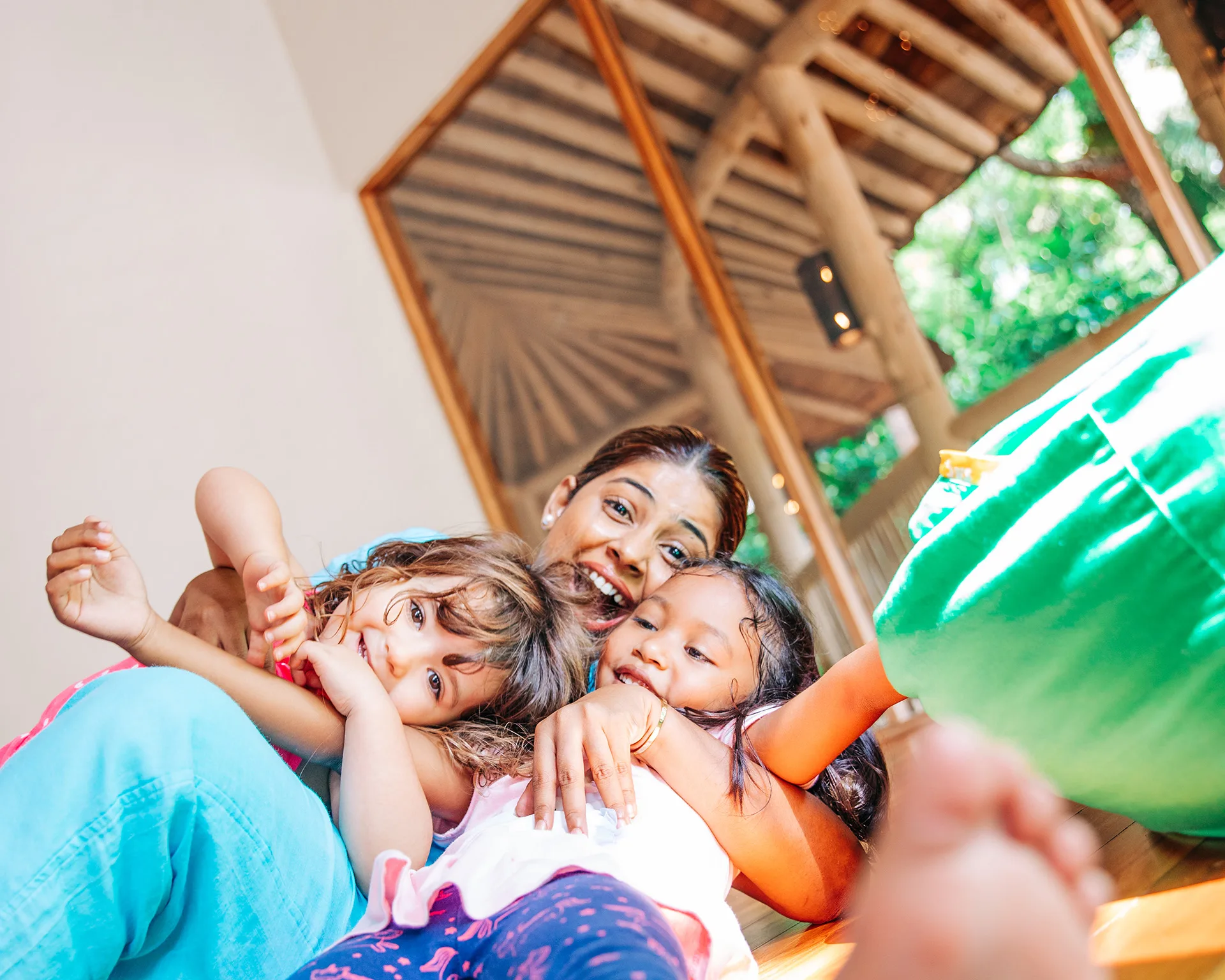
If the villas are the body of Soneva Fushi and The Den is its heart, the service is its soul, and it is the single most consistent thing we can tell you about the place. The Barefoot Guardian system (a personal host assigned to your villa, on call more or less around the clock) is world-class, and it is at its very best with families. Ours learned our children’s names within an hour, knew which one wouldn’t eat anything green and which one needed her water at exactly the right temperature, arranged bicycle seats and ice-cream ambushes and, on one birthday, spelled out a message in flowers and shells across the bed while we were at breakfast. It is the kind of anticipatory, warm care for children that cannot be trained into people who don’t feel it, and here it plainly runs deep. We watched staff interact with our toddler with a patience and gentleness that repeatedly disarmed us.
What struck us most is that it is warm without being stiff. This is not the white-gloved formality of a grand city hotel; it is barefoot, first-name, sit-down-and-chat hospitality, and it suits a family far better. The children were treated as guests in their own right, spoken to directly, given their own little rituals. Many of the staff have been here for years, and it shows in the ease of it all. We landed our service score at 9.5, our highest, and we do not give that number lightly.
It is not literally perfect, and honesty requires the small print. On a couple of occasions we noticed the seams: a villa pickup that ran late, a request that had to be made twice, the sense on one busy evening that the island was running closer to capacity than its staffing quite covered. These were minor and rare against a backdrop of extraordinary care, and every one was put right the moment we mentioned it, but at this price point even a small lapse registers, and we would be flattering the place to claim we never saw one.
Safety & Cleanliness
As a place for children to roam, Soneva Fushi is about as reassuring as a resort gets, and the reason is structural: there are no cars. The single greatest hazard of most family holidays (traffic) simply does not exist here, and the psychological relief of letting a competent nine-year-old cycle off to The Den by themselves, on a car-free island where every member of staff knows every child, is hard to overstate. The villas and grounds were kept immaculately; housekeeping was thorough and discreet; and the island’s whole eco-conscious operation, from the filtered drinking water bottled on-site to the organic gardens, gives the place a clean, wholesome feel that parents notice.
The water is the thing to think about, as at any beach resort. Villa pools are private and unfenced, so with toddlers you are, as ever, the lifeguard: there is no communal pool with an attendant, which cuts both ways. The lagoon is shallow, calm and warm, and the snorkelling is done under real supervision, with marine staff who take the safety briefing seriously. We felt entirely comfortable letting our children in the water within the reef, and the marine team’s respect for the ocean rubbed off on the kids in the best way.
Two non-trivial caveats keep this score at 8.5 rather than higher. The first is medical remoteness: this is a jungle island a seaplane or boat ride from a hospital, and while there is a resident doctor and a clinic, a serious emergency (a bad allergic reaction, a real injury) means an evacuation measured in hours, not minutes. Families with a child who has significant medical needs should weigh that carefully and travel well insured. The second is the transfer question again: the over-water journey is the least controllable part of the whole experience, and we would not pretend the seaplane leg is as routine or as gently managed as a road transfer at a European resort. It is the one place where we felt the ordinary machinery of a big remote operation, rather than the seamless magic of the island itself. Neither point should deter most families; both deserve a clear-eyed sentence rather than a brochure’s silence.
Value & Pricing
Here is the conversation you must have with yourself before you book, because it is the one thing that will define whether you come home elated or faintly resentful. Soneva Fushi is extraordinarily expensive. The entry-level Crusoe Villa with Pool opens at somewhere around a thousand US dollars a night in the deep low season and climbs past five thousand at peak, and in practice, for the sort of dates a family with school-age children can actually travel, you should budget on the order of two to three thousand a night for that smallest villa in the quieter months, before a tax-and-service load of nearly thirty per cent goes on top, and before you have eaten or drunk anything not included. The family villa suites and the overwater retreats climb from there into figures that we will politely describe as aspirational. This is, straightforwardly, one of the most expensive resorts in the Maldives, and the Maldives is not cheap to begin with.
And the costs do not stop at the room. This is the part experienced Soneva guests warn each other about: the in-resort spend. Unless you buy the all-inclusive meal plan, à la carte dining is punishing: a signature beach dinner can land near four hundred dollars a head before drinks, a beer runs into the double digits, a mocktail is not far behind, and the paid excursions (the SEABOBs, the dive trips, the outer-reef snorkelling) are priced to match. It is entirely possible to spend as much again on top of your room rate across a week without especially trying. Go in expecting that, budget for it squarely, and it will not ambush you the way it plainly has ambushed some.
So is it worth it? Our answer, and we hold it sincerely, is: yes, but only if you use the ecosystem. The value at Soneva Fushi is not in the thread count; it is in everything that is included and everything you do. The complimentary Den, the free water sports, the snorkelling on a world-class house reef, the unlimited ice cream and chocolate, the observatory, the cinema, the bicycles, the children who stay and dine free, the sheer square-footage of villa, and above all the service and the setting: a car-free jungle island with mantas offshore. A family that leans hard into all of that, that treats the island as a place to do things rather than merely a beautiful bed, extracts genuine value from a very large number. A family that flies all this way to lie on a lounger for a week and orders room service would, frankly, be lighting money on fire. We think it earns its place near the very top of the family-hotel world, but we would never call it cheap, and we would never pretend the sums are anything but serious.
Why We Picked It
We picked Soneva Fushi because, after a week of watching our children turn feral in the best possible way (barefoot, sun-browned, cycling off to The Den at dawn, snorkelling with turtles by lunch, eating their body weight in complimentary gelato by dusk), we became quietly convinced that it is one of the finest places on earth to be a family. Not the most polished. Not the newest. Not, heaven knows, the cheapest. But the most thoroughly, imaginatively, warmly built for the experience of children and the sanity of their parents, on a car-free jungle island where the ordinary anxieties of travel fall away and something rarer takes their place.
Be clear-eyed, though, and we would be poor friends if we weren’t. This is a destination for families who can comfortably absorb the cost (the room, the transfers, the meal plan, the extras) and who understand that the value lives in using every inch of what is here. It is at its absolute best for children roughly four to twelve, for whom The Den is close to a perfect world; it is superb for adventurous, water-loving teenagers, and merely quiet for teens who want a social scene; and it accommodates babies lovingly while asking their parents to weigh squarely a hard seaplane journey and hands-on days. Bring young children, embrace the barefoot rusticity rather than fighting it, budget without flinching, and use the island the way it wants to be used, and Soneva Fushi delivers something very close to the platonic ideal of a family holiday: the kind your children ask, for years afterwards, when you are going back to.
Soneva Fushi: Family Questions Answered
Is Soneva Fushi good for families?
Yes, if you’re comfortable with the price and the remote logistics. It’s built around family life: a car-free island, big pool villas, bicycles for all ages, and The Den kids’ club (complimentary). The trade-offs are the over-water transfers, the unfenced private pools (you’re the lifeguard with toddlers), and very high in-resort spend unless you plan carefully.
What ages is The Den kids’ club for, and is it free?
The Den is complimentary, with supervised drop-off aimed at roughly ages 4–12 from mid-morning to around 5pm. A daily programme is included (not just free play), and evening activities run depending on the schedule. Children under 4 are welcome in The Den only with a parent/guardian alongside: they aren’t independently supervised.
Can toddlers and under-4s be left at The Den without parents?
No. Children under four can use The Den, but only with a parent or guardian present: supervised “drop-and-go” begins at around age four. If you want childcare while you’re off doing dinner or an activity, you’ll need to arrange babysitting (extra cost) rather than relying on The Den.
Does Soneva Fushi offer babysitting?
Yes, babysitting is available on request, with a day’s notice, charged per hour. In the review stay, sitters were described as warm and patient at bedtime. Your Barefoot Guardian (personal host) can help organise it and generally acts like a family concierge for practical kid needs.
What ages does Soneva Fushi suit best?
It’s at its strongest for ages roughly 4–12. That’s when The Den’s supervised programme really works for parents, and the island feels like a safe, traffic-free playground. Babies are welcomed but the transfer and hands-on days can be tiring, while teens do best if they’re active and water-sports minded rather than looking for a social teen scene.
Is Soneva Fushi good for teenagers?
It depends on the teen. The structured offering thins after about age 12: there’s no dedicated teen space or full teen programme described in the article, but there are plenty of activities (diving, free-diving, surfing, eFoiling) and the Soneva Academy sustainability/marine programme for children and teens from around 12. Less sporty or more social teens may find it quiet after a few days.
What are the best villa options for families (and how many can they sleep)?
Family-focused layouts are a major strength here, starting with the Family Villa Suite (master bedroom plus a dedicated children’s room). Larger two-bedroom Crusoe categories and residences scale up, and some multi-bedroom compounds are described as sleeping ten, twelve, even fourteen. Every villa has a private pool, and there’s no communal resort pool.
Does Soneva Fushi guarantee connecting rooms?
The article doesn’t publish a connecting-room guarantee. Accommodation is primarily standalone villas and multi-bedroom residences rather than standard hotel rooms. If you specifically need a certain configuration (separate kids’ room, multiple bedrooms, or pavilions close together), confirm the exact villa category and layout before booking.
How do you get to Soneva Fushi from Malé airport, and how long does it take?
Most arrivals are by seaplane (around 30 minutes) from Velana International Airport. If your international flight arrives late, you typically route via a domestic flight to Dharavandhoo followed by a 10–15 minute speedboat. Seaplanes fly in daylight only, and the review advises building slack into connections and confirming transfer timings well in advance.
Is Soneva Fushi stroller- or mobility-friendly?
It’s car-free and easy by bicycle, but not well suited to limited mobility. The island terrain is sand and the distances are real; the article notes a wheelchair would struggle. Every villa comes with bicycles (including children’s bikes and bikes with baby seats), and there’s also a buggy service if you’d rather be driven.
Is the beach/lagoon safe for kids to swim and snorkel?
Generally yes, the lagoon is described as shallow, calm and warm, and the house reef is accessible from four entry points. The review mentions frequent turtle and reef-shark sightings close to shore, and highlights supervised snorkelling with marine staff who take safety briefings seriously. As anywhere in the Maldives, parents still need to supervise closely, especially around private, unfenced villa pools.
What’s actually included in the rate at Soneva Fushi?
Key family highlights are included: The Den kids’ club (space and supervised activities), non-motorised water sports, and the ‘free rooms’ for ice cream, chocolate, and cheese/charcuterie. The default rate is room-only, so most meals and many experiences are extra unless you take the Soneva Unlimited all-inclusive package (described as comprehensive but expensive).
Do kids stay and eat free at Soneva Fushi?
Often, yes, but it depends on the offer and villa category. The article states children under 12 generally stay and dine at no extra charge under the resort’s family offers, with terms varying by the current deal. It also notes that children from around 13 are typically priced as adults, so confirm the exact policy for your dates before booking.
How expensive is Soneva Fushi in real terms for a family?
It’s one of the most expensive family resorts in the Maldives, and the on-island spend can match the room cost. The entry-level villa is described as starting around US$1,000/night in deep low season and rising above US$5,000 at peak, with nearly 30% tax/service on top. Without the all-inclusive package, à la carte dining and paid excursions add up fast.
What are good alternatives to Soneva Fushi for a family trip?
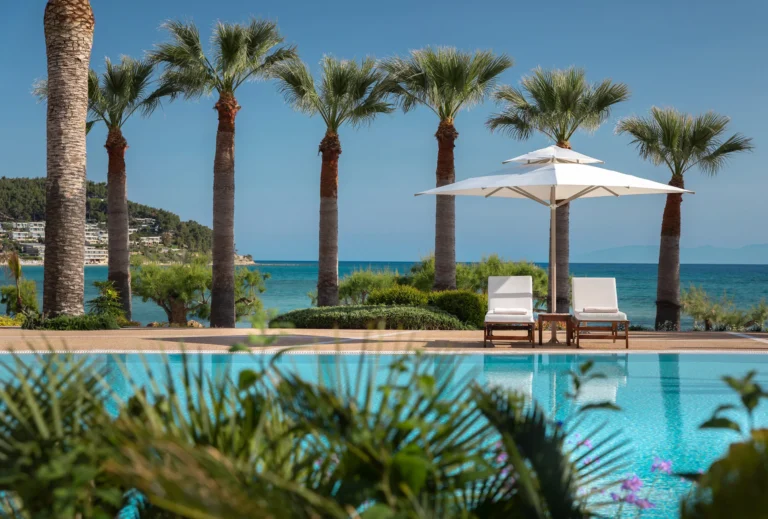
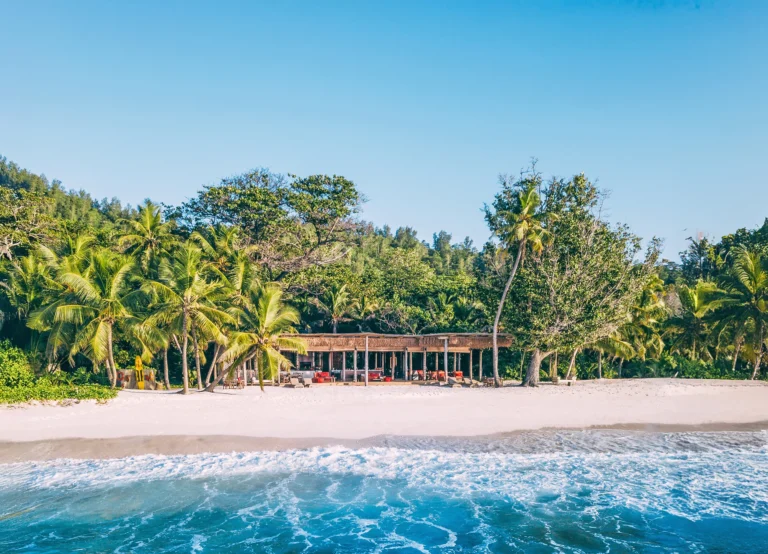
If you want a different style or price point, consider these FFH alternatives. One&Only Reethi Rah is another Maldives private-island all-villa resort (also price band 5). North Island, Seychelles is similarly a private-island barefoot-luxury villa resort (price band 5) but in the Seychelles. For a (generally) lower price tier in a classic beach-resort format, Sani Beach is price band 4 in Halkidiki, Greece.