CYBEX Pallas G3 i-Size
We clipped a wriggling two-year-old into this seat in under ten seconds, in the dark, in a hire-car park outside Bari, and that single move is the reason a family with a toddler and a long road trip ahead should look at it first.
Ten seconds in a dark hire-car park
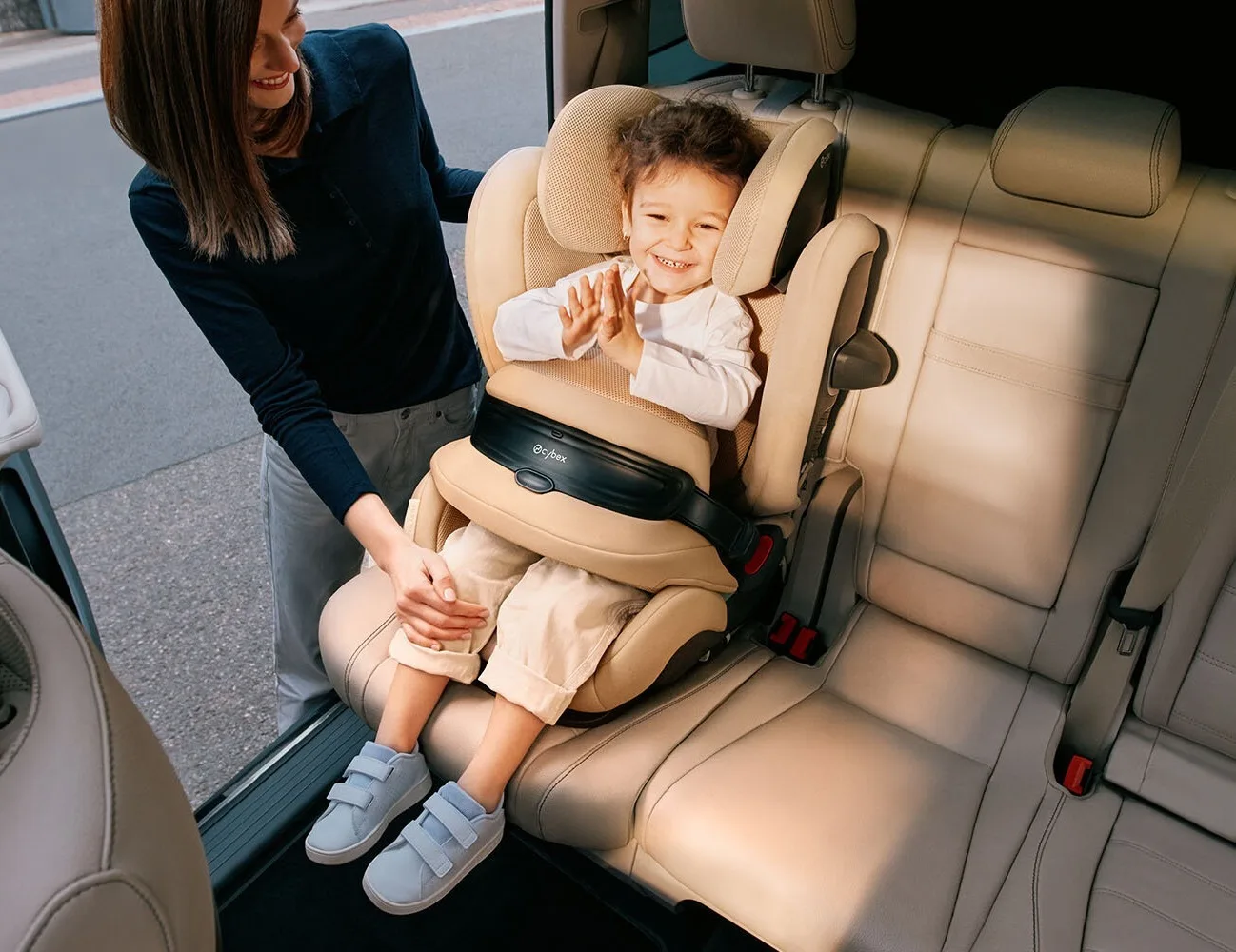
The previous seat in our rotation had a five-point harness, and our youngest had learned to thumb both shoulder straps down to his elbows somewhere around the second motorway toll. On the Pallas G3 there are no shoulder straps to escape from. A padded impact shield sits across the lap and tummy, the car’s own three-point belt runs through it, and it clicks into place with a lock indicator you can read in poor light. We did it one-handed with a bag of snacks in the other hand. No strap height to reset as he grew, no twisted webbing, no buckle digging into a thigh.
This is a forward-facing seat for children from 76 to 150 cm, roughly 15 months to 12 years, and it is built for the family’s main car or a long hire. It fixes with ISOFIX connectors plus a Top Tether strap that hooks behind the vehicle seat. The shield phase runs from 76 to 105 cm (and a maximum of 21 kg); from 100 cm the shield comes off and the seat becomes a high-back booster that positions the adult belt, all the way to 150 cm. One purchase and one learning curve cover more than ten years of school runs, ski drives and summer road trips.
The shield is not universally loved on day one. A toddler at the very bottom of the range may push it away for the first few drives, and some children simply prefer a harness. Ours protested for three journeys, then started using the shield as a tray for a picture book. Try it in a shop with your own child before you commit, ideally after lunch rather than before.
One seat from toddler years to secondary school
The real case for the Pallas G3 is arithmetic. At €218 on amazon.de on 14 November 2026 (the ADAC quotes around €260), spread across ten years of use, the seat costs roughly €22 a year. The usual alternative is two seats: a harnessed toddler seat at €200 to €300, then a booster at €150 to €250 when the child outgrows it. That second purchase also means a second install to learn and a second shell to store.
It also earns its place because of what it does on the side of the car you never think about until something goes wrong. The deep shell makes side collisions this seat’s strongest discipline. In the spring 2026 child seat test by ADAC, ÖAMTC and Stiftung Warentest it scored 2.5 overall (good), one of only six seats rated good out of 26, with 1.0 for harmful substances; the ÖAMTC’s published breakdown gives it 1.7 for side impact. The seat reclines with a one-hand lever and the headrest has a second, reclined position, which kept heads from lolling forward on our late transfers. It never goes flat.
If you are still at the infant stage, this is the seat after our CYBEX Cloud G3 i-Size review. The Cloud carries a baby rear-facing up to 87 cm, roughly the first two years; the Pallas picks up the moment your child is tall enough to face forward and you want one decision that lasts until secondary school.

Rental cars, ferries and the flight it cannot take
Rental cars first, because that is where the friction lives. ISOFIX is standard on every EU hire car we have picked up in the past few years, and the connectors slide on with green indicators that leave no room for doubt. The Top Tether is the problem child. It is mandatory in shield mode, and its anchor point moves from car to car: behind the rear seat in one, under the parcel shelf in another, on the boot floor in a third estate. Our first install in an unfamiliar Skoda took close to fifteen minutes with the boot open and a phone torch in our teeth. The second car, a hatchback we knew, took under two. Check the CYBEX vehicle compatibility list against the model you have booked, and ask the rental desk which car you will actually get.
Ferries and long drives suit it well. On a 600 km day from the Alps down to the Adriatic, with a ferry crossing at the end, the shield meant every stop, every toilet break and every fuel queue was a ten-second in-and-out rather than a strap wrestle. The cover comes off and goes into the washing machine at 30°C on a gentle cycle (no tumble dryer, no direct sun to dry it), which matters after the kind of incident that happens on mountain roads with a child who ate a cornetto twenty minutes earlier. The plastic shell underneath is wipe-clean only, so a pack of wet wipes in the door pocket handles the rest.
Now the flight. The Pallas G3 is not approved for use on aircraft, full stop. It cannot go in the cabin as a child seat, and at 8.9 kg with no carry handle it is not a gate-check companion either. We checked it in the hold, in a padded car-seat bag, on two trips; it counts against your checked-baggage allowance on most European carriers. For a fly-and-drive holiday where the rental company supplies seats, leave it at home and pick a booked rental seat instead. For a drive holiday, there is nothing we would rather have in the back.
In the hotel it lives in the car; at 8.9 kg it is not a seat anyone wants to carry up three floors and back every morning.
The numbers we checked before every trip
- Child height: 76 to 150 cm (roughly 15 months to 12 years), child weight 9 to 50 kg.
- Modes: impact shield for 76 to 105 cm (max 21 kg); adult three-point belt for 100 to 150 cm.
- Installation: ISOFIX plus Top Tether, forward-facing only. Tether mandatory with the shield.
- Seat weight: 8.9 kg.
- Footprint: 40.5 cm deep, 59.5 cm wide, 59 to 81 cm tall depending on headrest height.
- Approval: UN R129/04 (i-Size), valid across the EU.
- Headrest: two positions, upright and reclined for sleep.
- Cover: machine-washable at 30°C, gentle cycle, no tumble drying.
- Aircraft use: not approved.
- Warranty: 24 months statutory.
The Plus version shares the shell, the 8.9 kg and the approval. It swaps the standard fabric for a breathable mesh cover and adds CYBEX’s L.S.P. System Plus side-impact lining, which the brand says cuts side-impact forces by up to 20 percent; CYBEX lists it at €289.95. For summers in southern Europe, and for any child who runs hot, we would pay it. The standard padding is thin, and on drives longer than three hours our older child noticed.

Where it costs you: width, tether and a frontal score
Width comes first. At 59.5 cm across, this seat swallows the middle of the back bench. Three across is off the table in most family cars, and in a narrow hatchback the door side was a tight fit. The cost is concrete: either a bigger hire car (on a two-week Italian rental, that is easily €150 to €250 more), or a grandparent riding in a different car.
The tether is the second cost, paid in time. For a family that moves the seat between two cars every week, those minutes add up, and installation is the seat’s weakest sub-score in the ÖAMTC’s breakdown of the spring 2026 test (3.0). If you switch cars constantly, a seat that installs with ISOFIX alone will save you real irritation.
The third is the one we thought hardest about. Side protection is excellent, but frontal-impact performance sits mid-field: the ADAC rates the frontal injury risk as average, and the ÖAMTC gives it 3.1. That is still a pass in a demanding test, and the shield spreads frontal forces across a wide area of the child’s body instead of the neck. Parents who want the strongest frontal protection for a child under four will look at extended rear-facing seats instead, and that is a defensible choice that this seat does not try to make for you.
Smaller grumbles: the deep shell restricts the side view for a short child, the headrest adjuster is awkward to reach once installed, and the manual tucks itself into a cover pocket you will forget exists.

FFH Gear Score
- Functionality: 8.5 / 10.
- Quality & Durability: 8.3 / 10.
- Ease of Use: 8.0 / 10.
- Family Practicality: 7.5 / 10.
- Pricing: $$$ of $$$$$.
- FFH Gear Score: 8.1 / 10.
If we were buying tomorrow, staged by age
For a child between roughly two and four who escapes harnesses, rides in one main family car and does at least one long drive holiday a year, we would buy the Pallas G3 Plus without hesitation and keep it until the child is 150 cm tall. The shield alone repays the price on the first long day in the car.
For a child already past 105 cm, the shield’s best years are behind you, and a good high-back booster at half the price will do the remaining job almost as well. For a family that flies and rents more than it drives its own car, skip it: the 8.9 kg, the tether hunt and the lack of aircraft approval all point the other way. And if your toddler is still small, or you want to stay rear-facing past age four, stay with a rear-facing seat for now. If you are still choosing an infant seat for the first stage, our Maxi-Cosi Pebble 360 Pro2 review sits beside the Cloud G3 as the other option we have lived with.
Gallery
CYBEX Pallas G3 i-Size: questions families ask
Who is the CYBEX Pallas G3 i-Size best for?
It suits families with a child of roughly two to four who escapes harnesses, one main car and regular long drive holidays. The impact shield makes every stop a ten-second in-and-out, and the seat then converts to a high-back booster that lasts until 150 cm. Families who mostly fly and rent cars will find the 8.9 kg weight and Top Tether install a poor fit.
What ages, heights and weights does the Pallas G3 i-Size fit?
It is approved for children from 76 to 150 cm, roughly 15 months to 12 years, and 9 to 50 kg. The impact shield is used from 76 to 105 cm (maximum 21 kg); from 100 cm the shield comes off and the car's three-point belt restrains the child directly. It is forward-facing only and has no rear-facing mode.
How heavy and how big is the seat?
The seat weighs 8.9 kg and measures 40.5 cm deep and 59.5 cm wide, with a height of 59 to 81 cm depending on headrest position. The width matters most: three seats across the back is not realistic in most family cars, and in narrow cars the door-side protector may need to be retracted to close the door.
Can we take the Pallas G3 on a plane?
Not as an aircraft seat: it is not approved for use on board. It can travel as checked baggage, ideally in a padded car-seat bag, and on most European carriers it counts against your hold allowance. At 8.9 kg with no carry handle it is not a practical gate-check item. For fly-and-drive trips, booking a rental seat is the easier option.
Does it fit rental cars, and how hard is the installation?
It needs ISOFIX plus a Top Tether anchor, both standard on modern EU cars. The ISOFIX arms click on with green indicators in seconds. The tether is the slow part, because the anchor sits in a different place in each car; allow ten to fifteen minutes the first time. Check the CYBEX vehicle compatibility list against the car model you have booked.
How easy is it to clean after a long drive?
The fabric cover comes off and is machine-washable at 30°C on a gentle cycle; do not tumble dry it or dry it in direct sun. The plastic shell and frame are wipe-clean only and must not be taken apart or washed. On a multi-day road trip, plan for one overnight air-dry if the cover needs a wash.
Which safety standard does it meet?
The Pallas G3 i-Size is approved to UN R129/04 (i-Size) and is legal across the EU. In the spring 2026 child seat test by ADAC, ÖAMTC and Stiftung Warentest it scored 2.5 (good) overall, 1.7 for side impact and 3.1 for frontal impact in the ÖAMTC's breakdown, with very low harmful-substance results; it was one of six seats out of 26 rated good.
Is the Plus version worth the extra money?
For warm climates and long drives, yes. The Plus shares the shell, weight and approval, but adds a breathable mesh cover and an extra side-impact lining (CYBEX lists the Plus at €289.95). The standard padding is thin on drives over three hours, so the Plus is the version we would buy.
What are the main drawbacks?
The 59.5 cm width rules out three across in most cars, the Top Tether makes frequent car swaps slow, frontal-impact performance is mid-field rather than class-leading, and some toddlers reject the shield for the first few drives. It is also forward-facing only, so it does not suit parents who want to stay rear-facing past age four.
Should we start with the Cloud G3 or the Pebble 360 Pro2 before the Pallas G3?
Both are infant seats for the first stage, so either leads naturally into the Pallas G3 once your child faces forward. Our CYBEX Cloud G3 i-Size review covers the seat from the same CYBEX family, and our Maxi-Cosi Pebble 360 Pro2 review covers the rotating alternative. Choose the infant seat on your car and pushchair, then move up to the Pallas.