Nanit Pro Smart Baby Monitor, Nanit (Pro Camera)
Nanit Pro Smart Baby Monitor – Nanit
For the family that travels to villas and long-stay rentals with proper Wi-Fi, and wants the same overhead, breathing-aware nursery view on the road that they trust at home — not the grab-and-go monitor you stuff in a nappy bag for one night in an airport hotel.
Overview
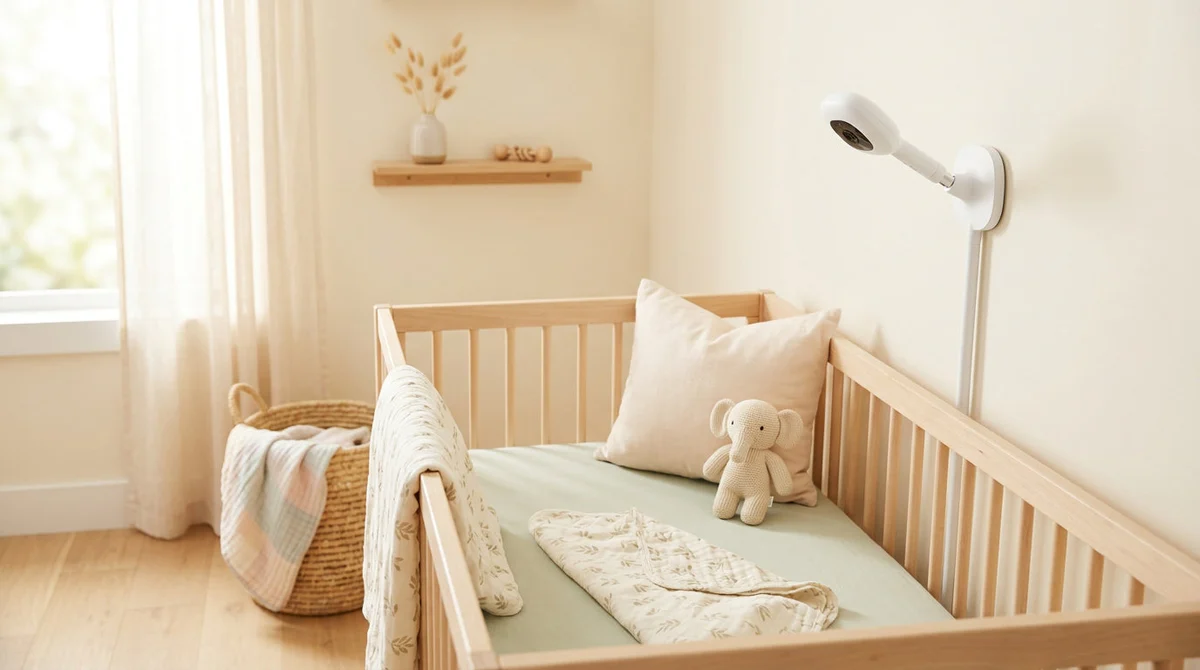
There is a specific kind of 3am that only happens away from home. You are in an unfamiliar room, the baby is in a cot you have never seen before, and the dark is the wrong shape. You lie there doing the thing every parent does on holiday — straining to hear breathing over the hum of a strange air-conditioning unit. The Nanit Pro is built, more than almost anything we have tested, for exactly that 3am. It is a 1080p Wi-Fi camera that mounts above the cot rather than beside it, giving you a clean, almost clinical overhead view, and pairs with a fabric Breathing Band that reads the rise and fall of your baby’s chest by computer vision — no sensor, no clip, just the camera watching a printed pattern on the wearable.
We clamped the floor stand beside a hotel cot in Mallorca, set it up again in a Tuscan villa, and lived with it for weeks at home in between. The headline is easy: when the Wi-Fi is good, this is the best baby view we have used, full stop. The overhead angle, the night vision, the sharpness, the two-way audio that re-settled a grizzling six-month-old from the next room — all excellent. The practical complications take longer to explain, and they matter enormously for travel, so we will not bury them. There is a subscription. There is a hard dependence on Wi-Fi. And there is one piece of safety honesty we will state plainly and early: the breathing-motion feature is a wellness feature for parental peace of mind. It is explicitly not a medical device and not an apnea or SIDS monitor. Treat it as reassurance, never as a clinical alarm.
Why It’s Great for Family Travel
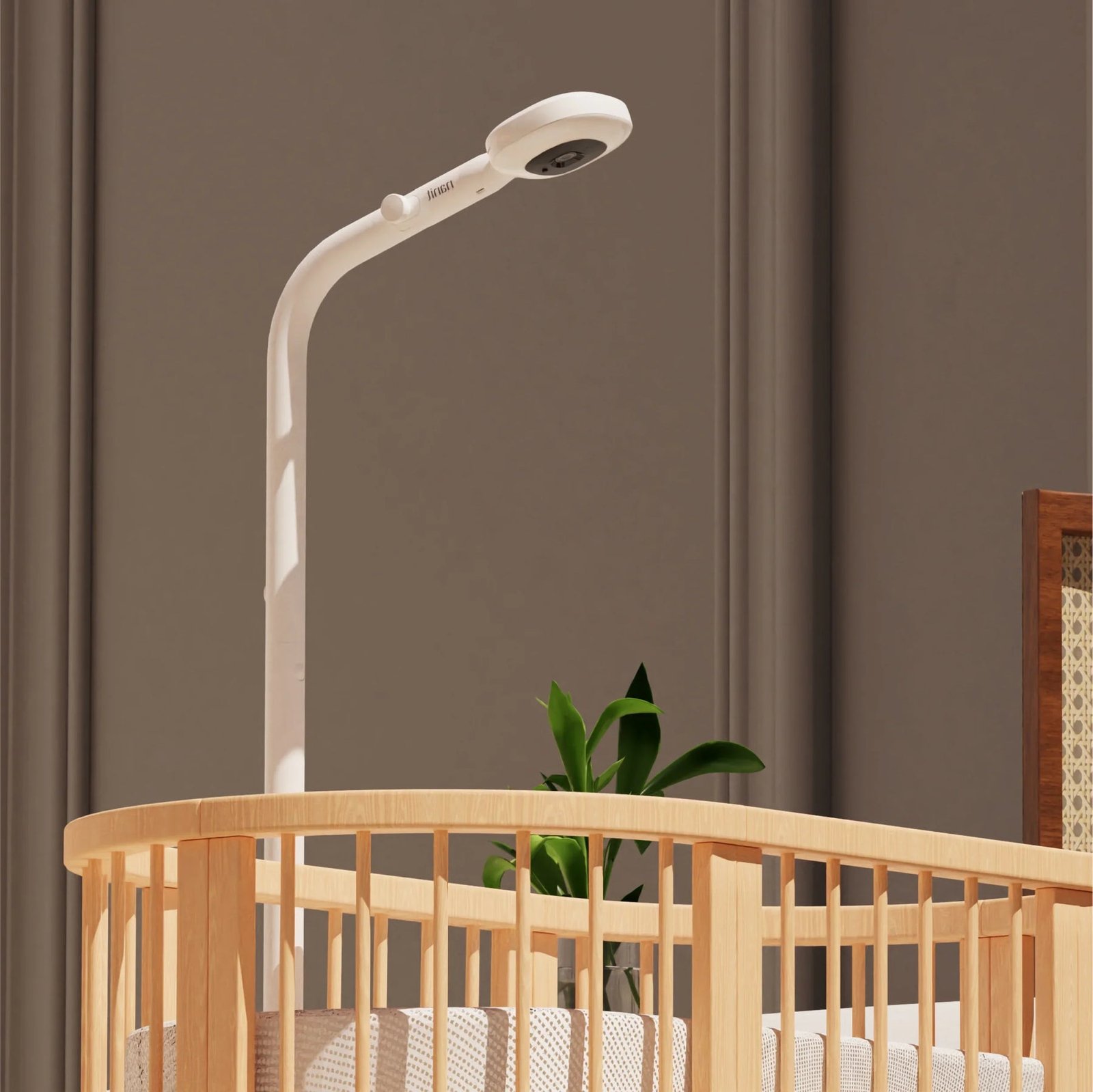
The thing that wins you over is the overhead view. Most monitors give you a low, angled shot from the cot rail, the baby foreshortened and half in shadow. Nanit looks straight down, and the difference is hard to overstate at night — you see the whole cot, both hands, whether the swaddle has worked loose, whether the dummy is anywhere reachable. In a dim villa bedroom with the shutters closed, the infrared night vision stayed crisp and even, with none of that blown-out glare around the cot edges you get from cheaper cameras. The image is sharp enough that you can tell a stir from a proper wake-up without getting out of bed, which on holiday — when bedtimes are late and adults are tired — is worth more than any spec sheet suggests.
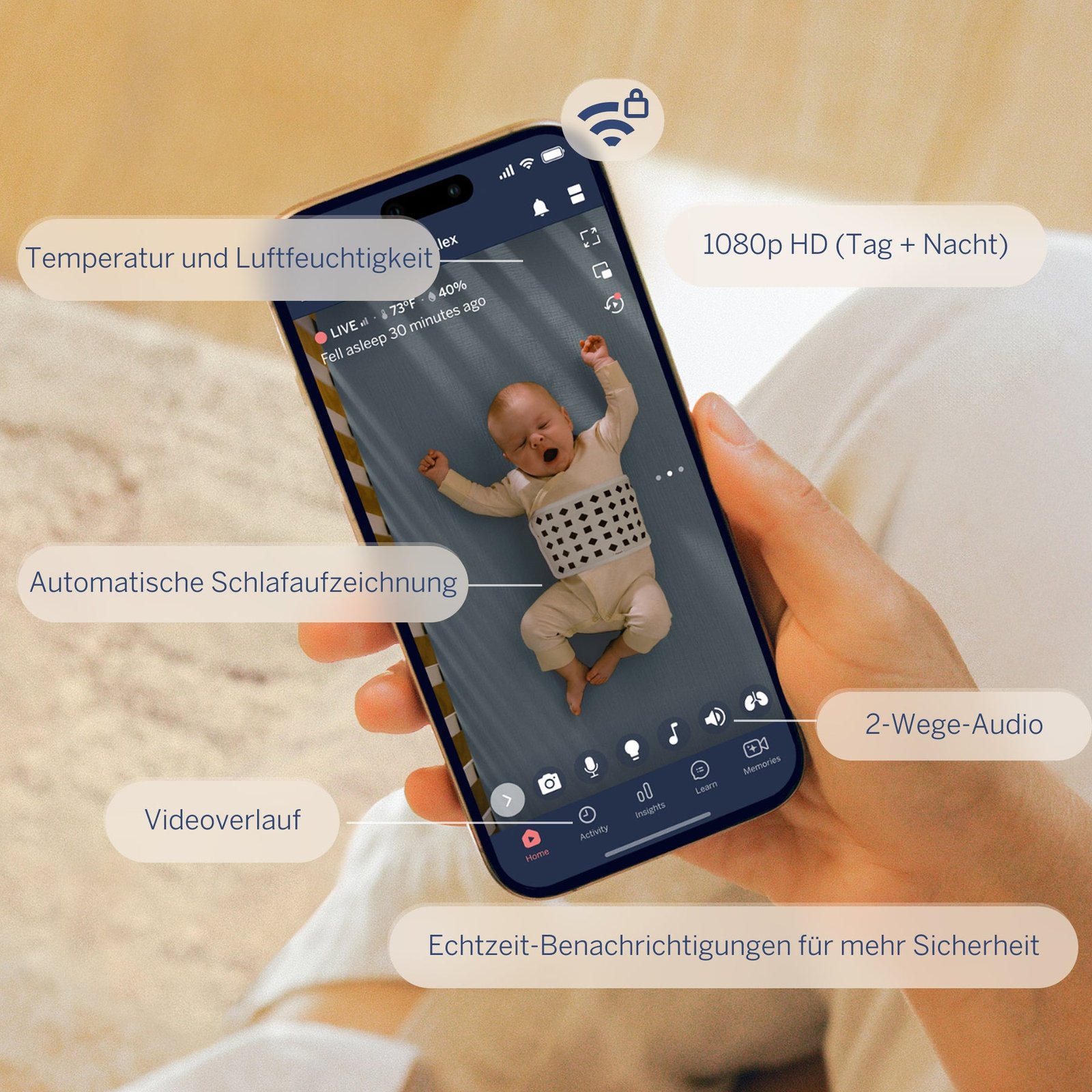
Then there is checking in from anywhere. Because the feed runs over Wi-Fi to the app, we could watch the cot from the villa terrace over dinner, from the pool, from a restaurant two streets away while a sitter stayed with the baby. The latency is genuinely tiny — barely a second — and the two-way audio is sharp enough that a few murmured words through the phone settled our youngest more than once without anyone going in. For a long-stay rental or a villa with strong private Wi-Fi, this turns the whole property into one big, monitored nursery. You also get cot-side temperature and humidity readings, which sound like a gimmick until you are in a hot Mediterranean bedroom wondering whether to crack the window.
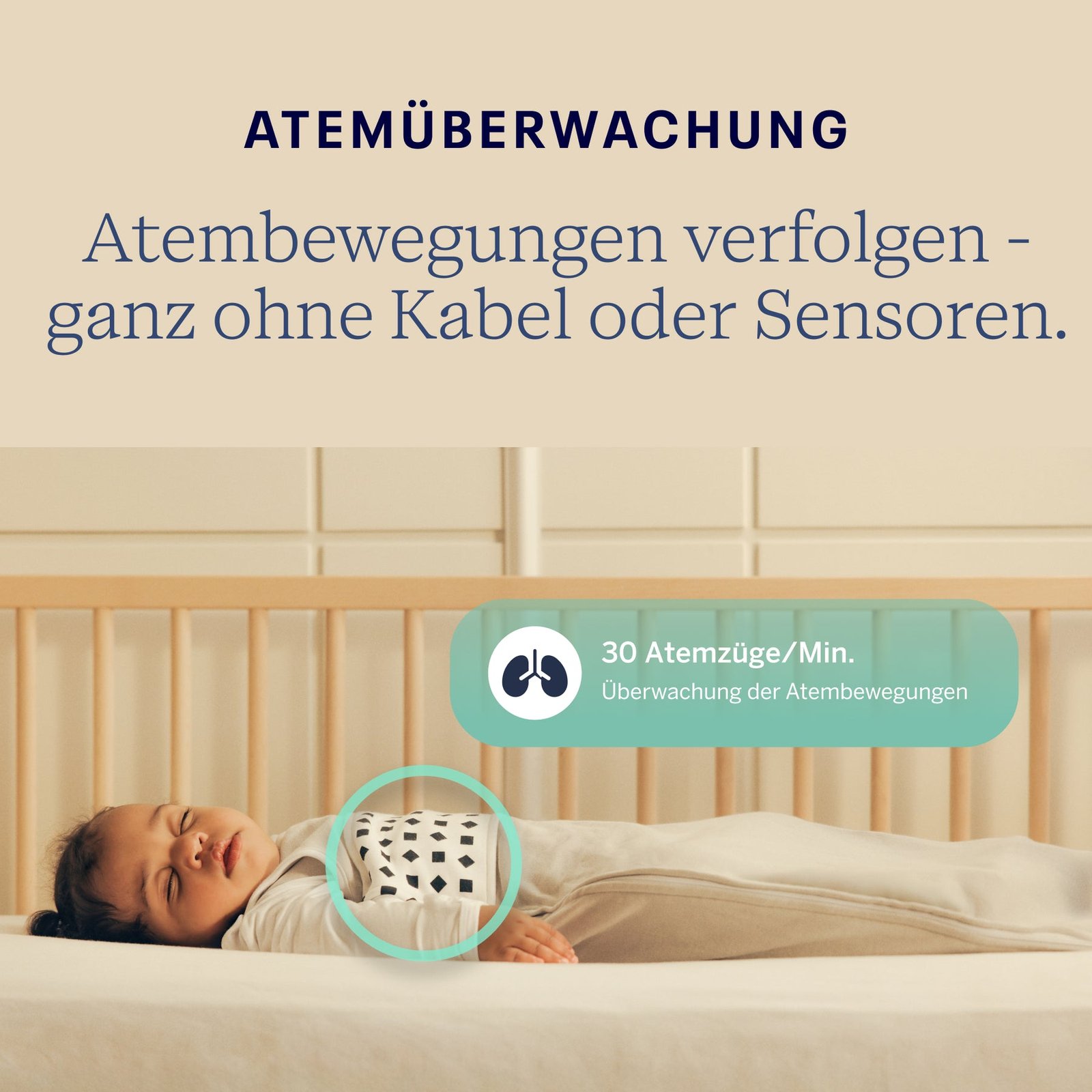
The Breathing Band deserves its own paragraph, because it is the reason most families buy a Nanit and the reason we have to be careful. Worn snugly over thin sleepwear, the band lets the camera count breaths by watching a woven pattern expand and contract — no wires, nothing on the skin. When it works, the effect is profoundly calming: a small, steady breaths-per-minute number glowing on your phone in a strange room. We never had a false alarm in weeks of use, and a German midwife panel that tested it found the breathing-rate count strikingly accurate. But two caveats are non-negotiable. First, it cannot be used over a swaddle, which means it is effectively useless in the very first weeks — precisely when many anxious parents most want it. Second, and we will say it again because it is that important: this is reassurance, not medicine. It will not reliably alert you to a medical emergency, and no parent should let it replace safe-sleep practice or a doctor’s advice.
Real-World Use (Airport / Car / Hotel)
Airport: In practice, this is not an airport device, and pretending otherwise would be a disservice. The camera is mains-powered — there is no battery — so it does nothing while you are in transit. It is tiny, about 109 grams, but the floor stand is bulky, and you are not whipping this out at a departure gate. If your need is properly mobile, a self-contained battery monitor is the right tool; the Nanit is luggage you set up at the destination.
Car: Same story. With no battery and a hard dependence on a network and the app, it is not an in-transit monitor in any meaningful sense — this is a device for a room with power and good Wi-Fi, not for the road.
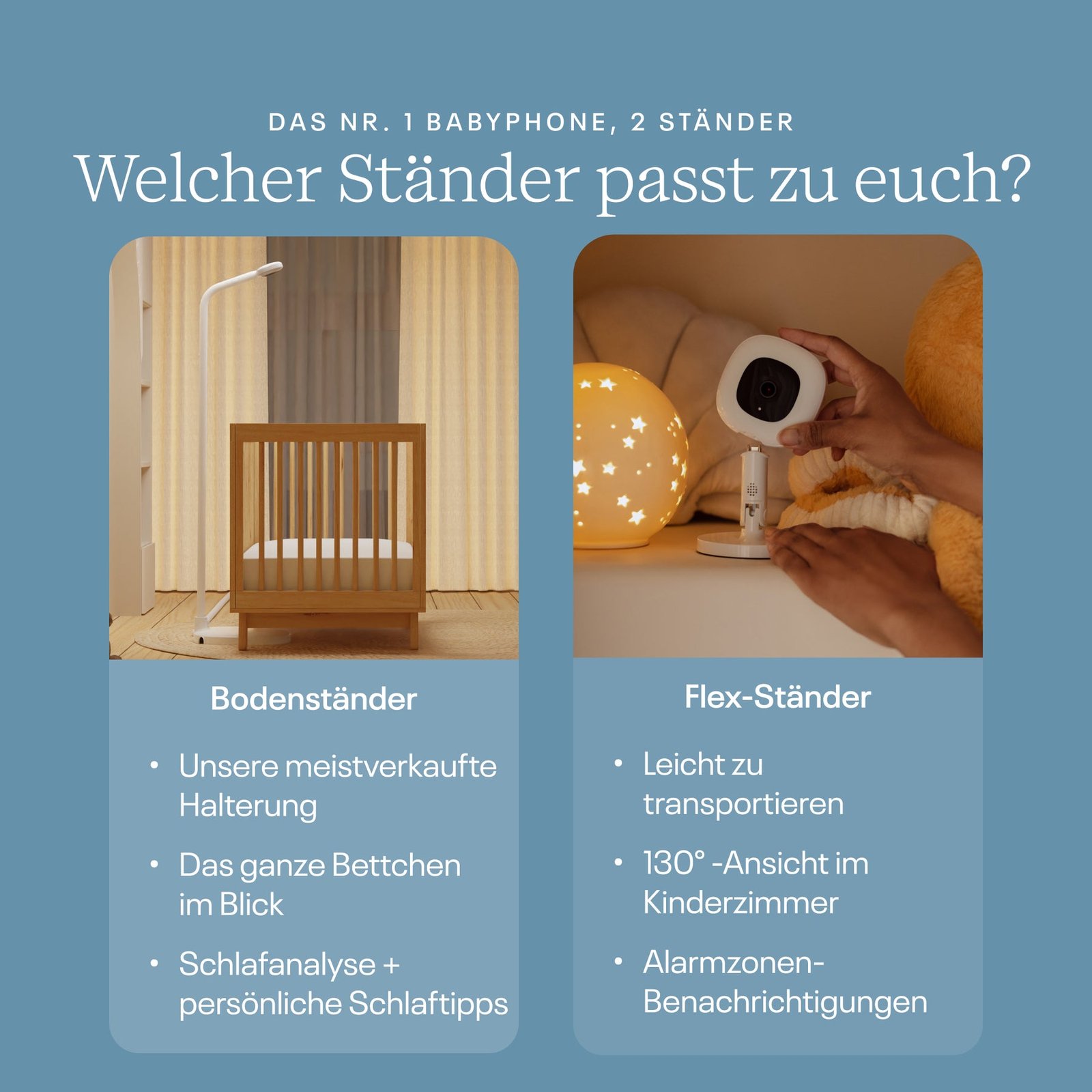
Hotel: Here is where it gets nuanced, and where the FFH lens really bites. In a good villa or a long-stay apartment with your own robust router, the Nanit is sublime — the floor stand assembles in under five minutes, clamps neatly beside the cot, the ASTM-certified cord cover keeps the long mains cable away from curious hands, and within minutes you have your home nursery view in a foreign country. In a typical hotel, it is a gamble. Many hotel networks use a captive portal — that browser sign-in page — and the Nanit camera simply cannot authenticate through it. We have sat in a perfectly nice hotel room watching the app spin and fail to connect, and we are not alone: real owners report exactly this with big chains, forcing them back to a basic non-Wi-Fi monitor for the night. There is a travel mode, but it limits features and the data you collect. The blunt verdict: superb for villas and long stays with strong private Wi-Fi; unreliable for hotels with captive portals or weak signal, where a self-contained monitor is the safer call.
Specs That Actually Matter
- Camera weight: approx. 109 g (~0.24 lb) — tiny; the floor stand is the bulk of the package.
- Camera dimensions: approx. 8.1 × 8.1 × 3.8 cm (3.2 × 3.2 × 1.5 in).
- Floor stand: maximum height 170 cm, base width 30 cm — positions the camera for the overhead cot view.
- Video: 1080p HD with infrared night vision; overhead (birds-eye) cot angle; two-way audio; sound and motion alerts; temperature and humidity sensing.
- Breathing tracking: sensor-free, via the included Breathing Band read by computer vision (band sized 0–3 months; larger Breathing Wear sold separately).
- Power: mains-powered (AC) via USB adapter and a long cord through the stand’s cord cover — no internal battery.
- Connectivity: requires a private, robust Wi-Fi network (supports 2.4GHz and 5GHz) plus the Nanit app.
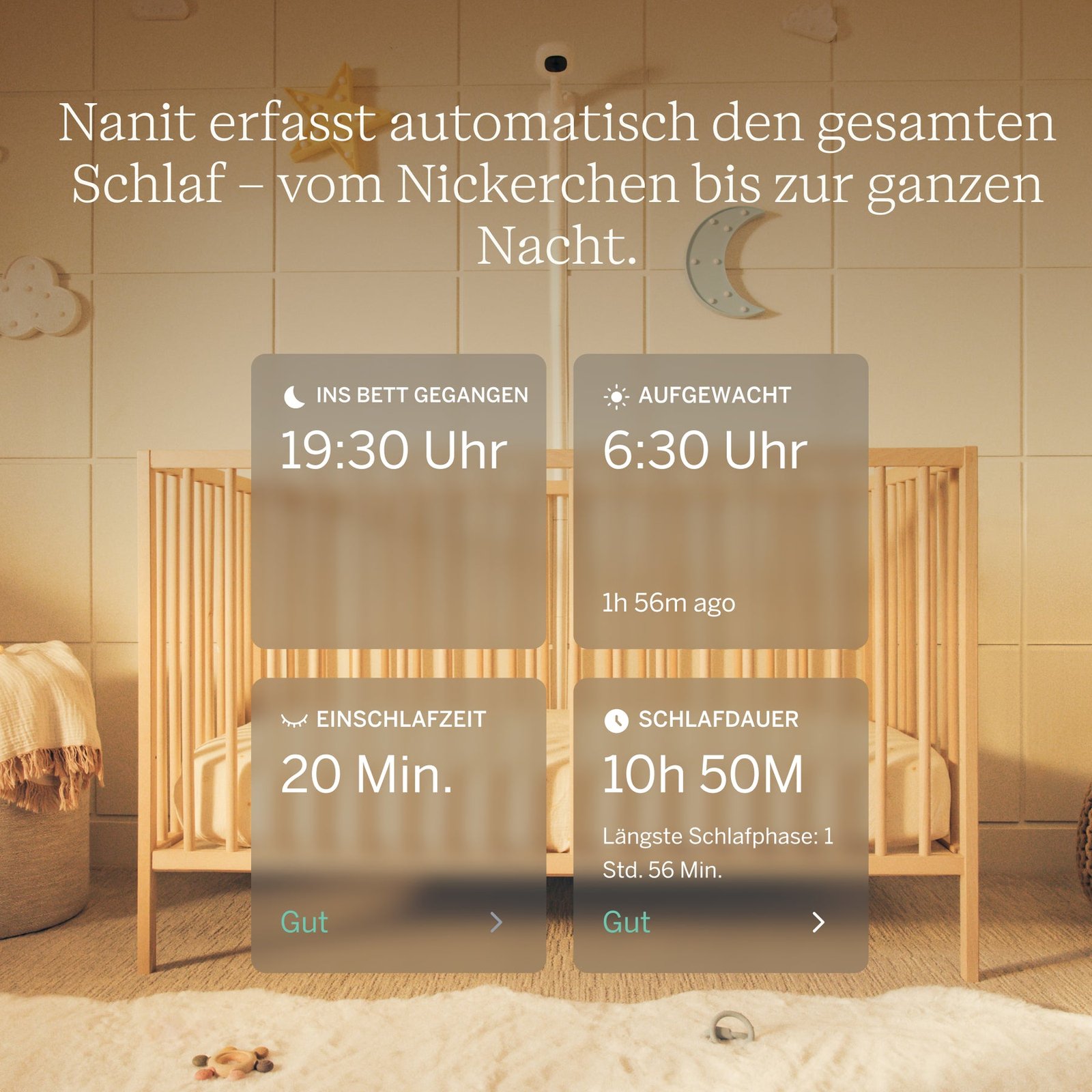
- Subscription: live view, two-way audio and sound/motion alerts work without a plan; full sleep and breathing Insights need a Nanit subscription (bundle includes a 6-month Sleep Plan trial).
- Safety / data: ASTM-certified cord cover; 256-bit AES encryption and two-factor authentication.
- Warranty: 24-month manufacturer warranty.
- Age suitability: newborn 0–3+; included Breathing Band fits 0–3 months.
Pros & Cons
Pros
- Best-in-class overhead 1080p view with genuinely excellent night vision.
- Breathing-motion tracking is accurate and deeply reassuring (within its limits).
- Check in on the cot from anywhere with strong Wi-Fi; near-zero latency.
- Sharp two-way audio that can re-settle a baby without going in.
- Floor stand sets up in under five minutes; ASTM-certified cord cover; solid encryption and 2FA.
- Cot-side temperature and humidity readings, useful in unfamiliar rooms.
Cons
- The headline sleep and breathing Insights sit behind a subscription that lapses after the trial — the single most common owner complaint.
- Wholly Wi-Fi dependent, with no battery and no backup: it fails on captive-portal hotel networks and during outages.
- Not a grab-and-go travel monitor — mains-powered, app-dependent, and bulky once you count the stand.
- The Breathing Band cannot be used over a swaddle, so it is effectively unusable in the first weeks.
- Premium price plus accessories and ongoing subscription make total cost of ownership steep.
- Camera can need re-pairing after a router restart.
FFH Gear Score
One honest note before the numbers. We keep coming back to the same tension with the Nanit Pro: the hardware and the view are close to the best we have used, and the value equation is the weakest part of the package. You are paying a premium price up front, and then the very features most people buy it for — the sleep and breathing Insights — lapse into a paid subscription after the trial year. None of that changes how good the camera is at 3am in a villa. It does change who should buy it. And to be unambiguous one final time: the breathing feature is wellness reassurance, not an apnea or SIDS monitor, and not a medical device.
- Functionality: 9.0 / 10
- Build Quality & Durability: 8.0 / 10
- Ease of Use: 7.5 / 10
- Family Practicality: 7.5 / 10
- Pricing: $$$$ of $$$$$
- FFH Gear Score: 8.0 / 10
Final Verdict
If your family travels the way the Nanit suits — villas, long-stay rentals, the kind of trip where you bring your own router or trust the property’s private Wi-Fi — this is the monitor we would pack, eyes open to its faults. The overhead view, the night vision and the breathing reassurance are worth real money to a parent who wants the home nursery to travel with them. But buy it for what it is. It is not a one-night-in-an-airport-hotel monitor; it will let you down on a captive-portal network exactly when you need it. It is not cheap, and the subscription will keep asking for more after the box is opened. And it is reassurance, not medicine — never a substitute for safe sleep or a doctor. For the FFH family settling into a beautiful rental for a fortnight with strong Wi-Fi and a baby in the next room, the Nanit Pro earns its place in the case. For everyone whose monitoring needs are genuinely mobile, a humbler, battery-powered, self-contained monitor will serve you better and cost you a great deal less.
Gallery
Nanit Pro Smart Baby Monitor: Family Questions Answered
What kind of family trip is the Nanit Pro actually best for?
It’s best for villas and long-stay rentals with strong private Wi‑Fi. The Pro Camera is designed to live in a room with mains power and a reliable network, where you can recreate an overhead nursery view. It’s much less reliable in typical hotels, especially where Wi‑Fi uses a captive portal sign-in that the camera can’t authenticate through.
Will the Nanit Pro work on hotel Wi‑Fi?
Not always—hotel Wi‑Fi is a known weak spot. Many hotels use captive portals (a browser sign-in page), and the Nanit camera may fail to connect on those networks. In private rentals with your own robust router it’s described as “sublime,” but for hotels with weak signal or captive portals a self-contained, non‑Wi‑Fi monitor is the safer backup.
Does the Nanit Pro have a battery for travel and outages?
No—it's mains-powered and has no internal battery. The camera needs AC power via a USB adapter and relies on Wi‑Fi plus the Nanit app, so it won’t function in transit and can fail during outages. If you need a truly mobile monitor for airports, cars, or one-night stops, this isn’t designed for that use case.
How does the Nanit Breathing Band work—and is it medical?
It tracks breathing motion via computer vision, and it’s explicitly not a medical device. The camera watches a printed pattern on the fabric band and counts breaths from the rise and fall of the chest—no sensor or clip on the baby. Nanit frames this as a wellness feature for peace of mind, not an apnea/SIDS monitor, and it should never replace safe-sleep practice or medical advice.
Can you use the Nanit Breathing Band with a swaddle?
No—the Breathing Band can’t be used over a swaddle. That limitation matters because it can make breathing-motion tracking effectively unusable in the very first weeks, when many families still swaddle. The included band is sized for 0–3 months; larger Breathing Wear is sold separately for older babies.
What do you get without a subscription, and what’s paywalled?
Live view works without a plan, but the full sleep and breathing Insights require a paid subscription. The product states that live view, two-way audio, and sound/motion alerts work without a subscription. The “headline” Insights features sit behind a plan after the included 6‑month Sleep Plan trial, which the article flags as the most common owner complaint.
How big and packable is the Nanit Pro for flights?
The camera itself is tiny (about 109 g), but the floor stand is the bulky part. The camera is approximately 8.1 × 8.1 × 3.8 cm and about 109 g. The floor stand reaches up to 170 cm high with a 30 cm base width, which makes the overall travel kit more “luggage you set up at the destination” than a grab-and-go monitor.
What safety and privacy protections are stated for the Nanit Pro?
It states an ASTM-certified cord cover plus 256-bit AES encryption and two-factor authentication. The long mains cable routes through the stand’s cord cover, described as ASTM-certified. On the data side, the product info lists 256‑bit AES encryption and 2FA. If you have specific network-security requirements for travel, confirm your setup and Wi‑Fi environment before relying on it.
What are better FFH alternatives if you don’t want a Wi‑Fi-dependent baby monitor?
If your priority is “works anywhere,” consider travel gear that doesn’t depend on hotel Wi‑Fi. The Nanit Pro’s core drawback is its hard reliance on strong Wi‑Fi and mains power. For mobility, products like the Stokke YOYO3 (Pricing Tier 4) or OXO Tot 2-in-1 Go Travel Potty (Pricing Tier 2) solve different travel problems without any network setup—useful if hotel connectivity is your recurring pain point.