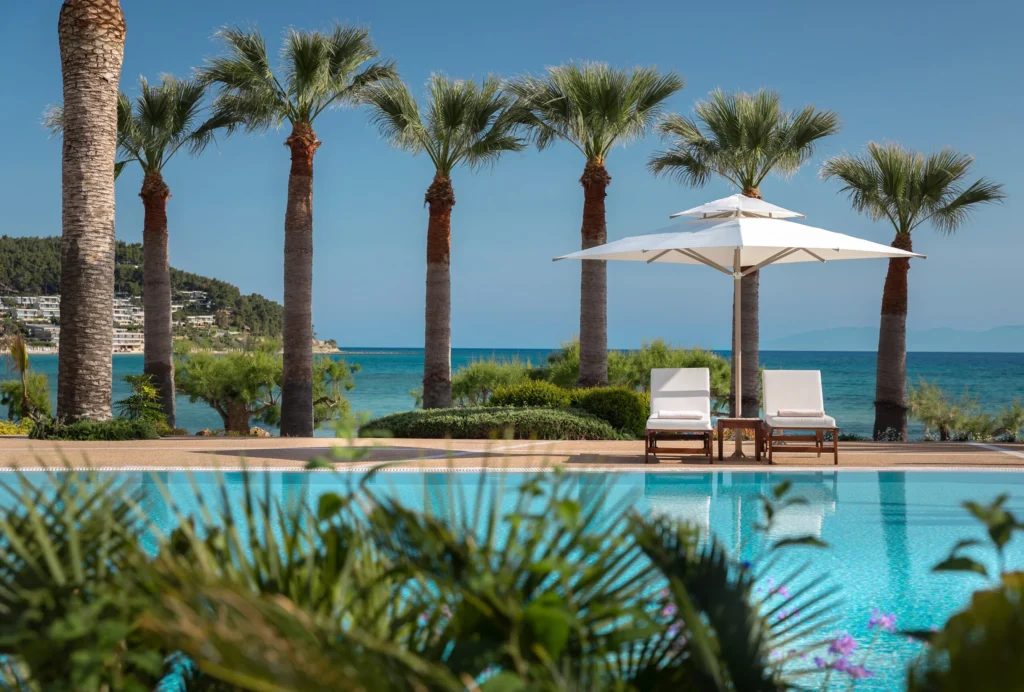
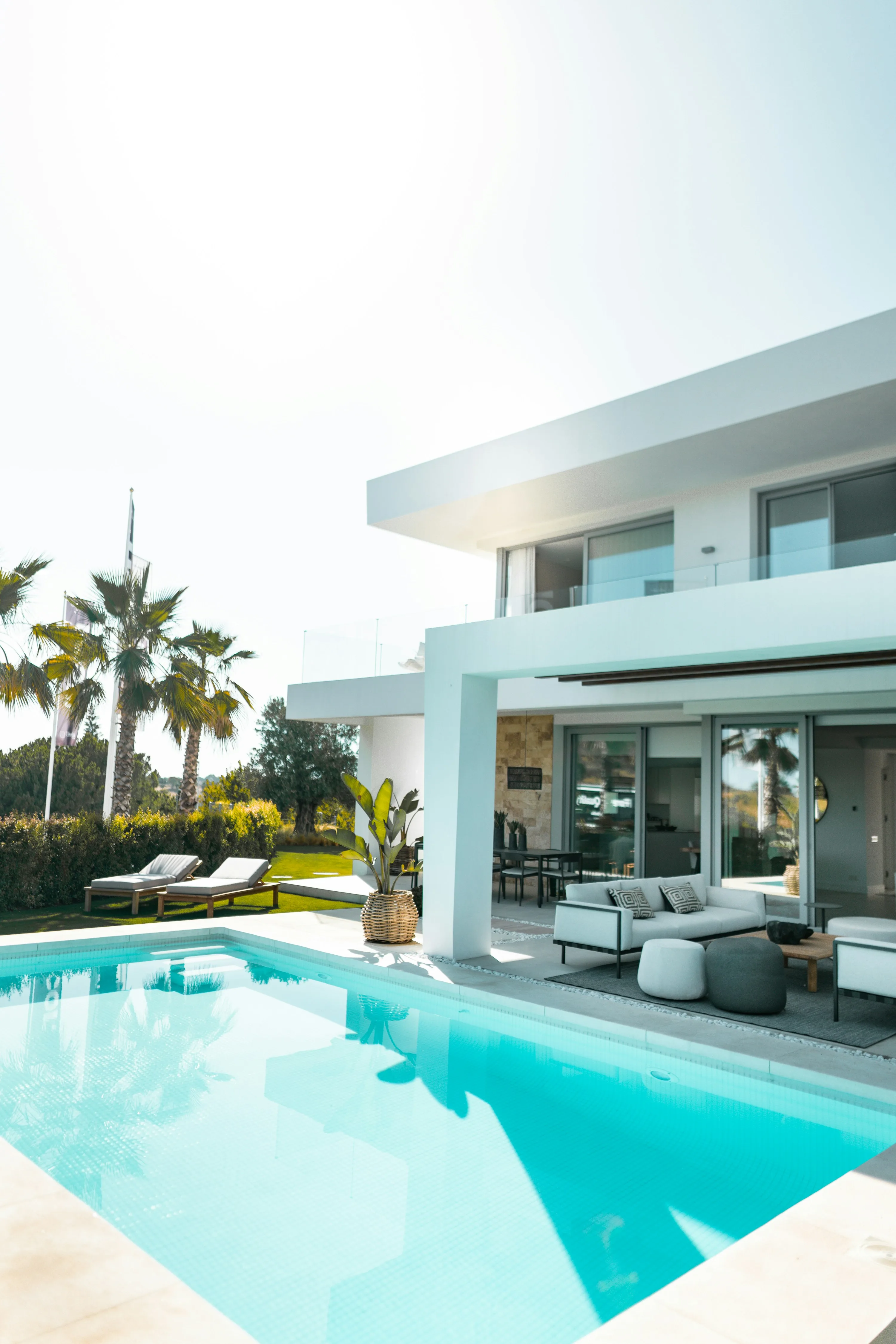
Which one actually wins when you run the real numbers: the staffed villa with its own chef and nanny, or the all-inclusive resort with its kids' club? The answer is not the same for a two-year-old as it is for a fifteen-year-old, and most families book the wrong one.
The quick version
- The villa math only beats the resort once your group clears six people. Below that, the per-person cost of a staffed villa is usually higher than an all-inclusive suite, not lower.
- The “villa is 30–60% cheaper” line is true for Bali at six-plus guests, conditional in the Caribbean, and close to false in Tuscany or Mykonos once chef labour, provisioning, service charges and gratuities are added.
- Budget 35–40% on top of any advertised villa nightly rate. A headline of $9,000 a night for a week becomes roughly $85,000–$88,000 all-in once taxes, cleaning, food deposit and staff tips land.
- For under-5s and large multi-generational groups, the villa wins decisively: a gated private pool, delivered baby gear, and a chef who cooks around nap times beat any shared resort pool.
- For 9–17s, the resort wins just as decisively. A teen club full of same-age peers is an ecosystem a private villa cannot manufacture, however many staff it has.
- The clean dividing line: villa if your youngest sets the agenda, resort if your oldest does. Mixed-age families should look hard at the villa-within-a-resort hybrid and accept it costs more than either.
Where the line actually falls

We will save you the suspense. The staffed villa versus resort argument is not really a cost argument at all, even though that is how it is always sold. It is an age argument wearing a spreadsheet. The villa-with-nanny model is superb for children who cannot yet read a menu and awful for children who would rather die than eat dinner with their parents, and almost everything else in the decision follows from that one fact.
The cost math matters, and we will do it properly below, because it decides whether you can. But the age math decides whether you should, and it is the one families get wrong. A couple with a toddler and a baby books a sprawling resort and spends the week ferrying a pram past a kids' club their children are too young to use. A couple with two teenagers books a beautiful staffed villa on a hillside and watches their fifteen-year-old spend seven days on a phone, marooned from anyone their own age. Both parties paid a fortune to be in the wrong place.
The cost math, line by line

Start with the resort, because it is the number people quote against. A five-star all-inclusive at the Caribbean tier runs roughly $300 to $400 per person per night. That figure already contains the things that quietly bleed a villa budget: meals, most drinks, kids' club access, non-motorised watersports, and usually airport transfers. It is not a perfect number. Premium restaurants, specialty spirits, motorised watersports and spa treatments sit outside it, and a tourism tax of five to twelve percent lands on top. But it is close to what you will actually pay, which is more than can be said for a villa headline.
Now the villa. A property listed at $2,000 a night sounds like a bargain split eight ways: $250 per person, below the resort rate. Split it twelve ways and it drops to $167. This is the whole case for the villa, and it is real, but only at scale. The per-person advantage exists once your group passes six, widens as you fill more beds, and quietly reverses when a family of four rattles around a house built for twelve.
The headline rate is where the honesty gap opens. Advertised villa prices systematically understate the true cost, and the additions are not small. Reckon on 35 to 40 percent above the quoted rate before you have eaten a thing. A worked example makes it concrete. A Turks and Caicos estate at $9,000 a night for seven nights advertises at $63,000. Add a ten percent service charge ($6,300), a twelve percent tourism tax ($7,560), cleaning (around $1,500), a food deposit ($3,000 to $5,000) and staff gratuities (roughly $4,400), and you land between $85,000 and $88,000. The number you booked against was off by more than twenty thousand dollars.
The single biggest line that catches people is food. In a resort it is bundled. In a villa the chef's labour and the groceries are usually separate, and Caribbean groceries land 30 to 60 percent above US mainland prices. A private chef, the most-requested villa amenity by a wide margin in 2026, costs $200 to $400 per person per day for full service, and expects a gratuity of around twenty percent of that in cash at the end of the stay.
So the “cheaper” claim needs sorting by destination. In Bali, a fully staffed three-bedroom villa genuinely saves a group of six between 50 and 80 percent against three comparable five-star suites; the labour is inexpensive and the bundle is generous. In the Caribbean the saving is real but thinner once the fee stack is added. In Tuscany and Mykonos, where chef labour and provisioning are billed on top of already high rates, the villa is rarely cheaper than a good resort suite once everything is counted. What it buys you there is space and privacy rather than any saving on the bill.
What “fully staffed” really buys

The phrase does a lot of unearned work in villa listings. “Fully staffed” is a spectrum, not a package. At the entry end it means a chef who does breakfast, a daily housekeeper and a house manager. At the top end, on the great European estates, it means a team of eight or more: butlers, drivers, in-villa spa therapists, gardeners, event staff, and childcare arranged on request. The word tells you almost nothing until you have the written list.
Three things separate the villa's service from a resort's, and they are the reasons to pay for it. The first is a chef who cooks your family's rhythm: an early toddler supper at half past five, an adult dinner at nine, a fridge that is never empty of the one yoghurt your four-year-old will accept. No resort restaurant, however good, bends to a single household like that. The second is total command of the environment: which staff are in the house and when, whether the pool gate locks, how loud the evening gets. The third is space, and it is not marginal. A resort suite gives roughly 75 square feet per person once eight people share adjoining rooms. A 3,000-to-5,000-square-foot villa gives 375 to 625. That is four times the room to spread out, and with a large multi-generational group it is the difference between a holiday and a house-share.
One caution worth putting in writing before you book: nannies are almost never a standard inclusion. Operators will arrange one, but it is a separate arrangement at a separate price, quoted on request, and it needs setting up well in advance. If the childcare is the reason you are choosing the villa, confirm it in a contract, not a brochure.
Under-5s: the villa wins, and it is not close

For the youngest children the private villa is the better instrument, and the reason is control. A toddler can drown in two inches of water, silently, in the time it takes to answer the door. A private pool with a gate you control removes the single largest holiday risk for this age in a way a shared, open, lifeguarded resort pool never can. The good family-villa operators know this: they filter for gated pools, deliver cots and highchairs and baby gear before you arrive, and keep a nanny on call.
The rest of the under-5 case follows from the same logic. Children this age run on naps and routine, and a house that answers only to your family protects both. The chef works around the nap, not the buffet's opening hours. Bedtime happens in the next room, not a fifteen-minute buggy-push from the restaurant. Nobody this small needs a peer group they will not remember; they need their parents rested and nearby, which a staffed house delivers better than a resort ever will. This is also where the multi-generational math lands perfectly: grandparents, parents and small children under one roof, one big table, split across enough beds to make the per-person cost sing.
Resorts have noticed the gap and are trying to close it. The best now run dedicated crèches for the very young: Sani Beach in Greece staffs a Little Explorers crèche for four months to four years, three sessions a day, seven days a week, which is exactly the provision a villa has to buy in privately. If you want the youngest cared for and the resort ecosystem, a property like that is the answer. But for pure command of a toddler's day, the villa is still the sharper tool.
9–17s: the resort wins, and the villa cannot fix it

Now flip the age and the whole argument inverts. The thing a nine-to-seventeen-year-old needs on holiday is other nine-to-seventeen-year-olds, and that is the one thing a private villa structurally cannot provide. You can staff a house with a chef, a butler and a driver and it will still contain exactly the same people it contained at home. For a teenager, that is not a treat; it is a week of enforced family time with better views than the one they get at home.
The resort's advantage here is not a facility, it is a society. A teen club is an ecosystem: same-age peers arriving daily, a space that is theirs and not their parents', activities built around them, and the low-stakes social friction where holiday friendships actually form. Sani's Ozone Teen Club for 12-to-17s sits at the marina with themed evenings, console tournaments and a snack bar, wrapped around programming that reads like a teenager's wish list: a Bear Grylls survival academy, a Rafa Nadal tennis centre and a Chelsea FC football academy. In the Maldives, Soneva Fushi's Den runs for 4-to-12s and 13-to-17s, and its Academy for over-12s teaches stargazing, marine biology and plastic-pollution research. None of that is replicable by a family alone, however well the villa is staffed.
The commercial signals are loud, and they tell you where the industry thinks the leverage sits. Resorts are now competing hard for the teen demographic because teenagers move the family booking decision. Club Med runs a dedicated Chill Pass club for 14-to-17s with its own pool parties and social spaces. That is not sentiment; it is resorts recognising that the family who books for the teenager will book the whole family. A villa has nothing to answer with. Its greatest strengths, privacy and control, are precisely what a teenager is trying to escape.
The tell is easy to read before you book. Teenagers who prize independence and their own space will tolerate, even enjoy, a villa if it sits somewhere with a town and a beach they can reach on their own. Teenagers who are social animals will wilt in one. If your fifteen-year-old's idea of a good holiday involves meeting people, the resort is not the safer choice, it is the only one that works.
The Maldives exception
One destination breaks the whole framework, and it is worth knowing before you try to apply the villa logic there. The Maldives has almost no standalone villa rental market worth navigating. The “villas” you see are room categories inside resorts, not independent houses you rent from an owner. The only true private alternative is buying out an entire private island, which is a different order of expenditure altogether.
This matters because it removes the villa's two advantages at a stroke. Choosing an overwater villa here does not give you independence or a cost saving; it simply removes your children from the kids' club and adds a tax layer of over 23 percent, plus seaplane transfers of $350 to $600 a person, to the bill. The honest advice in the Maldives runs opposite to everywhere else: put the money into a higher-tier resort with a strong kids' club and a real beach, rather than a water villa a small child may find frightening and a teenager will find isolating. Soneva Fushi, where children up to twelve typically stay and dine as part of the resort's family offer (conditions per villa category apply), is the model: the resort is the island, and the ecosystem is the point.
The hybrid, and why it costs more
There is a third option, and for a mixed-age family it is often the right one: the villa within a resort. Soneva Fushi offers private villas inside its footprint; Costa Navarino in Greece pairs private family villas with a full resort; Windjammer Landing in St Lucia does the same. You get the private house, the gated pool and the chef, plus a walk to the teen club and the kids' programme, which on paper is the answer to the entire dilemma.
It is also not cheap, and you should not expect it to be. The hybrid commands a premium over both a standalone villa and a standard resort room, because you are paying twice: once for the privacy infrastructure, once for access to the amenity ecosystem. That is the correct price for solving a real problem, and for a family spanning a toddler and a teenager it can be money well spent. Just do not book it expecting the villa's per-person savings. The savings were never the reason to choose it.
How to choose, and what we would book
Reduce it to two questions and the decision makes itself. First, who sets the agenda? If your youngest child does, book the villa: the gated pool, the chef around the nap, the space for the grandparents all point one way, and the per-person math rewards you for filling the beds. If your oldest child does, book the resort: the teen club is the product, and no amount of staff replaces a peer group. If the answer is genuinely both, look at the hybrid and price it in full.
Second, does the math survive contact with the fee stack? Take any villa headline and add a third before you compare it to a resort's all-inclusive rate. Confirm in writing which staff are resident, what the chef covers, whether groceries and nanny are extra, and what the service charge, tourism tax and expected gratuities come to. Do that and the villa either still wins on space and value or it quietly reveals itself as a resort suite with a bigger bill and a lonelier teenager.
If we were booking tomorrow, the calls would be quick. A family with two under-fives and visiting grandparents: a fully staffed Bali or Tuscany villa, six beds full, chef confirmed, pool gated. A family with two teenagers: a resort with a serious teen ecosystem, Sani or Soneva Fushi, no hesitation. A family straddling both: the hybrid, eyes open about the premium. For the wider Mediterranean picture, both the villa and the resort case play out across Greece, which is why we keep sending families there whichever way the age math falls.