Twenty-four million bags were mishandled in 2025. That figure is small beside five billion passenger journeys, yet large enough to make one point: a family should never put every important thing on the same conveyor belt.
The quick version
The FFH Long-Haul Family Logistics Checklist
Six decisions that keep the journey manageable and the suitcase honest. Tick items as you confirm them; your progress stays on this device.
At booking
Reserve what can sell out or derail the trip.
Two weeks before
Turn hotel promises into written confirmations.
If it is not explicitly confirmed, it stays on the packing list.
Cabin essentials
Keep journey needs and the first 24–48 hours within the family's actual cabin allowance.
Power banks and spare lithium batteries stay in hand baggage; remove them before a cabin bag is gate-checked. Essential medicines and baby food or milk needed during the journey may exceed the usual European 100 ml limit, although proof may be requested.
Checked luggage
Use the hold for replaceable bulk.
Confirmed at destination
This is where a good family hotel earns space in your suitcase.
Night before
Close the last avoidable gaps.
- Carry the items that would materially derail the first 24 to 48 hours: documents, medication, power, basic clothes, feeding essentials and each child’s irreplaceable comfort item.
- Check the ordinary, replaceable bulk: the main wardrobe, shoes, full-size toiletries and non-critical toys.
- Remove equipment from the packing list only after the hotel or rental provider confirms the exact item in writing.
- Use doorstep bag collection to simplify a difficult airport departure where the service and airline support it.
- Forward luggage across borders only when the load is exceptional, non-critical and ready to leave well ahead of the family.
Start with consequence, not suitcase size
Most packing systems begin with categories: clothes here, electronics there, children’s things in a third pile. We prefer to begin with consequence. Ask what happens if an item disappears for two days. If the answer is pain, a medical problem, a missed border form, no sleep or a small child who cannot eat, that item stays with the family. If the answer is buying another swimsuit, it can travel in the hold.
This distinction cuts through the false urgency that builds around departure day. A passport, prescribed medicine, a feeding component, the only pair of glasses and the soft rabbit that has settled every unfamiliar bedroom for four years do not share a risk class with evening shoes. Nor should they share a bag merely because a packing cube makes the arrangement look tidy.
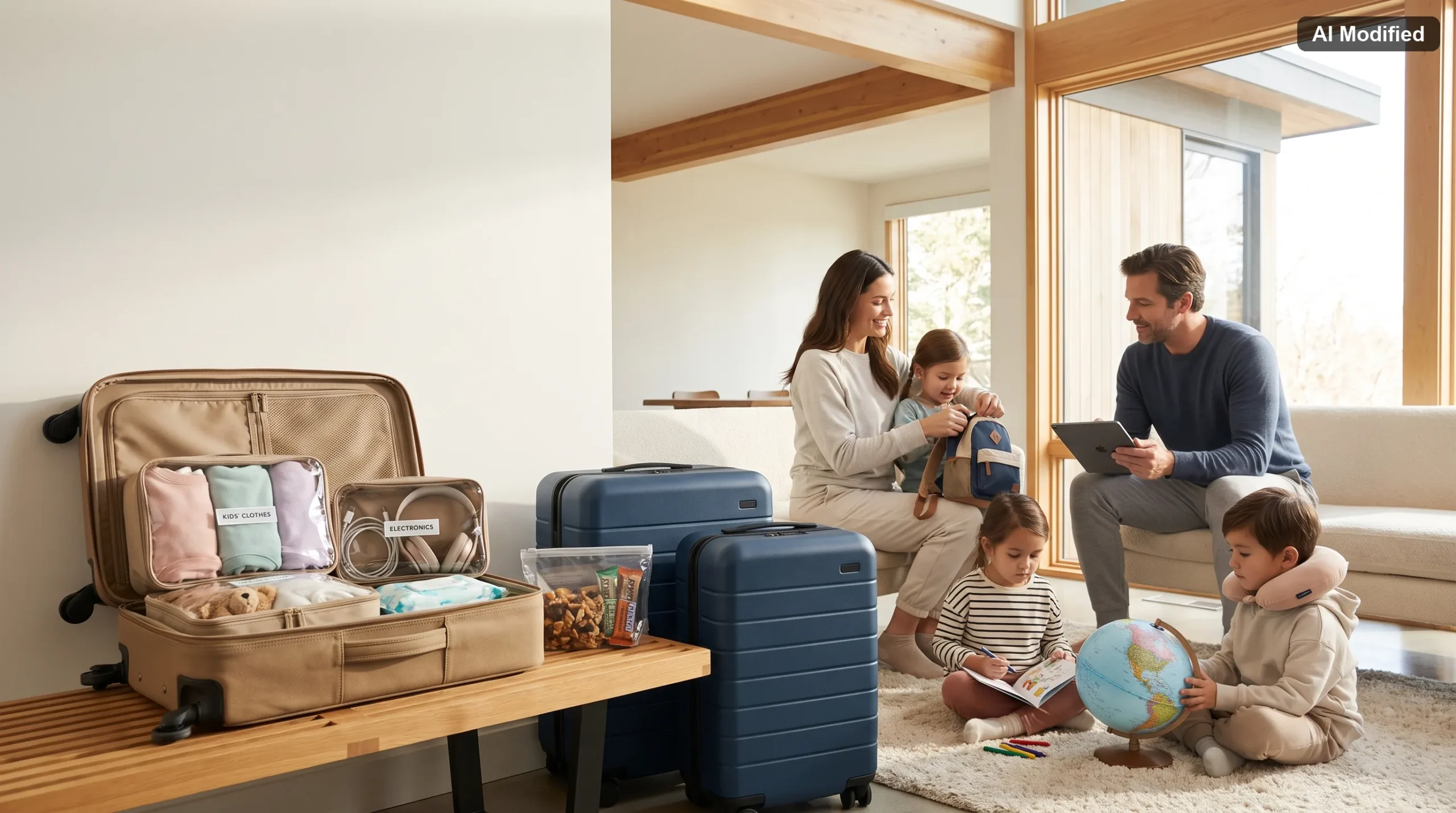
Our working unit is the continuity kit: enough to keep the family comfortable and functional through the journey and the first two nights. Keep its contents within the airline’s actual hand-baggage limit: documents, permissions, insurance details, medical information, a change of clothes, underwear, sleepwear and the minimum wash kit. The point is not survivalism. It is to turn a delayed case into an administrative nuisance rather than the opening drama of the holiday.
Carry the first two days of certainty
The cabin layer needs more discipline than the hold because several items are regulated. Spare lithium batteries and power banks belong in hand baggage, with terminals protected from short circuit. Units up to 100 Wh are the straightforward category; those between 100 and 160 Wh can require airline approval, and larger batteries are a different proposition. If cabin luggage is taken at the gate, remove power banks, spare batteries and battery-powered essentials before the bag goes below. A tiny tracker in a checked case follows a separate low-energy rule, so do not use its presence as proof that a charging bank belongs there too.
Medicine stays accessible. For travel through European airport security, essential liquid medication and baby food or milk needed during the journey can exceed the standard 100 ml limit, though staff may ask for proof. Border rules are another question. The United States currently asks travellers to declare medication of up to a 90-day supply and keep it in original packaging with a prescription in the traveller’s name. Other countries set their own limits, sometimes tighter ones, particularly for controlled medicines. Check the destination and every country where the family will clear customs, keep labelled packaging, and carry the prescription or doctor’s letter that makes the need intelligible.
The continuity bag should be easy to open under pressure. We like the Peak Design Travel Backpack 45L for the adult layer because its organisation prevents the familiar terminal-floor excavation. Brand is secondary. What matters is that medicine, charging cables, wipes and pyjamas each have an obvious home that another adult can find without instructions.
Children do better when their small kit is recognisably theirs. Give each child one reachable entertainment choice, one snack plan that survives a delay, headphones that have already been tested, and the object that carries sleep from home to elsewhere. Do not fill the cabin with contingency toys. A bag that cannot be managed through security or lifted into a locker has stopped being a continuity system and become another problem.
Check the replaceable bulk
Checked luggage remains the right answer for most of a two-week family holiday. It is already built into many long-haul fares, particularly premium-cabin and family bookings, and it moves on the same itinerary as the passenger. Read the actual ticket before buying a separate logistics service. Infant entitlements can change between weight-based and piece-based baggage systems; stroller and carry-cot treatment can change with cabin space, route and whether a child seat is also travelling. One airline’s generous published allowance tells you nothing reliable about the next carrier.
Put the main wardrobe, shoes, full-size toiletries and replaceable toys in the hold. Split clothes across two cases when a lost bag would otherwise leave one family member with nothing. Photograph the packed contents for a long or valuable trip, add contact details inside as well as outside, and use a compatible tracker if the airline permits it. These are modest precautions. They cost less effort than trying to carry the entire holiday through security.
There are clear exclusions. Formula for the journey, prescribed medicine, necessary medical equipment, tomorrow morning’s clothes and the one sleep object that cannot be replaced do not belong in the floating nursery of a checked suitcase. Expensive jewellery and the only copy of a document stay out as well. The hold is for things you need eventually, not for things you need on arrival.
Make the hotel earn space in the suitcase
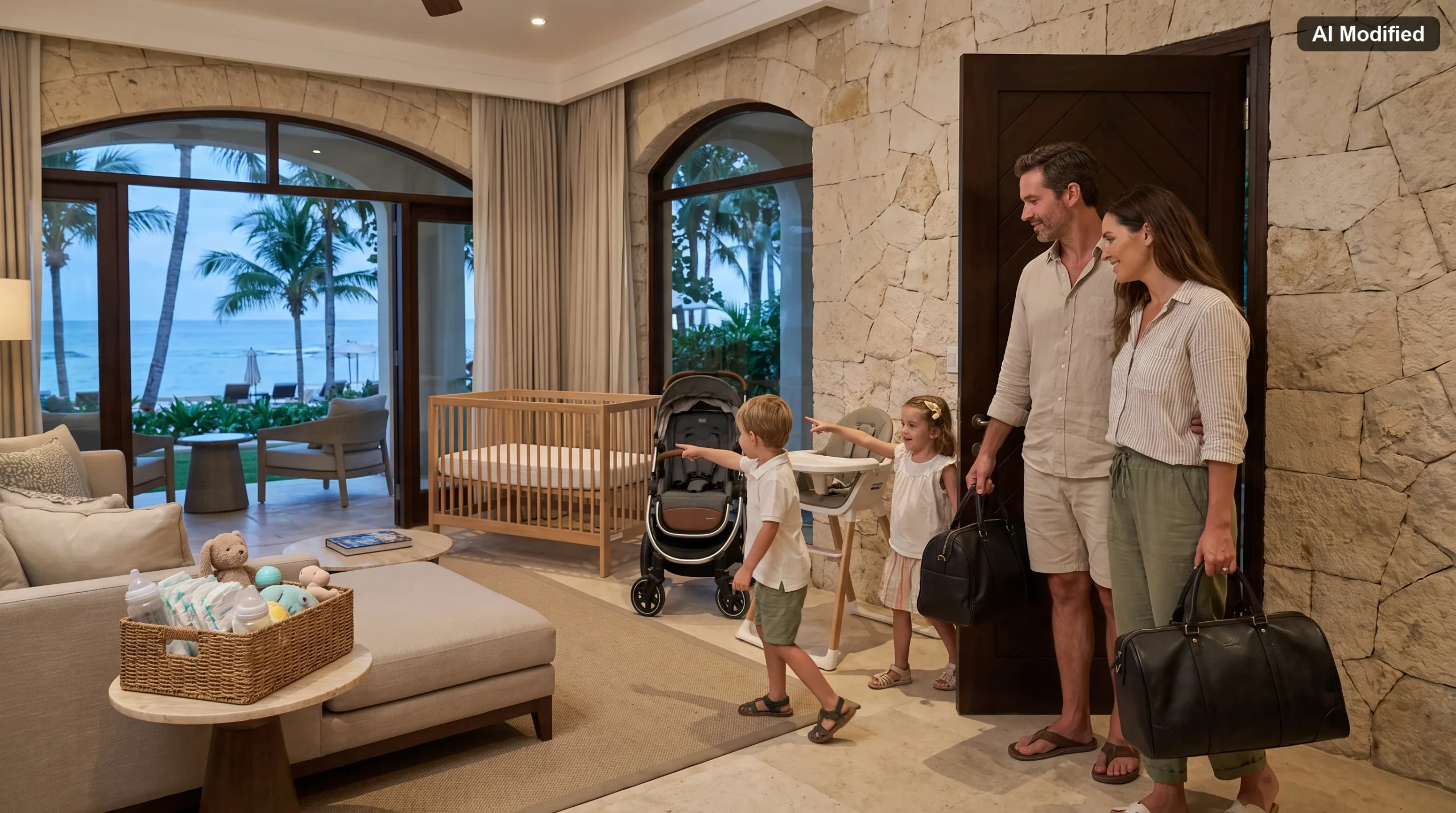
A strong family hotel can remove an extraordinary amount of volume, but only when its promise becomes a reservation. “Baby equipment available” is too vague. Email a numbered list and ask the property to confirm the exact item, quantity, age suitability, location, charge and delivery time. For a cot, ask about the mattress and bedding. For a stroller, ask for the model or at least the age and weight range. For a car seat, confirm the child’s height and weight, the vehicle, the applicable standard and who installs it.
Sani Beach shows what useful disclosure looks like. Its Travel Light programme currently lists a stroller, cot, bottle steriliser, bedding, white-noise machine and baby monitor on request. It also says that supply is subject to availability. That final line is the important one. Until the property confirms the item against your booking, it remains on the packing list.
Ask beyond the obvious furniture. A baby bath, bottle warmer, highchair, bed rails, changing mat, childproofing kit, nappy bin and blackout solution each removes a different bit of friction. Families travelling with allergies or sensory needs should be equally literal about food preparation, fridge access, quiet-room position and bedding. The concierge cannot solve a requirement that arrives as “anything suitable for children”. Precision is the courtesy that gives the team enough information to return a useful answer.
A local rental provider is the second line, especially in cities or villas where a hotel inventory is thin. Established services in supported markets deliver cots, strollers, car seats and feeding equipment to hotels, rentals and airports. Read the individual provider profile, confirm cleaning and safety information, agree the handover window with the property, and keep the booking details offline. Inventory is local. A platform name does not guarantee that the exact seat or cot is available in the city you are visiting.
Car seats require two decisions. A destination rental can solve the airport transfer and road journey. It does not determine whether a young child uses an approved restraint in the aircraft cabin. Decide the flight plan first, then the road plan, and do not let the convenience of one stand in for the safety rules of the other.
Use doorstep check-in for the airport problem
Doorstep baggage collection and international forwarding solve different problems. In a supported departure service, an agent collects eligible cases from a home, hotel or office, verifies the required passengers and documents, seals the bags and checks them into the booked flight. The family travels to the terminal without the trolley, then collects the luggage from the usual carousel. The cases still fly as airline baggage.
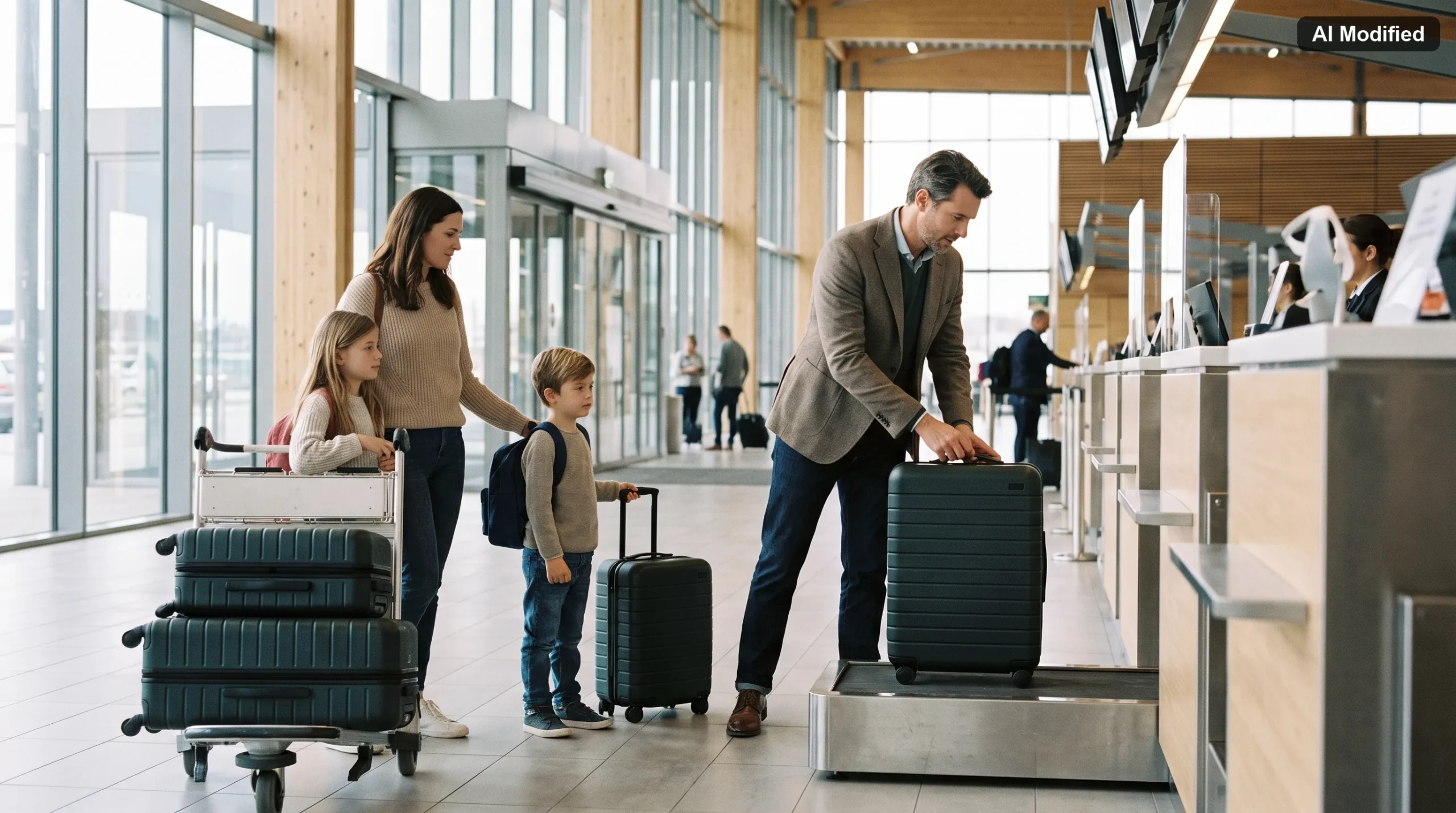
This service earns its fee on an early departure, a rail journey to the airport, or a family moving a stroller, car seat and several cases through a crowded terminal. Coverage changes by address, airport, flight and partner airline. Some carriers require every passenger to be present at collection; others need only the lead traveller once online check-in is complete. In Dubai, home check-in can include an agent coming to a hotel or residence, tagging the bags and taking them to the flight. Elsewhere the available service may stop at airport delivery rather than airline check-in.
Check the precise handover contract before paying. The useful version gives digital baggage receipts, a sealed chain of custody and clear instructions if the airline cannot accept a case. The weak version merely transports bags to an airport meeting point, leaving the family to collect and check them. Both remove a taxi problem; only one removes the bag-drop queue.
Forward only the load you can live without
International courier forwarding belongs at the narrow end of the stack. Standard delivery estimates are measured in roughly 7 to 11 business days, not overnight promises. Customs paperwork joins the itinerary, and the prohibited lists remove many continuity items: prescription and over-the-counter medicine, medical equipment, food, lithium batteries, most electronics, alcohol products and pressurised containers. Taken together, that is almost a catalogue of what should stay close to a travelling family.
The service makes sense for a long seasonal stay, a second wave of clothing, skis, golf clubs, dive equipment or a multi-stop trip where ordinary airline allowance becomes cumbersome. Pack early, photograph the contents, read destination restrictions and leave time on both sides of the quoted window. Do not send anything whose absence would change the first week of the holiday.
There is also a value question. Forwarding a standard international case can cost several hundred dollars each way. Compare that total with the ticket’s baggage allowance, prepaid excess luggage, sports-equipment rates and doorstep airline check-in. Courier freight is elegant when it removes a genuine logistical knot. Used as a reflex, it can introduce more tracking, customs and timing anxiety than the suitcase ever created.
Send one useful email, then make three columns
Seven days before departure, send the property one message with the booking number, every traveller’s name, the children’s ages and a numbered request list. Ask for written confirmation beside each item and its charge. Reconfirm the airport transfer, child restraints and childcare as separate lines, because those services may sit with different teams. Save the reply where both adults can open it in an airport queue without mobile data.
Then build three columns: carry, check and confirmed at destination. Every object must earn one place. “Probably at the hotel” is not a fourth column. “We might need it” is a prompt to decide, not permission to pack a duplicate. This is the stage where the luggage count falls without any theatrical commitment to minimalism.
The best properties understand that a family welcome begins before arrival. A resort such as Atlantis The Royal is worth considering when the pre-arrival team can coordinate the room, transfer and family arrangements as one plan. Fine facilities matter, but the real luxury is avoiding three contradictory confirmations from three departments.
What we would pack for two weeks
For a two-week long-haul trip with a connection, we would carry two days of clothes, all travel documents and medicine, protected power, feeding and sleep essentials, and one compact entertainment layer per child. We would check the ordinary wardrobe and spread it across the family’s cases. We would ask the hotel to confirm bulky baby equipment and transfers in writing, renting locally only when the item and handover were specific.
We would use doorstep airline check-in when the route supported it and the departure would otherwise involve several cases, small children and an unpleasant hour. We would send luggage across borders only for bulky sports equipment or a non-critical second wave packed well in advance. Everything else would travel with the family or wait at the hotel.
That is the whole stack: carry certainty, check replaceable bulk, reserve what can be trusted, and ship only what can arrive late without changing the trip.