Every major resort now sells a “digital detox.” Most of it stops at the spa door while the teenagers scroll by the pool. Here is the protocol that actually works — and the handful of places whose programming is good enough that a fourteen-year-old forgets the phone on their own.
The quick version
- A device ban with nothing to replace it just breeds resentment — the resort has to earn the phone-down with programming, not confiscate your way to a reset.
- The winners are screen-light by design (remote, no TVs by default, activity-dense), not the ones selling a “detox package” that ends at the treatment room.
- Judge a property on its activities for the older brackets (9–12, 13–17). Screen-detox lives or dies on whether teens have something real to do.
- Parents are usually the worst offenders. This only works if the adults do it too — teens notice, and they will call it out.
- Aim for dramatic reduction plus defined check-in windows, not total blackout. Cold turkey backfires; a camera or an offline music player kept in hand does not.
- Our shortlist that earns it: Soneva Fushi (Maldives), Jean-Michel Cousteau (Fiji), Sonnwies (Dolomites), plus Singita Serengeti House and C Lazy U Ranch.
Why most “digital detox” resorts are selling you nothing
Unplugging is the defining wellness posture of 2026, and the hospitality industry has noticed. Hilton has coined “hushpitality” for low-stimulation travel; Virtuoso’s travel advisors report that even some teenagers now ask for holidays that make it easier to switch off. The trouble is that most of what gets marketed as a “digital detox” is spa copy. A no-phones sign in the treatment room. A lockbox at the front desk nobody uses. Meanwhile the nine-year-old is on a tablet at breakfast and the teenager has found the one Wi-Fi hotspot by the pool bar.
We have sat through enough of these to be blunt about it. Confiscation is not a programme. The resorts that properly reset a family are the ones where the environment does the work: no news channels, no in-villa television as standard, a location remote enough that a bar of signal is a small event, and — above all — a menu of things to do that out-competes the screen without anyone having to police it. There is a real difference between a resort that is screen-light by design and one that merely sells a detox package. The rest of this guide is about telling them apart, and the family protocol that makes either one stick.
The protocol: before you go
The single biggest predictor of whether a screen-detox holiday works is set weeks before you fly, at home, at the kitchen table. Decree it and a teenager will treat it as a challenge to be beaten. Agree it together and you have buy-in — and buy-in is the whole game, because the moment a teen has unsupervised access to a device, an imposed rule is worthless. The durable changes come from a teen who has actually signed up, not one who has been sentenced.
- Make the rules together, not for them. Sit down as a family and set the terms: what comes, what stays, when phones are checked. Let the teenagers negotiate a clause or two. Ownership of the plan is worth more than any policy the resort can enforce.
- Wind down in the week before. Don’t go from six hours a day to zero overnight — that is the version that ends in a slammed door. Taper: cut an hour, move phones out of bedrooms at night, reclaim mealtimes first. The brain starts shifting within a couple of days, so a gentle run-up means arrival isn’t a shock.
- Agree the one shared device. The realistic compromise is a single family phone or camera for logistics and photos, not a household-wide blackout that ignores that you still need to find the dive boat. Name whose it is and what it’s for.
- Pre-load the flight. Download films, audiobooks and games offline before you leave so the journey isn’t the first battle. For younger siblings, a screen-free audio player — a Toniebox loaded with stories — buys you the flight and the airport without a screen in sight.
On arrival: the ritual, not the ban
The best properties turn the handover into a small ceremony rather than a punishment. At the resorts that get this right, phones go into the in-room safe on day one as a deliberate, shared act — everyone’s, adults included — not a bag search at reception.
- Set check-in windows, not a blackout. The evidence-backed approach is scheduled digital rest — agreed windows — rather than cold prohibition. Twenty minutes after dinner to message home, and that’s it. A defined window removes the low-grade anxiety of not knowing when you’ll next be online, which is half of what keeps a teen reaching for the phone.
- Let teens keep something analog in hand. A camera, an offline music player, an e-reader. The goal is to remove the infinite scroll, not every pleasure a device ever offered. Stripping everything is what triggers the resentment.
- Respect older-teen autonomy. A seventeen-year-old is not a toddler. Total blackout is rarely realistic or wise — there’s a real safety case for basic contact on a remote island, and a clear developmental case for not treating a near-adult like a captive. Nuance beats a blanket rule every time.
During: replace, don’t just remove
Here is the rule that separates a good detox holiday from a miserable one: substitute, don’t subtract. Outright removal — a device withdrawn with nothing put in its place — is the version that ends in conflict, hidden backup phones, and Wi-Fi secretly switched back on. What works is filling the space with things a child would rather do anyway. A dive that physically requires both hands. A dawn ride. A telescope. The screen loses not because it’s banned but because it’s boring by comparison.
- Book the activities that out-compete the phone. Diving, sailing, riding, a night-sky session, a cooking class, a proper sport. Slot them into the day like appointments so there’s structure, not a vacuum.
- Parents model it — this is non-negotiable. The most overlooked factor in the whole business is the adult. A parent scrolling at dinner while enforcing a phone-free table is a rule that dies on contact, and teens see the hypocrisy instantly. If you can’t put yours away, don’t expect them to. This is your reset too.
- Stock the villa with analog. Board games, a deck of cards, a book swap. It sounds twee; it works. Print book sales have risen for two straight years for a reason — the appetite for the non-digital is real, and a wet afternoon with Monopoly beats a wet afternoon of everyone on separate screens.
For teens specifically
Tweens and teens are where screen-detox holidays succeed or fail, and the failure mode is always the same: infantilising them. A thirteen-year-old parked in a kids’ club built for six-year-olds will be back on the phone within the hour, and rightly so. What actually works for this age group is autonomy and real challenge — a genuine skill, a certification, a summit, a project they come home able to talk about. Give a teenager mastery and a bit of independence and the phone becomes an afterthought without anyone confiscating it.
This is exactly why we judge these properties on their 9–17 programming and almost ignore the crèche. We’d book the junior diving cert for the thirteen-year-old, not the kids’ club. We’d sign the fifteen-year-old up for the marine-biology course, not the treasure hunt. The trip they remember is the one where they did something hard and came back better at it.
The shortlist: resorts that earn the phone-down
These are the properties whose programming is deep enough — and whose setting is remote enough — that the phone goes down on its own. We’ve weighted them hard toward what there is for older kids to do.
Soneva Fushi, Maldives — screen-light by design
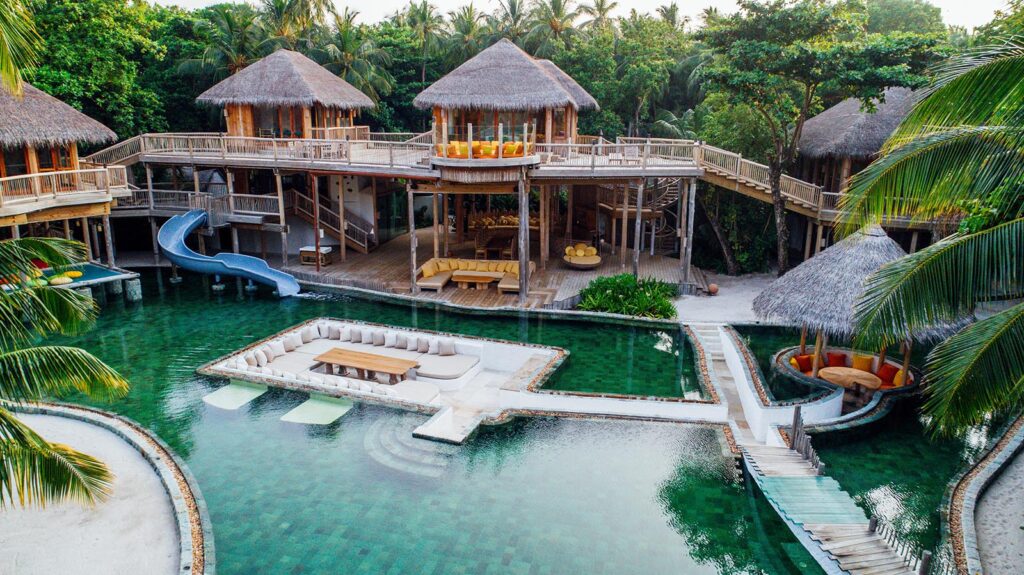
The archetype, and still the benchmark. Soneva’s founding philosophy is “no news, no shoes” — shoes come off on the speedboat and stay off, and none of Soneva’s resorts carry television or news channels as standard. In-villa Wi-Fi can be switched off at the flick of a switch. This is a resort engineered from the ground up to be low-stimulation, which is precisely why it works where a “detox package” doesn’t.

For families, the differentiator is the programming. The Den is billed as a technology-free zone — over 1,300 square metres, the largest kids’ club in the Maldives, with a pirate ship, cinema, music studio and cooking classes, for children and teenagers alike. But the real teen hook is the Soneva Academy, with courses for ages 12 and up: coral-reef ecology and sea-turtle research guided by the resident marine biologist; a night-sky course at the observatory with a resident astronomer; and “Adventure of The Corbin,” a navigation course built for teenagers around a real 1602 shipwreck on a nearby reef. That is the kind of thing a fifteen-year-old actually wants to do. Villas run from roughly $2,000 a night, with family configurations climbing well past $10,000 in high season; confirm current rates directly with the resort. Read our full Soneva Fushi review for the detail.
Jean-Michel Cousteau Resort, Fiji — conservation as the whole identity
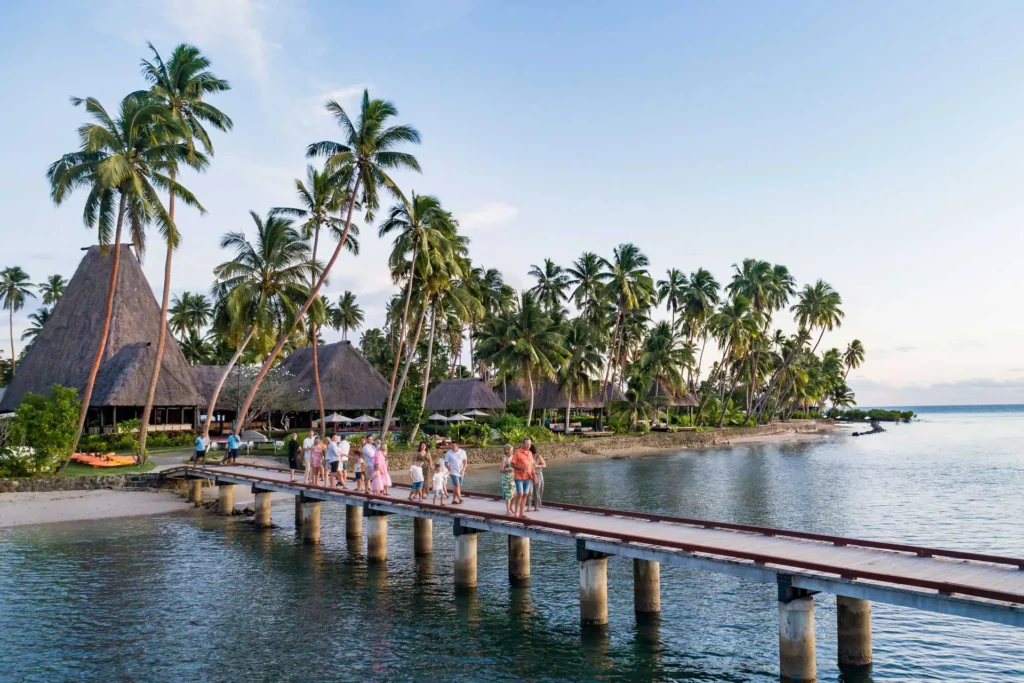
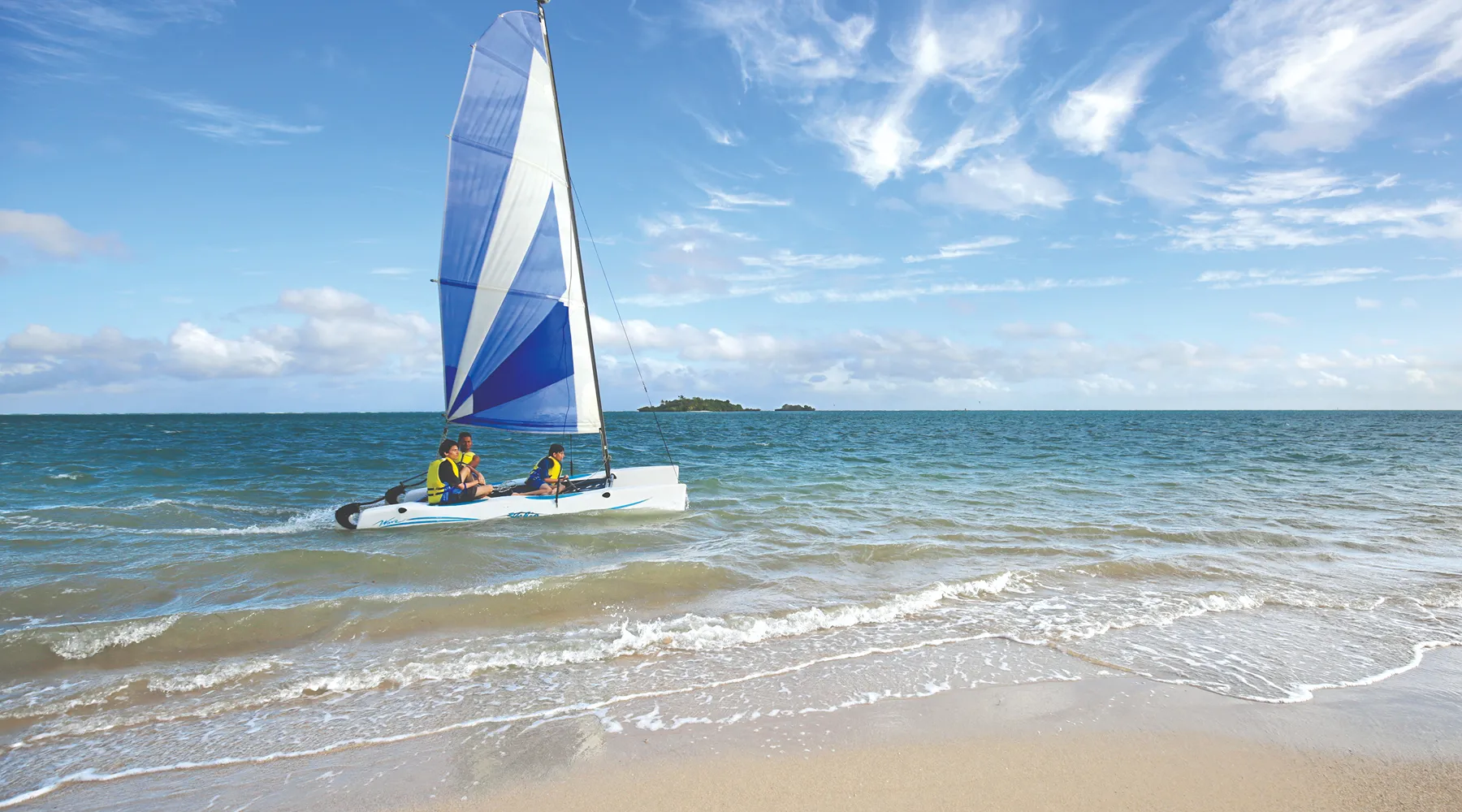
Deliberately remote — Savusavu, on Vanua Levu, reached by a domestic flight and a transfer — and built around marine conservation rather than bolting it on for marketing. For older kids this is one of the strongest in the world. The Buddies teen programme (13+) runs with a dedicated activities staffer through the day: waterfall hikes, Hobie Cat sailing, night snorkelling, coral planting, reef-ecology sessions. Younger ones are covered across three age bands: nanny care for 0–5, the Fijian Buddy programme for 6–12, and a dedicated teen programme for 13–17. And the on-site dive centre is a PADI 5-Star operation offering scuba from age 10 (Junior Open Water), with a pool-based Seal Team and Bubblemaker for eight- and nine-year-olds. A teenager coming home a certified diver is the definition of a project worth putting the phone down for. Expect all-inclusive rates in the thousands per night for a family; confirm current pricing directly with the resort. See our Jean-Michel Cousteau review.

Sonnwies, Dolomites — the mountain option
Proof that this isn’t only a beach-and-reef trick. Sonnwies sits on a hillside in the UNESCO Dolomites with its own farm, in a setting that is inherently low-connectivity and activity-dense — no formal device ban, just a mountain that gives a phone very little to do. For the 7-and-up bracket there’s farm work, forest exploration, an outdoor climbing hall, ponies and ice skating; for teenagers it steps up to wild-water rafting on the Eisack, tandem paragliding, e-bike tours and guided Dolomite hikes, with a new equestrian centre and a teen lounge folded into the all-inclusive rate. Rates run from roughly €4,550 for a seven-night summer all-inclusive for a family of three to five, or about €5,300 in winter with a family ski pass included. Our Sonnwies review has the full picture. If your children are younger, our guide to European family hotels where toddlers aren’t an afterthought is the better starting point.

Singita Serengeti House, Tanzania — off-grid by geography
An exclusive-use house for up to eight in the private Grumeti Reserve, western Serengeti — a place where the signal simply thins out and the reserve is closed to the public, so incidental connectivity is near zero. The family programming is tailored: a Mini Rangers course covering animal tracking, bush survival, astronomy and spotting competitions, plus hot-air ballooning (7+), anti-poaching K9 conservation tours, bush walks and stargazing, all shaped around the family by dedicated field guides. This is off-grid detox by geography, not by policy. It is also eye-watering — 2025 exclusive-use rates ran from around $11,815 to $26,290 a night depending on season and party size. FFH does not review Singita yet; we’re flagging it to commission. For the wider off-grid nature case, our editors’ pick of family safari lodges worth booking is the companion read.
C Lazy U Ranch, Colorado — the ranch reset
A different flavour entirely: an upscale, all-inclusive dude ranch in Grand County, Colorado, working since 1919. There’s a dedicated summer teens programme — horseback riding and instruction, archery, tubing, campfires, animal care, hiking and overnight pack trips — and the ranch’s own line is that “screens can’t compete with the real West.” Wi-Fi exists but is framed as optional; the model relies entirely on activity density making the phone irrelevant rather than any ban. It’s the strongest North-American pick for a family who wants horses and open country over reef and sand. No public rates — you contact the ranch directly. Not an FFH review yet; flagged to commission.
A word on the “detox package” resorts
You’ll see properties advertising formal, tiered detox programmes — Six Senses La Sagesse in Grenada, for instance, offers 3-, 5- and 7-night Detox programmes (wellness screening, spa treatments, nutrition consultation, and on longer stays breathwork and meditation) starting at USD 842 for one guest on the 3-night programme — a package price, not a nightly room rate. These can be excellent, but read the fine print for families: many are built around adult wellness, and the teen-and-family suitability is often unclear. The honest test is the same one we’ve applied throughout — is the reset baked into the place and its programming, or is it a package bolted onto a resort that otherwise runs exactly like every other? The former survives contact with a bored fourteen-year-old. The latter usually doesn’t.
What we’d actually book, by age
The right choice flips completely depending on the youngest passenger, so be honest about who you’re really travelling for.
- 0–8: This bracket isn’t really doing a detox — it’s the adults who need one, and the job is a resort that keeps small children happily, safely occupied so you can put your own phone down. Prioritise a serious kids’ club and gentle programming: the Den at Soneva Fushi, the Bula Club at Jean-Michel Cousteau, or the farm-and-forest world at Sonnwies. Pack the screen-free fallbacks — a Toniebox for the flight and the down hours — and let the grown-ups model the reset.
- 9–12: The window where replacement really starts to bite. Book the structured, slightly grown-up activities — junior diving at Jean-Michel Cousteau (from age 10), the marine and night-sky sessions at Soneva, riding and rafting at Sonnwies, the Mini Rangers course at Singita. Enough challenge to be proud of, not so much autonomy that they wander off.
- 13–17: This is where you either win or lose, and the answer is autonomy plus a real skill. We’d book the diving certification, the Soneva Academy course, the paragliding, the overnight pack trip — and we’d agree the check-in window with them, not impose it. Give a teenager mastery and a little independence and the phone goes quiet, because for the first time in a while there’s something better in front of them.
Whatever you book, hold the two rules that make all of it work: the resort has to earn the phone-down with programming, and the adults have to do the detox too. Get those right, pick a place that’s screen-light by design rather than by slogan, and pack the one shared camera. The reset does the rest. If a single carry-on is the ambition, our editors rate the Peak Design Travel Backpack 45L for exactly this kind of trip.